Category Archives: PhD
T is for… Transactional Perspectives on Occupation (Book) #AtoZChallenge
T is for… Transactional Perspectives on Occupation (Book)
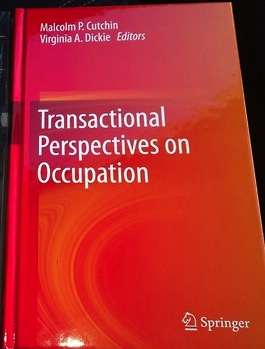
I think I might be a little bit in love with this book. I have even read a few whole chapters of it and am planning a full read through. This is because the concepts outlined in it appear to make sense to me (I’m sure when I start reading more this will change and I will become confused again).
From the back cover:
‘An occupation is, most simply put, any activity we participate in that engages (occupies) our attention, interests, and/or expectations…’
‘The transactional perspectives articulated in this book both implicitly and explicitly suggest that occupations are forms of activity that create and re-create a multitude of our relationships with the world.’
‘In the same way that people exist within situations through occupation, they respond to these situations with occupation.’ (Dickie and Cutchin, 2013, p. 258).
This suggests looking at occupation as a response which is something I think I could explore.
Another chapter in this books highlights the importance of narrative in OT practice and provides support for spending time getting to know our clients. As I said, this book speaks sense to me (in that it fits with my worldview).
This perspective is based on the work of John Dewey and pragmatism which acknowledged the need to be flexible and do what needs doing.
Going to leave this here for now and work on my research question for supervision later this week. I do think this blogging has helped me.
Dickie, V.A. and Cutchin, M.P. (2013) Transactional Perspectives on Occupation: Main Points of Contribution in This Volume. In: Dickie, V.A. and Cutchin, M.P. (eds) (2013) Transactional Perspectives on Occupation. Dordrecht: Springer, 257-261.
What has blogging helped you discover?

Share this on Facebook, Twitter and Google+

S is for… Situating Everyday Life (Book) #AtoZChallenge
S is for… Situating Everyday Life (Book)
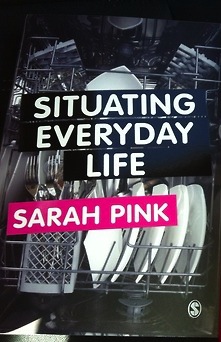
Another book I’m yet to read – but I love the front cover of this one. I have to admit to being very grateful to my dishwasher – my back has definitely been less painful since I got one.
From the back cover:
‘This agenda-setting book provides a coherent, interdisciplinary way to engage with everyday activities and environments. Arguing for an innovative, ethnographic approach…’
Some of my fellow OTs and other online fans may be interested in Chapter 8 – The Digital Places of Everyday Life: Thinking About Activism and the Internet
Chapters for me:
Chapter 1 – Introduction: (Re) Thinking about Everyday Life and Activities
Chapter 2 – Theorising the Familiar: Practices and Places
Chapter 3 – Researching Practices, Places and Representations: Methodologies and Methods
My thoughts:
I think this book may help inform my research methodology – there seems to be discussion of use of online technologies in this (something I mentioned being interested in, in my R post on Saturday).
The idea of the everyday interests me – I have always said I want to look at the ‘everyday’ experience of creative writing rather than looking at creative writing as therapy.
A quick scan through the reference list at the back doesn’t immediately show up obvious OT or Occupational Science literature (hopefully I will find something when I look more closely, if not there is a question that needs asking again about how we can share our insights with others).
I really do love my dishwasher!!
What aspect of your everyday life do you think is worthy of further study?
Share this on Facebook, Twitter and Google+

R is for… Radical Rhetoric #AtoZChallenge

R is for… Radical Rhetoric
One of the current drivers in research is that of impact – getting the message out there.
Often when people finish their PhDs they have a nice bound copy of their thesis to put on their bookshelves and a copy gets into the university library. Nowadays that copy may be electronic, but, still the audience for reading a whole thesis is limited – and if they are unlucky your family and friends may be among them.
Next comes conference presentations and publications in academic journals – again potentially a very limited audience.
If it is newsworthy you might get the sensationalised headlines that I mentioned yesterday.
Within social sciences there has been a drive to use more performative methods of dissemination – e.g. using films, poetry, fictional writing, photographs etc.
Because I will be using autoethnography as my methodology, and as a writer, I am keen to present my work more creatively, I am looking into how I can do this to satisfy my examiners as well as myself. There is also the potential of social media to explore.
‘Of all the developments in qualitative inquiry, performative practices are the most radical.’ (Gergen and Gergen, 2011)
This is because of the blurring of art and science – sounds perfect to me.
Here’s a link to an article if you’d like to read any more – http://www.qualitative-research.net/index.php/fqs/article/view/1595/3105
Gergen, M.M. and Gergen, K.J. (2011) Performative Social Sciences and Psychology. Forum: Qualitative Social Research. 12 (1), Art.11.
Are you interested in research that is happening? How would you like to find out about it?


 kirstyes