Monthly Archives: April 2013
U is for… Ubiquitous #AtoZChallenge
U is for… Ubiquitous
I decided I liked the sound of this word and wondered what it meant and if I could fit it in to my PhD blog topics. Turns out I really could.
According to Oxford Dictionaries online it means:
‘present, appearing, or found everywhere’
I felt that writing about writing was ubiquitous amongst writers – and when I see something so often I start to wonder why.
A number of the books I have reviewed during this challenge are on this very topic (and there are more to come).
This is one of the things that has influenced the direction of my PhD – I want to understand why.
If you are a writer and have written about why you write, the need to write etc. do please link to your blog post below.
What word do you like the sound of but don’t remember the meaning of – I challenge you to use it in a sentence below?

Share this on Facebook, Twitter and Google+

U is for… Um there are no ‘U’s so let’s go for numbers – 666 Park Avenue #AtoZChallenge

U is for… Um there are no ‘U’s so let’s go for numbers – 666 Park Avenue

I can’t think of any supernatural, sci-fi or fantasy TV shows that I’ve seen that begin with U so as numbers don’t have their own category in A-Z I’ve decided to go with that instead.
The show I’ve chosen to look at is a current one – 666 Park Avenue. This is very very very loosely based on a series of books (I have them waiting to read). In fact so loosely that the descriptions of the two different formats would be difficult to match up without the titles.
I also started watching this knowing it had already been cancelled in the states – so there is only one short 13 episode season only (unlucky in this case and I have to comment that I find 13 episodes really annoying because 12 fit on 2 discs perfectly!).
What I’ve seen so far I’ve enjoyed and I’m interested enough to see it through to its conclusion but worried it might not have been given a proper one.
Terry O’Quinn (Lost’s John Locke) is particularly sinister in it.
Why do lots of the shows I like get cancelled too early? Do I have particularly obscure taste?
What you think of TV shows that are similar to books in name only?
(Oops just found this in my drafts – Sat 27th April – it was written so I don’t know how I forgot to post it).
Share this on Facebook, Twitter and Google+

T is for… Transactional Perspectives on Occupation (Book) #AtoZChallenge
T is for… Transactional Perspectives on Occupation (Book)
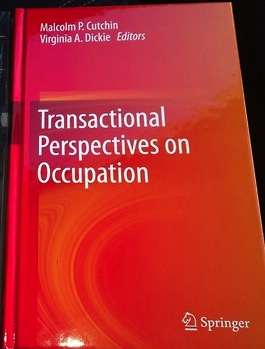
I think I might be a little bit in love with this book. I have even read a few whole chapters of it and am planning a full read through. This is because the concepts outlined in it appear to make sense to me (I’m sure when I start reading more this will change and I will become confused again).
From the back cover:
‘An occupation is, most simply put, any activity we participate in that engages (occupies) our attention, interests, and/or expectations…’
‘The transactional perspectives articulated in this book both implicitly and explicitly suggest that occupations are forms of activity that create and re-create a multitude of our relationships with the world.’
‘In the same way that people exist within situations through occupation, they respond to these situations with occupation.’ (Dickie and Cutchin, 2013, p. 258).
This suggests looking at occupation as a response which is something I think I could explore.
Another chapter in this books highlights the importance of narrative in OT practice and provides support for spending time getting to know our clients. As I said, this book speaks sense to me (in that it fits with my worldview).
This perspective is based on the work of John Dewey and pragmatism which acknowledged the need to be flexible and do what needs doing.
Going to leave this here for now and work on my research question for supervision later this week. I do think this blogging has helped me.
Dickie, V.A. and Cutchin, M.P. (2013) Transactional Perspectives on Occupation: Main Points of Contribution in This Volume. In: Dickie, V.A. and Cutchin, M.P. (eds) (2013) Transactional Perspectives on Occupation. Dordrecht: Springer, 257-261.
What has blogging helped you discover?


 kirstyes