Blog Archives
E is for… (#atozchallenge)
E is for…
E
By e I don’t mean the mathematical constant (whatever that is) or e=mc2
I mean e for electronic, as in e-learning, e-CPD, e-portfolio, e-books and so on.
One of the big debates of the moment is about e-books and whether they are helping publishing and writers. As an administrator of an online Writing Community I can say that the emergence of e-publishing has made it pretty easy (and cheap) for me to publish competition anthologies and a magazine for http://www.slingink.com. I have done this through http://www.lulu.com. The only real financial layout I have had is in ordering the proof copies of the print books so that they can be distributed though other retailers. The books can be made available as a PDF download or individual customers can make a print on demand order all managed through lulu. They’ve also just contacted me to say they are putting the books forward to become available through iBooks (a word of caution you do have to have some, or get some, technical knowledge of PDF formats to create an uploadable file).
Of course it’s the Amazon Kindle that really seems to be driving the e-book market forward and allowing authors to self-publish their material and in some cases make more money doing this than they would through traditional publishing. The name that springs to mind is Amanda Hocking and you can read her recent blog post about her switching back to traditional publishing here.
When I have something decent written I may well turn to Kindle myself too.
My C post was on CPD and one of the things I have been investigating over the last few years at work is finding an e-portfolio tool that will support my students (and myself) to maintain our CPD and share elements of it with potential employers, our registering body and others. In fact my presentation at last year’s College of Occupational Therapists Annual Conference was on this topic. One of the biggest findings that arose from an audit I completed was that current practice was still very much paper based and I think this is a factor that is preventing e-portfolios taking hold once students leave university. I think I’ll leave this topic here today and post in more detail at a later date. The search continues…
I am a huge supporter of e-learning and by this I mean using online technologies to support learning. As an Open University alumni I have been an e-learner myself, distance learning using the Firstclass forums. The OUs OpenLearn initiative to share free learning resources means that everyone with access to a computer can get a flavour of a range of subjects. In my professional life it is e-learning and developing online resources that inspires me and I have used Facebook, podcasts, blogs, wikis, e-portfolios to name but a few to, hopefully, enhance the learning experience of my students.
Despite my love of all things e, I think there is a place for traditional means and methods too.
I have a kindle but I am not planning on selling any of my books anytime soon and as my B post demonstrates I love Books (weirdly enough a second hand smoky smelling, liquid book arrived through the post (which had been described as in Good condition) – I am sending it back and debating buying the kindle version instead.
I still have to buy albums in CD format (though I will download singles) and films and TV shows have to contribute to my DVD collection.
At one of the sessions at the e-portfolio conference I attended in Birmingham recently, the speaker discussed having given students a choice of how to gather evidence for a portfolio, scrapbooking was a more popular option than e-portfolios.
As good as e-learning can be there are some things that can only be taught face to face. I particularly enjoy one to one or small group sessions where I can really get a flavour of what students have learnt.
A few questions for you:
What have your experiences of e-learning be? In what situations would e-learning be the best method to learn and in what situations would other methods be better?
Has anyone used an e-portfolio? What type? What were your experiences? OTs, if there was a readily accessible e-portfolio system available for you to use, would you? Why/Why not?
Writers what do you think of the e-book versus traditional publishing route?

Share this on Facebook, Twitter and Google+

D is for… (#atozchallenge)
D is for…
Domestic Abuse
I recently sat in on a third year health students’ presentation about domestic abuse and in this they shared with their audience a number of resources that stayed with me and that I would like to share. Please be warned the video below may be distressing and is not suitable for young children and the poem had me in tears.
This is a subject I have chosen to write about a couple of times myself in the past (not thankfully inspired by events in my life though I am aware of people I know having been in this situation). I share with you four pages from my poetry book.
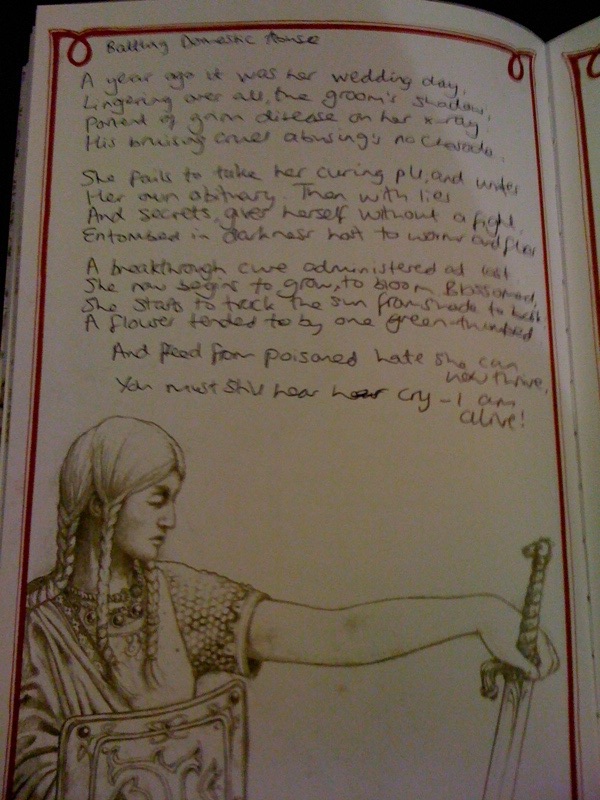
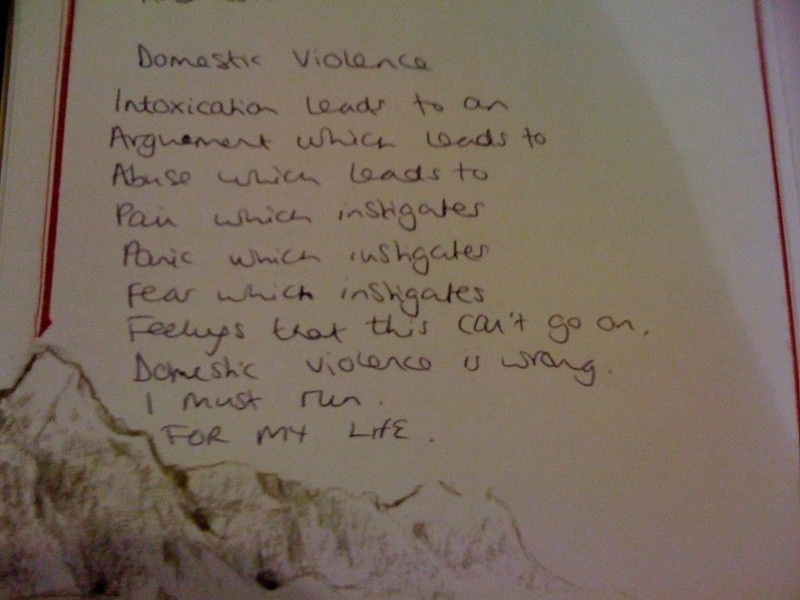
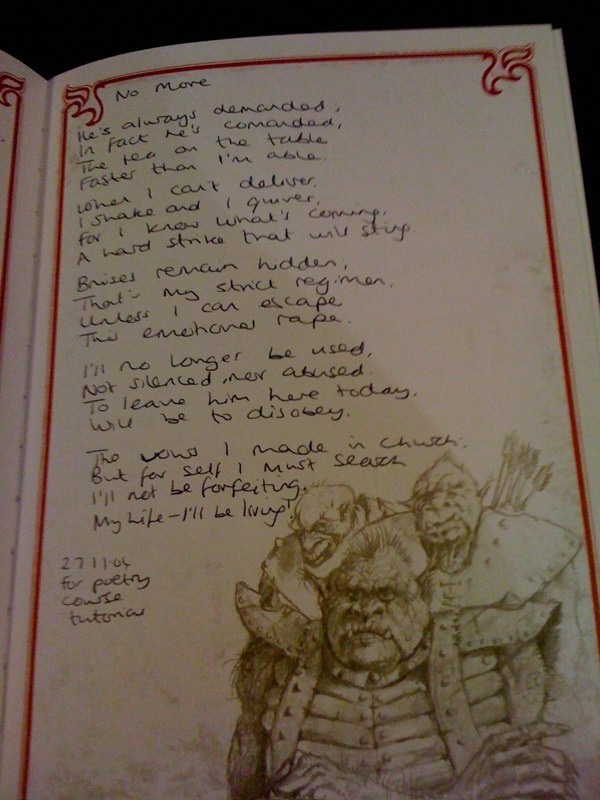
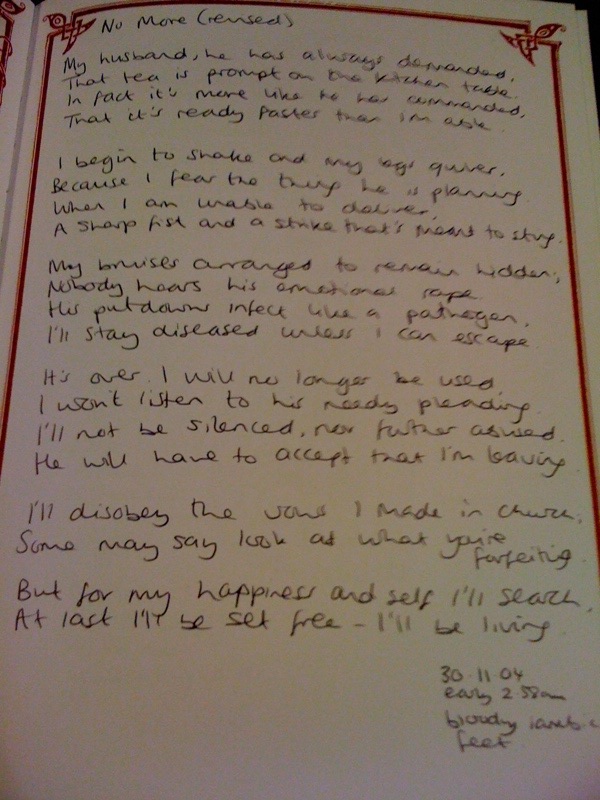
Domestic Abuse is not always as obvious as the examples above or always to do with physical violence. Abuse can be emotional, sexual, financial, or related to social isolation. It’s not just women that it affects, it can affect men too, and children, even if they aren’t the target, may be aware it is happening.
If you are in this situation I know it is not easy to leave but please seek support and try to tell one person that you trust. Don’t forget in an emergency situation to dial 999.
Some useful links may be:
Relate – the relationship people for relationship counselling
Samaritans for a listening ear and non-judgemental advice
Men’s Advice Line for men in abusive relationships
Refuge for women and children
And more can be found on the BBC Health Domestic Violence page.
Be safe and try to remember that nobody deserves to be abused.

Share this on Facebook, Twitter and Google+

C is for… (#atozchallenge)
C is for…
Creativity in CPD
UK Occupational Therapists, I don’t want to burst any bubbles of denial but did you know that the two yearly audit of CPD activity is coming up again this summer, ready for our November re-registration?
Is that nod you are giving me a smug, ‘my CPD folder is completely up to date’ or a slow nod of fear? My nod lies part way between these.
CPD for the uninitiated stands for Continuing Professional Development (or at least it does in this case).
This blog post will hopefully help you to see where you have completed CPD already, provide links to useful resources and hopefully make you less fearful of being randomly selected for audit and preparing your profile. (Come back again on April 21st where I’ll be talking about Reflection in more detail).
The first thing to say is that CPD is not just about attending courses, nowadays money to actually do this may be tight. See what the Health Professions Council (soon to become the Health and Care Professions Council) say constitutes CPD activity. What can you already tick off as having done in the last two years? What could you do in the next few months? Next see what they suggest can provide evidence of CPD. What can you gather together to put into a folder (whether this is in paper or electronic format)?
Now I called this post creativity in CPD because I believe that we may have to create these opportunities ourselves but I think we can also be creative with this.
- If you are reading this post then I suspect that you are engaged with social media. Why not summarise what you’ve learnt from your engagement with this over the past two years. What contacts or networks have you developed?
- Do you watch television programmes and films, read books, newspapers and magazines? What have these taught you about occupations, conditions, life… that you can apply to your practice?
- How can you demonstrate that what you do in your home life and spare time applies to development of professional skills, i.e. transferable skills?
- Have you experienced a situation that went really well? Do you know why? Can you read around the topic to see what theory might help you understand the situation better. Or can you be creative and write something from the Point of View of a colleague you were working with or the client. Note the additional insights this gives you so that you can try to replicate the positive experience next time.
- You don’t just have to write, you could capture your CPD through drawing, painting or photography. You could video yourself or tape an audio reflection (be sure to gain consent or maintain confidentiality with any means you use).
- Now if you do have money available for training in your department why not see if you can get sponsored to attend the Annual Conference in Brighton. I attended my first conference last year and I found it so useful. If you can’t attend follow the tweets on Twitter using the hashtag #cot2011.
- The BAOT/COT website has the Interactive Learning Opportunities Database available to members with links to relevant training and resources such as reflective tools.
- An excellent CPD activity would be to take a student on placement with you, why not speak to your department’s practice placement coordinator about this or if you are a private practitioner contact your local university.
So if you are called up for audit what will you be expected to do?
You will need to write a profile explaining the CPD activity you have completed over the last two years and how it has helped you meet the HPC’s 5 Standards of CPD. You also need to provide a few select examples of evidence to support this profile. Some of the documents you could use to check your activity against are, your job description and person specification, your appraisal documentation and KSF outline (if in the NHS). Also take a look at both your COT and HPC Codes of Ethics and Conduct and the HPC Standards of Proficiency for Occupational Therapists.
I hope you now feel you can you show your CPD has been continuous and is up to date, that you have completed a range of activities, that these have improved the quality of your practice and that it has been of benefit service users.
On this page you can find completed examples of a practitioner, manager or educator profile.
My final suggestion would be that we all aim to complete our profiles over the next few months rather than waiting for the audit, reviewing how far you’ve progressed over the last two years can be a positive experience and it can help show what we still have to learn so that we can plan goals for the next two years (after all it is called Continuing Professional Development). Why not do this as a departmental CPD activity and review your profiles with your colleagues?
Hoping this has been helpful – look forward to reading your comments and queries.


 kirstyes