Blog Archives
D is for… Dialogism: Bakhtin and his world (Book) #AtoZChallenge
D is for… Dialogism: Bakhtin and his world (Book)
I thought I would use this challenge to remind myself why I had bought a few of the books on my bookshelf. Knowing that I wouldn’t be able to read whole books I decided scan reading and providing an overview of each on my A to Z list would be sufficient for now; providing me with a synopsis I could return to.
I bought Dialogism: Bakhtin and his world by Michael Holquist (New Accents series) after attending a session at BU led by someone from the media school. It sounded interesting, possibly relevant and I remember Bakhtin was one of the theorists who cropped up a few times when I was studying for my OU degree in Literature. I bought this book (originally published in 1990) for my Kindle (2002 edition).
I started scanning and reading and quickly I got lost. I was confused and the words on the page didn’t all seem to make sense when combined. I felt stupid – I believe this is a feeling that will occur again on my PhD journey. Occasionally though there was a glimmer of hope and I was highlighting sentences, sometimes even whole paragraphs that I understood and thought could be useful.
I guess the fear is that is where I could stop – only using that which makes sense – in terms of understanding, and with reference to my worldview. I have to be cautious to push myself further – push myself back. Theorists refer to other theorists and so it goes on. I feel I need to make myself a timeline – distinguish how Bakhtin relates to and differs from Kant, Heidegger and the like (names mentioned in this book). Believe me I’m already lost in a sea of names that sound familiar but that I can’t automatically place.
Anyway back to a very brief synopsis of this book and why I think it might be relevant:
Clearly it refers to the idea of writing (particularly the novel) as being a dialogue and one that is context driven. I can’t tell you how much this links to my distrust of learning literature at school – “just read the words” and then the more satisfying experience at university – “yes it is ok to understand the social, political, historical and personal contexts of when the words were written”. Dialogism also refers to a ‘multiplicity’ of perception – again acceptance that opinions and perception will be different.
The book talks about relations (this is becoming more important to me and the direction I am taking) – between an author and their heroes for one, and even goes as far as referring to novels being able to actively shape cultural history. A quote from the book ‘In dialogism, literature is seen as an activity that plays an important role in defining relations between individuals and society.’ (Location 1692 in the kindle edition).
It mentions intertextuality (which I have another whole book on – see the letter I post to come).
Generally this appears to discuss language and books with less discussion for example about what this all means for the author/writer – that is something that I hope to explore.
And that’s it – all I seem to have understood (?!) at the moment. I think this is a book to come back to when I’ve grown more brain!
How do you best tackle books/articles that you just don’t get on a first read, especially if you think you need to understand them?

Share this on Facebook, Twitter and Google+

D is for… Dollhouse and Dead Like Me #AtoZChallenge

D is for… Dollhouse and Dead Like Me
I initially put that I would discuss Dead Like Me today (and I will a little) but how could I overlook another Joss Whedon classic – Dollhouse – which was given two measly seasons (2009-2010).

The main character in this is the ‘doll’ Echo played by Eliza Dushku (Faith from Buffy and Angel).
The basic premise of the show is that dolls or ‘Actives’ are people who have had their minds and memories wiped so that they can be imprinted with new personalities and skills to become people for hire, girlfriends, assassins, etc. In their wiped state they are very docile and childlike.
My top five Dollhouse episodes are:
True Believer – Season 1 Episode 5
Echo becomes Esther a blind woman who joins a freaky religious cult as a true believer – but do the people wanting to shut down the cult have honest intentions?
The Target – Season 1 Episode 3
I’m sure there is an episode similar to this in Criminal Minds. The Dollhouse need to vet their customers better because Echo’s camping trip turns sinister. Boyd her handler comes to the rescuer – we like him.
Ghost – Season 1 Episode 2
This week Echo plays a kidnap negotiator whose imprint happens to have a traumatic past that threatens the negotiations.
Gray Hour – Season 1 Episode 4
Inconveniently Echo’s imprint gets wiped when she is trapped in a safe waiting for the authorities to arrive. Her childlike state doesn’t get the job done.
Stop Loss – Season 2 Episode 9
Victor has served his time in the Dollhouse and is released back to his old life. His relationship with Sierra, amongst other complicated factors means that the transition back to real life isn’t smooth.
Again this was tricky to narrow down and I’m basically listing all of the episodes. See my brief review of a few more on the post here – https://kirstyes.co.uk/2011/04/12/j-is-for-atozchallenge/
…
Dead Like Me
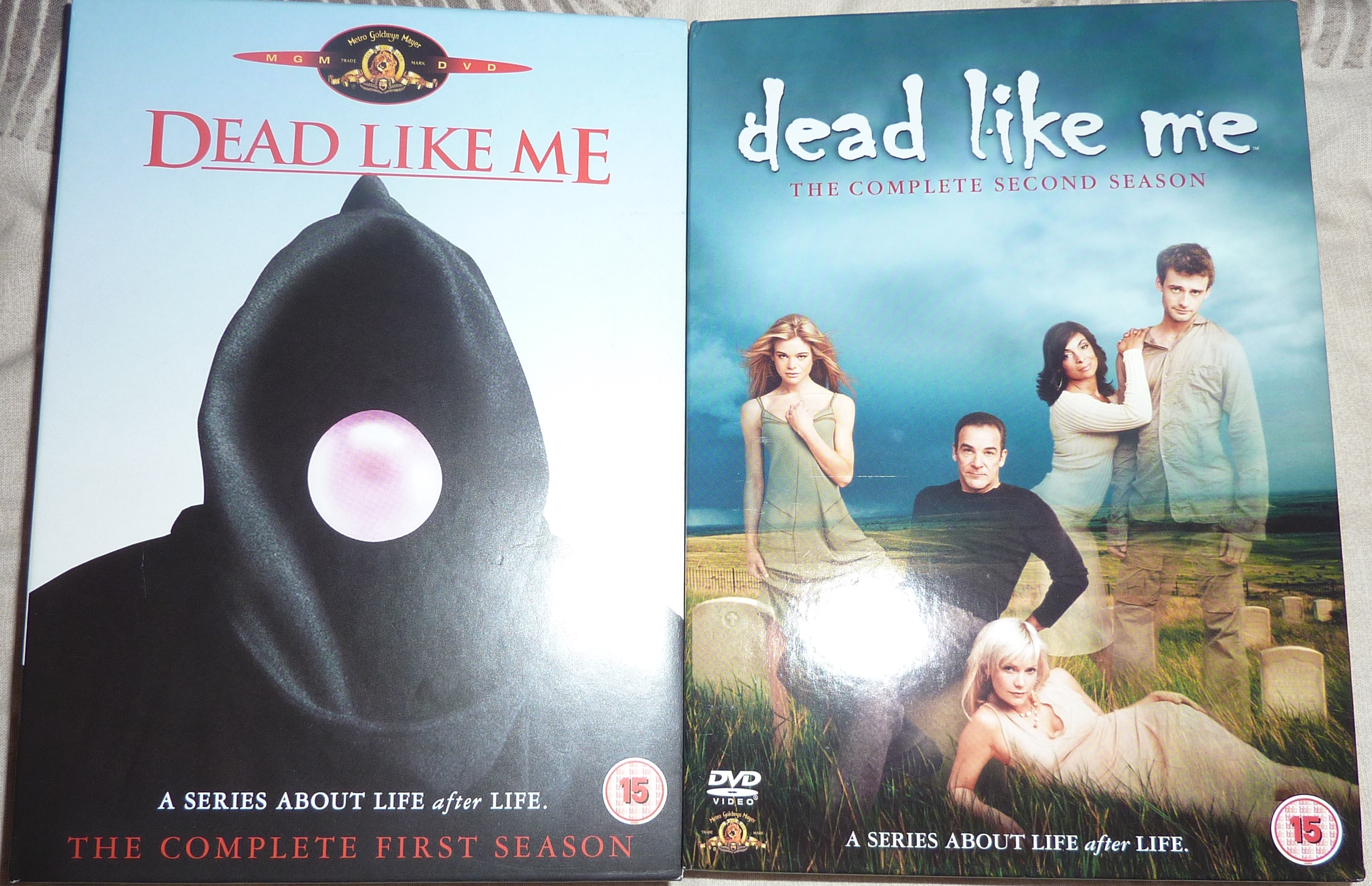
I watched this series ages ago so I can’t remember it well enough to pick out specific episodes but the stand out image is that the girl is killed by a toilet seat from space!! It also has Mandy Patinkin in it and I had a bit of a thing for Callum Blue at the time. Sadly this only got two seasons (2003-2004). Poor Georgia ends up becoming a grim reaper with the job of seeing others’ souls through to the afterlife as well as having to have a regular job – rude. I also remember the fact that she still is so close to her family is tough on her. Deserves a rewatch at some point.
Any D’s that I missed – @GentleChaos on twitter pointed out Dark Angel which I do own but have never watched?
What did you think of the two futuristic season finales of Dollhouse?
Share this on Facebook, Twitter and Google+

C is for… Conferences #AtoZChallenge
C is for… Conferences
Academic conferences can be scary places but they can be hugely inspirational, both to attend and to present at. They can also be extremely tiring – you have been warned.
Advice when completing a PhD nowadays is to publish as you go along, the thought of this, to me, has been petrifying, but standing in front of people chatting about my ideas is less so (odd, yes?). I guess there is more of a permanence in the latter and because ideas mould and develop over time the idea of solidifying something in a journal seems too daunting. Not that I won’t challenge myself to go there – but I might need to take baby steps – blogging about my ideas is one of these.
I have already presented at conferences on my PhD and other subjects – I’ve also recorded myself presenting but not yet listened back, though it will be really helpful to, so that I can remember a) What I said and b) What questions I was asked and how I answered them.
One of my tasks for when I return to work is to add all the conference presentations/posters I have completed to the work publications archive – but will I be brave enough to add the audio?
I’m going to tell you my secret stages of presenting at conferences now:
1. See a conference that looks really exciting – note the date that abstract submission closes.
2. Forget the date that abstract submission closes and panic write an abstract the night before (pull out your hair trying to get it under the minuscule word count whilst retaining a semblance of coherent thought – I think/hope I’m getting better at this).
3. Miraculously get abstract accepted (or not then maybe you can attend without fear).
4. Realise not too long before the conference that you need to write something, develop a poster, presentation etc.
5. Re-read abstract and try and remember what you were talking about when you wrote the abstract.
6. Possibly realise that in the interim months you have moved on with your ideas and try and write something which matches the original abstract but also expresses your new thoughts.
7. If you are like me continue working on said presentation up until the presentation (this is because I like to try and acknowledge what I’ve heard in the sessions I’ve heard before where relevant).
8. Go over time because you have added things last minute.
9. Think it has gone awfully and decide never to write an abstract again.
10. See a conference that looks really exciting…
Or is this just me?
Speaking of writing abstracts there is a deadline on Friday… hope this post doesn’t jeopardise my chances.
I am very excited to be attending and presenting at the auto/biography conference to be held in Barcelona in July. I was also lucky enough to be awarded PGR development funding to attend. I will be presenting the following (and a joint presentation that I’m really excited about):
Cover Stories: using books to tell the tales of a writing life
My PhD explores my need to engage in the occupation of creative writing. Books are the artefacts or tools of a writer’s trade. It is commonly suggested that we should not judge a book by its cover but in reality that’s exactly what we do. This paper will become a field text (Clandinin and Connelly 2000) examining my creative writing narrative and autobiography through the cover images of books that have been influential in my writing life. The literary concept of intertextuality will be discussed as an understanding that works of literature cannot be separated from other works that have come before, or from the general culture in which they are created (Allen 2000). This further supports my decision to utilise autoethnography as a methodological approach, where the self is always seen in connection with others (Chang 2008).
Finally, books have been a great source of comfort to me and even looking at a familiar book can induce a sense of calm. This will be linked to the core belief of occupational therapists and occupational scientists – that occupation links to wellbeing (Wilcock 1998).
Allen, G (2000) Intertextuality. London: Routledge.
Chang H (2008) Autoethnography as method. Walnut Creek, CA: Left Coast Press.
Clandinin DJ and Connelly FM (2000) Narrative inquiry: experience and story in qualitative research. San Francisco, CA: Jossey-Bass.
Wilcock AA (1998) An Occupational Perspective of Health. Thorofare, NJ: Slack.
What has your best conference experience been?
Does my ‘stages of presenting’ seem familiar to you? Please say I’m not alone?


 kirstyes