E is for… (#atozchallenge)
E is for…
E
By e I don’t mean the mathematical constant (whatever that is) or e=mc2
I mean e for electronic, as in e-learning, e-CPD, e-portfolio, e-books and so on.
One of the big debates of the moment is about e-books and whether they are helping publishing and writers. As an administrator of an online Writing Community I can say that the emergence of e-publishing has made it pretty easy (and cheap) for me to publish competition anthologies and a magazine for http://www.slingink.com. I have done this through http://www.lulu.com. The only real financial layout I have had is in ordering the proof copies of the print books so that they can be distributed though other retailers. The books can be made available as a PDF download or individual customers can make a print on demand order all managed through lulu. They’ve also just contacted me to say they are putting the books forward to become available through iBooks (a word of caution you do have to have some, or get some, technical knowledge of PDF formats to create an uploadable file).
Of course it’s the Amazon Kindle that really seems to be driving the e-book market forward and allowing authors to self-publish their material and in some cases make more money doing this than they would through traditional publishing. The name that springs to mind is Amanda Hocking and you can read her recent blog post about her switching back to traditional publishing here.
When I have something decent written I may well turn to Kindle myself too.
My C post was on CPD and one of the things I have been investigating over the last few years at work is finding an e-portfolio tool that will support my students (and myself) to maintain our CPD and share elements of it with potential employers, our registering body and others. In fact my presentation at last year’s College of Occupational Therapists Annual Conference was on this topic. One of the biggest findings that arose from an audit I completed was that current practice was still very much paper based and I think this is a factor that is preventing e-portfolios taking hold once students leave university. I think I’ll leave this topic here today and post in more detail at a later date. The search continues…
I am a huge supporter of e-learning and by this I mean using online technologies to support learning. As an Open University alumni I have been an e-learner myself, distance learning using the Firstclass forums. The OUs OpenLearn initiative to share free learning resources means that everyone with access to a computer can get a flavour of a range of subjects. In my professional life it is e-learning and developing online resources that inspires me and I have used Facebook, podcasts, blogs, wikis, e-portfolios to name but a few to, hopefully, enhance the learning experience of my students.
Despite my love of all things e, I think there is a place for traditional means and methods too.
I have a kindle but I am not planning on selling any of my books anytime soon and as my B post demonstrates I love Books (weirdly enough a second hand smoky smelling, liquid book arrived through the post (which had been described as in Good condition) – I am sending it back and debating buying the kindle version instead.
I still have to buy albums in CD format (though I will download singles) and films and TV shows have to contribute to my DVD collection.
At one of the sessions at the e-portfolio conference I attended in Birmingham recently, the speaker discussed having given students a choice of how to gather evidence for a portfolio, scrapbooking was a more popular option than e-portfolios.
As good as e-learning can be there are some things that can only be taught face to face. I particularly enjoy one to one or small group sessions where I can really get a flavour of what students have learnt.
A few questions for you:
What have your experiences of e-learning be? In what situations would e-learning be the best method to learn and in what situations would other methods be better?
Has anyone used an e-portfolio? What type? What were your experiences? OTs, if there was a readily accessible e-portfolio system available for you to use, would you? Why/Why not?
Writers what do you think of the e-book versus traditional publishing route?

Share this on Facebook, Twitter and Google+

D is for… (#atozchallenge)
D is for…
Domestic Abuse
I recently sat in on a third year health students’ presentation about domestic abuse and in this they shared with their audience a number of resources that stayed with me and that I would like to share. Please be warned the video below may be distressing and is not suitable for young children and the poem had me in tears.
This is a subject I have chosen to write about a couple of times myself in the past (not thankfully inspired by events in my life though I am aware of people I know having been in this situation). I share with you four pages from my poetry book.
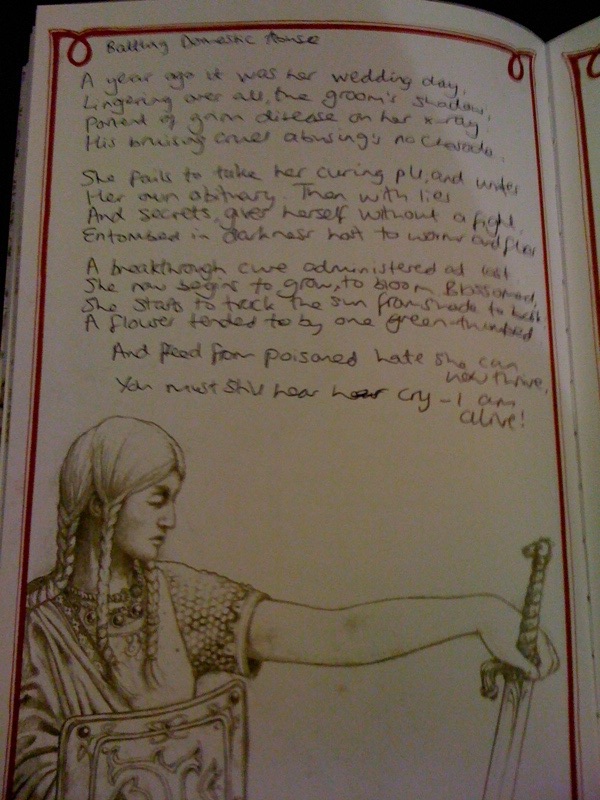
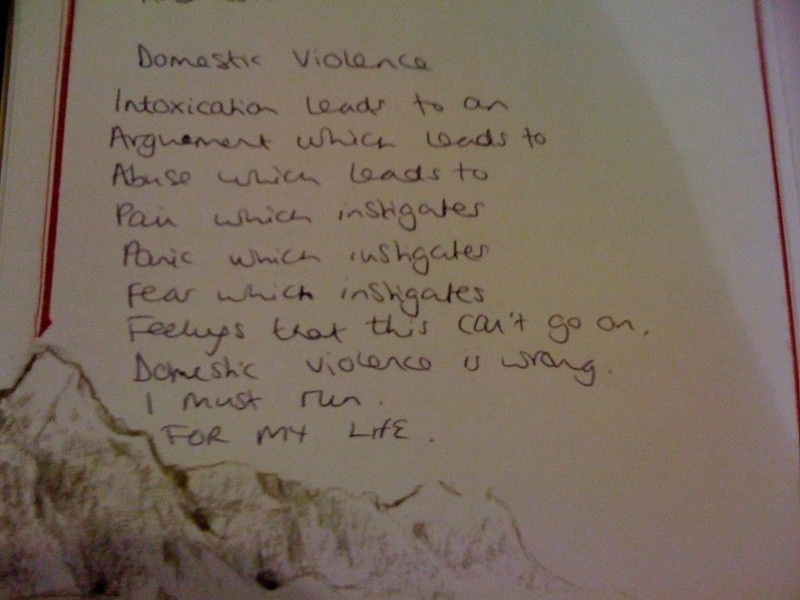
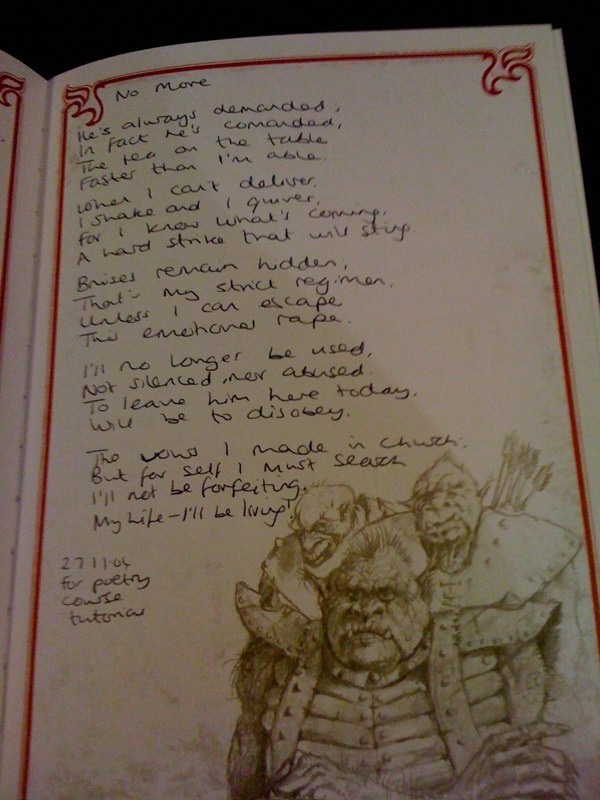
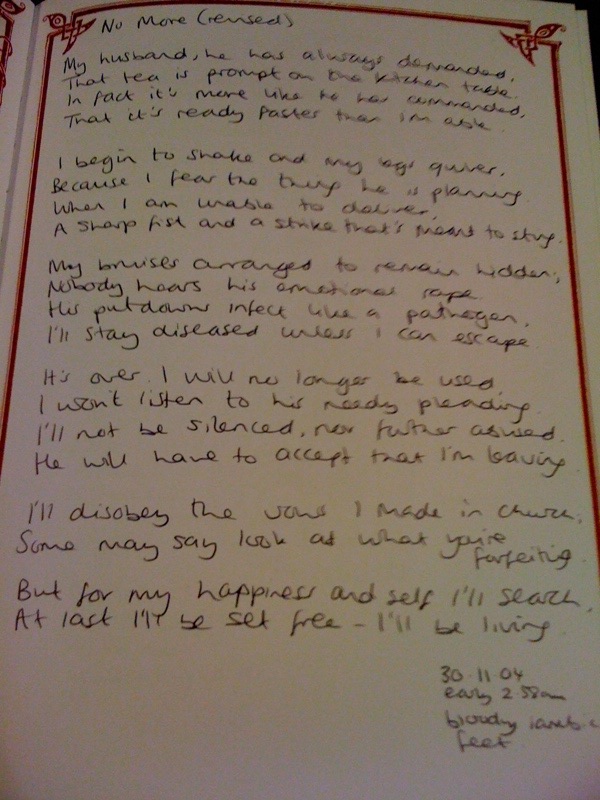
Domestic Abuse is not always as obvious as the examples above or always to do with physical violence. Abuse can be emotional, sexual, financial, or related to social isolation. It’s not just women that it affects, it can affect men too, and children, even if they aren’t the target, may be aware it is happening.
If you are in this situation I know it is not easy to leave but please seek support and try to tell one person that you trust. Don’t forget in an emergency situation to dial 999.
Some useful links may be:
Relate – the relationship people for relationship counselling
Samaritans for a listening ear and non-judgemental advice
Men’s Advice Line for men in abusive relationships
Refuge for women and children
And more can be found on the BBC Health Domestic Violence page.
Be safe and try to remember that nobody deserves to be abused.

Share this on Facebook, Twitter and Google+

#SSF2011 – the nitty gritty (Saturday)
#SSF2011 – the nitty gritty (Saturday)
I promised a further post on the Southern Script Writing Festival and here they are – I’ve gone from single to plural because this was becoming a long post so I am splitting it down by day.
These are the sessions I attended on the Saturday with a brief run down of the key points I took from them (please consider I was pretty much a scriptwriting novice so apologies if these seem like really obvious points to you):
I should also say that these are my interpretations of what was said based on my almost unintelligible scrawling notes made on the day so my apologies if I have misquoted anyone.
Saturday
Writing for Young Audiences – Chris Hill and Danny Stack
With kids scripts (and I presume this applies to books too) the protagonist is often set a few years older than its target audience – to give them something to aspire to.
The panel were asked about what was allowed (or not) at different ages:
For pre-schoolers they suggested that we look at ‘constructive emotive behaviour’ (if I noted that correctly) and that you tend to have psychologists/psychiatrists giving you notes on your script.
Now I’m not entirely sure what CEB is and a Google Search takes you to articles on Rational Emotive Behavior Therapy. This seems to be similar to Cognitive Behaviour Therapy in which one is taught to rationalise responses and thoughts to direct behaviour and responses to situations. The link I share above, talks about an A,B,C approach where A is the Activating Event, B is the Evaluation (Cognitive-Affective-Behavioural) and the C is the Consequence (emotional). It is the evaluation (and its rational or irrational nature that causes the consequence rather than the actual event (The website probably explains it much better than me). And how it applies will take much more thought than I have in me at the moment (hoping my copy of Psychology for Screenwriters arrives soon). I’m guessing those in basic terms it means modelling rational responses and thought processes to events so as not to engender extreme negative reactions, phobias, challenging behaviours etc.
For 6-12 year olds the key was imitable behaviour – this basically means that you avoid putting in any behaviours that would be dangerous or unsafe for them to copy (because they will). The examples given were no pouring cereals over siblings heads or sticking knives in plug sockets, etc. I guess this means putting in behaviours you want them to imitate.
For older children – it was the commissioning editors and execs that guided content.
Meet the Agent – Nick Turner (of Linda Seifert Management Agency)
Nick, who was a past BA Screenwriting student at BU gave lots of tips and hints – here is a summary. Nick mainly deals with TV Writers though his colleague deals with features.
Agents as we know take a 10% commission on all types of rights for your work.
Nick’s agency do some script development with their writers, not all do.
Nick’s tips on finding an agency was that they should be 100% passionate about your writing, that you should look at the writers they already manage and that you should always send a full script so that they can see your potential and accompany this with a writers CV (see my notes on Phil’s Writing and Producing the Short that could help you build up your CV). They may often ask to see a second script to know that you can produce more than one idea. They will also want someone who is personable.
When you are actually in an agency the advice was to keep writing and sending scripts that they could use to share to get you writing credits on existing series.
When pitching a script keep in mind your audience, think about what channel you can see it playing on. BBC1, BBC2, BBC3, ITV, Ch4 (Ch5 not really taking at the moment), Sky 1, Sky Atlantic, Sky Living, Sky Arts, E4.
Returnable series was the buzz word throughout the sessions I attended. Generally these have been 6 episodes of 60 mins that could potentially return season after season.
There have been 5 episode week events and 3 parters (prob 90 mins) also were quite popular
As a newer writer it was suggested that single dramas were harder to commission, they have to be relevant to now whether they are contemporary or not.
My Family has just been cancelled (:o() so a comedy that represents the family structure of today might be a good idea).
For the Sky Channels – if you’ve got a strong idea of an English show that could complement their American acquisitions then think about this. Book adaptations, e.g. Terry Pratchett/Martina Cole seem to be popular.
I asked a question about book adaptations, Nick’s advice was if there was a book you really liked and could see adapting the first thing to do would be to approach the writer and see if they still had the rights (they may have sold them or they may have planned to adapt the book themselves).
The topics then got into things that had I been a screenwriting student I may have understood though I managed to pick up some of the lingo. This was to do with spec scripts and series bibles!
This was for if you were pitching a series, you don’t have to have the whole series written. You’d probably have the first episode and then a series bible. This would contain a very detailed outline of a 1st episode and briefer outlines for say ep 2-6. Character biographies and character arcs. An idea of the arena and tone.

Why Are We Teaching Writers to Pitch? – Sandy Lieberson
Sandy suggested that the easiest time to pitch was potentially when it was just an idea (I suppose when you aren’t completely signed up to a written script that you don’t want to change).
He showed a clip of the film The Player (which I must try and get to see), where Richard E Grant is pitching his script to Tim Robbins very passionately. Looks funny.
So, to the question why are writers being taught to pitch? Basically because a script is a technical document and not the best way to convey the actual narrative, character relationships and dynamics.
Some pitching tips:
Know who are pitching to and what other films etc they have been involved with.
Use existing points of reference (what is it like) – A note of caution though, if you use existing titles, e.g. It’s a cross between x and y, make sure their is a unifying concept between them, choose your references carefully.
As you develop the pitch talk more about and buy into the characters.
Show integrity – believe in your script, don’t cave at every suggestion to change it – be prepared for it to be turned down – (obviously you will have received feedback from other sources before you do this).
Can you create an atmosphere of the genre of the piece, romance, tension, etc.
Write out your pitch first but don’t read it as it may come across that you don’t know your idea well enough.
I guess some of the other points are debatable such as suggesting potential actors, who you’d like to direct. I’m guessing some will like that, some don’t (and Sandy did mention ‘see the poster’ but see my note about this on the Sunday post.
You can bring visuals such as a story board, character pics, photos, music, the book (if an adaptation), materials, e.g. Magazine or newspaper that inspired the idea. Photo or illustration of location – to demonstrate atmosphere. Short clips from other films to show style, a website potentially.
Writing for Theatre – The Writer’s Avenue
The Writer’s Avenue should be at www.writersavenue.co.uk but it looks like it is currently undergoing maintenance so I’ve provided a link to a BBC Website that mentions them.
This was a workshop run by Sandra (the Artistic Director of TWA) and Chrissie.
They stressed how important the first 20 mins of a script are and how you need to find the inciting incident of your play in approx the last 5 pages of your 20. You also need to make it clear who are protagonist is and who we should be following.
You don’t have to cram in action – dialogue can have a subtext.
Your audience will want to know why when thinking about what a character wants. This should come through without exposition.
Don’t try to direct a play from stage directions unless it is essential – make it implicit in the narrative/dialogue.
Sometimes in a scene it is nice for a character not to talk – sometimes they can say volumes by keeping schtum.
Try showing how your protagonist usually acts – so that we know what the implications of later actions are.
The audience builds notion of character through a matrix of impressions. Do we always need the protagonist in the first few scenes, sometimes we can get a sense of them by how other characters describe them or act when they are introduced.
In a second draft move your scenes around to fit and to get rid of clumsy exposition and character introduction.
If you want to write for theatre talk to their literary department and look at their current programming. Have faith in your style and find somewhere to match this.
We then practised describing films and plays in one sentence (can you give ideas about the obstacle, character and theme in fewer than 20 words or preferably less than 15).
Here’s my attempt to describe Inception ‘A team commit corporate espionage through planting ideas in people’s dreams.
When plotting think of the pre event, event and post event for each scene and the play as a whole.
Story is created when your character is under pressure (usually time limited) and forced to make a decision. This will be high risk and it needs pressure for them to make that decision, even not making a decision could be the decision – there will be consequences either way. Characters have to be active, especially if they are women.
Pitching Contest – you heard about this already
Sunday’s sessions will follow in a separate post that I will finish writing tomorrow.
Hope this inspires you to sign up next year.


 kirstyes