Category Archives: PhD
N is for… Narrative Inquiry (Book) #AtoZChallenge
N is for… Narrative Inquiry (Book)
Haven’t had time to read this book, or even scan through it really so I’m just going to add a picture of the cover. I know this is one I’ll be reading.

Instead I’m going to briefly talk to you about the workshop I attended at work today – which was aptly called The power of narrative and stories in enabling learning for professional practice.
This was an event sponsored by the Higher Education Academy. You can see the programme here.
A few of us tweeted using #heanarrative – I was hoping to make a storify (but the website is playing up at the moment).
My colleagues shared the narrative work they have been undertaking in health and social care education and research and I got to read some of the poetry I have been writing on my research journey (I thought I was just putting it up for people to read – nothing like being thrown in at the deep end).
I was moved to tears a couple of times during the day and, although you can’t hear his full poem here listen to Jagdev Singh being given a space to and finding his voice through poetry.
The creative group I was with shared our feedback via the magic story mask of insight – symbolising the fact that stories can teach us so much.

Finally here is one of my insights from the day

What is the most important thing you have learnt from a story or through listening to someone’s narrative?

Share this on Facebook, Twitter and Google+

M is for… Mewburn (Dr Inger) – The Thesis Whisperer #AtoZChallenge

M is for… Mewburn (Dr Inger) – The Thesis Whisperer
Dr Inger Mewburn is the Thesis Whisperer – which according to her website tagline is ‘Just like the Horse Whisperer – but with more pages’
The Thesis Whisperer is a blog that provides helpful articles on the process of completing your thesis. Less a how to, more a how to survive.
I’d like to share with you a link to one of the most recent articles on Wormhole literature
In summary this is about:
• Freaking out when you realise how much there is to read
• The process of exploring reference by reference and getting sucked into a wormhole
• Starting to recognise names and pockets of thought
• Finding THAT PAPER – the one that gets you better than you get yourself
• Panic about what would have happened if you’d missed that paper
• And I guess the process might be cyclical
This fear about missing THAT PAPER is one of the Thesis Whisperer’s top five #phdemotions (Shared with Creative Commons “Attribution-non-commercial-sharealike licence” – [my personal additions in square brackets])
1. Elation when you realise you know more than your supervisor about your topic and you feel brave enough to argue about it. [Not there yet]
2. Fear of being ‘found out’ as fraud, not really knowing enough/being smart enough to be Phd student. [All the time – this appears to also be referred to as The Impostor Syndrome and I’ll be attending a session in June on how to combat this very thing]
3. Unexpected admiration of your own writing. [Rarely – although sometimes I look back at my older writing and wonder why I don’t remember writing that thing that seemed to make a bit of sense]
4. The “I’m a genius! Why hasn’t anybody thought to do that before?” moment before people point out the obscure paper you’ve not read. [This relates to THAT PAPER above – I’ve found a few of those which have set me on a slightly different track each time – though I don’t ever think I’m a genius more that’s an OK idea Kirsty]
5. Misplaced smugness after photocopying/downloading loads of stuff but not actually reading it. [I’ll add in books here too and I think you’ll see by the number of books I’m reviewing for this challenge that this one is very true to my experience and the first thing I need to tackle].
I have felt very much like ‘Jenny’ wormhole and in fact submitted the following photograph to the PGR (Post Graduate Researcher) Conference at my uni which will be held on 29th April.
Drowning in Words
This image represents the conflict between loving words, books and creative writing (the topic for my PhD) and being overwhelmed by the introduction of a new series of terminology and more reading than it seems possible to manage. Books are used as handholds for rescue but are also the method of drowning. The quill and blog (on the iPad screen) are the means to write my way free.

Drowning in Words (c) Kirsty Stanley 2013
How do you manage the wormhole?
What thesis whispering techniques have you used?
Do you recognise any of the top five PhD Emotions?
Share this on Facebook, Twitter and Google+

L is for… Le Guin on Writing (The Wave in the Mind) (Book) #AtoZChallenge
L is for… Le Guin on Writing (The Wave in the Mind) (Book)
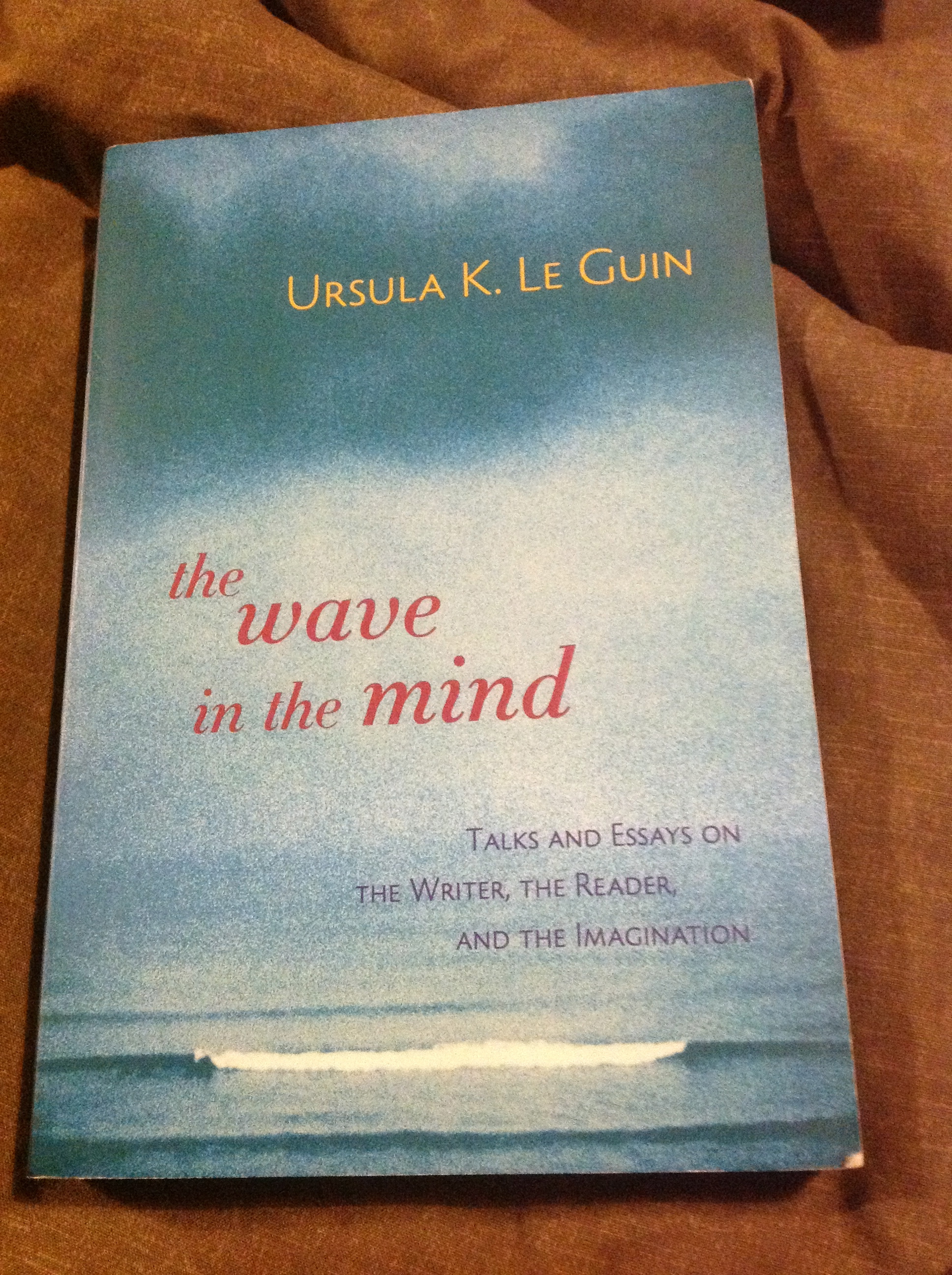
This book has been knocking around on my shelf unread for a while too. The Wave in the Mind by Ursula K. Le Guin has the subtitle: Talks and Essays on The Writer, The Reader and The Imagination.
Once again I am led back to thinking that writers don’t half write about writing. This is one of the things that interests me most. It seems like there is a need to explore why we write.
I had a quick flick through last night and Ursula writes about a variety of topics, reading, writing, feet!!
I’ve decided just to pick a few select quotes and note what I thought when I read them.
‘…I tried to figure out what was troubling me. I did it in writing because I think best in writing.’ (p.152)
I feel this way too and wondered how true this is of writers in general. In fact this was one of my arguments for looking at doing online data collection rather than face to face interviews.
She talks, as others do about multiple meanings in texts and that there is no one way to read something explaining that is depends on who is reading/writing, ‘what their relationship is, what society they live in, their level of education, their relative status, and so on.’ Books aren’t there to simply disseminate information or facts. ‘They are full of meaning and of meanings.’ (p.187).
I wonder if this is true of the writer’s relationship to their writing too?
In an essay called A Matter of Trust she says ‘In order to write a story, you have to trust yourself, you have to trust the story, and you have to trust the reader.’ (p. 223)
• You have to have trust and confidence in yourself as a writer – to do this you need to write.
• You have to be prepared to lose control when in the composition phase (control comes in planning and revision)
• In terms of trusting a reader she talks about dancing with them, not attacking them. Trusting them not to give up if your first line isn’t perfect.
I wondered whether getting to this state of trust links to engaging in writing being better able to support our health and wellbeing. I don’t think I have point one yet. I can definitely lose control in the composition phase but struggle to regain in when editing. I hope I trust the reader.
In The Writer and the Character she talks about characters starting to ‘have a life of their own, sometimes to the extent of escaping from the writer’s control and doing and saying things quite unexpected to the author of their being.’ (p.235)
Oh yes this happens – they do things like get themselves killed when you aren’t expecting it too.
Ursula says the question she gets asked most is where do your ideas come from. A comment I’ve heard lots about books are, I don’t know how they thought of that, how odd. It made me wonder about openness. Are writers just more in tune with their thoughts and feelings, even the dark ones that some people repress?
In Old Body Not Writing Ursula lets out a secret, writing is hard work, it is challenging. She describes being in ‘a kind of trance state that isn’t pleasant or anything else.’ (p.283). To me this is interesting because of discussions about occupational flow and its link to health and wellbeing. This ‘trance state’ doesn’t really sound like flow so there must be something else to explore here. This is one chapter I want to read in detail.
The final chapter is an extended poem The writer on, and at her work – I’m just going to pick a very tiny portion of it to conclude.
‘So if I am
a writer, my work
is words. Unwritten letters.
Words are my way of being
human, woman, me.
That certainly set waves going in my mind, especially the pause on the word being – what about yours?

By MG_FX – from http://www.sxc.hu/photo/1418313 (used with permission)


 kirstyes