Category Archives: PhD
Research views
Inspired by the wonderfully talented and creative Gillian Crossley I have used ArtSet and some comic apps to create a little comic on my current views on qualitative research to help me make sense of my philosophy when selecting a research methodology (which I seem to be going round in circles with).
Enjoy (p.s. I do not claim to be artistic)
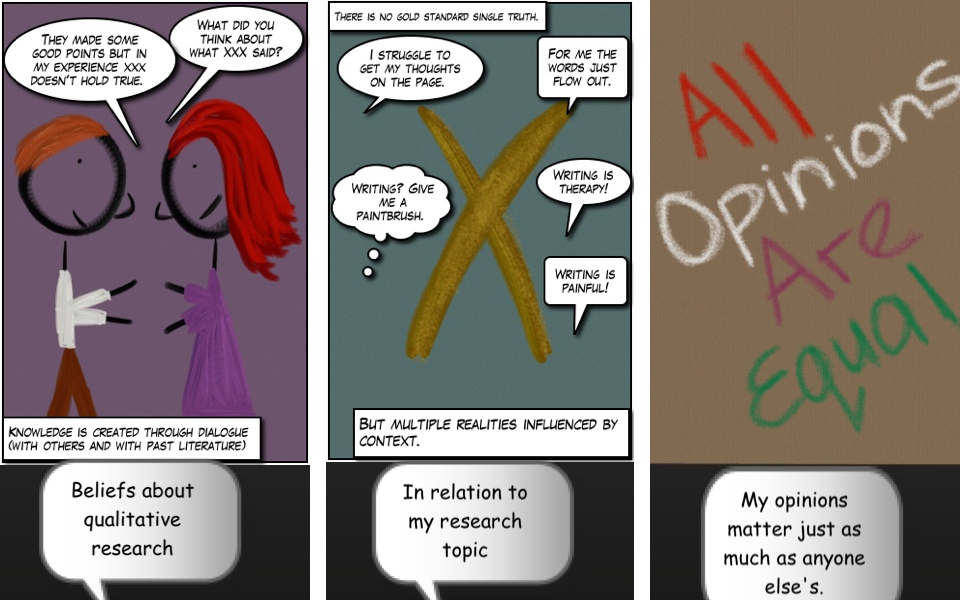
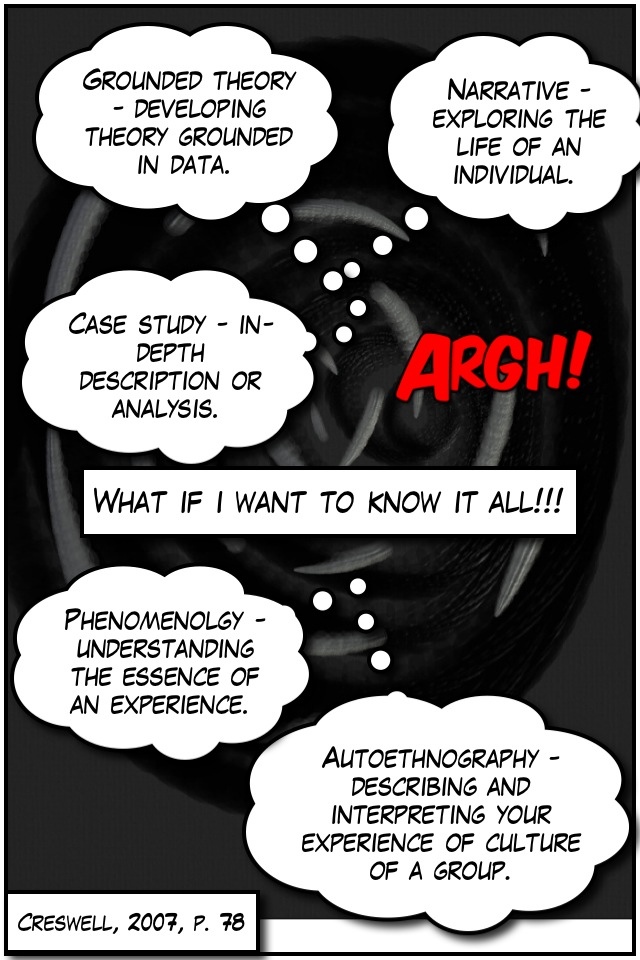
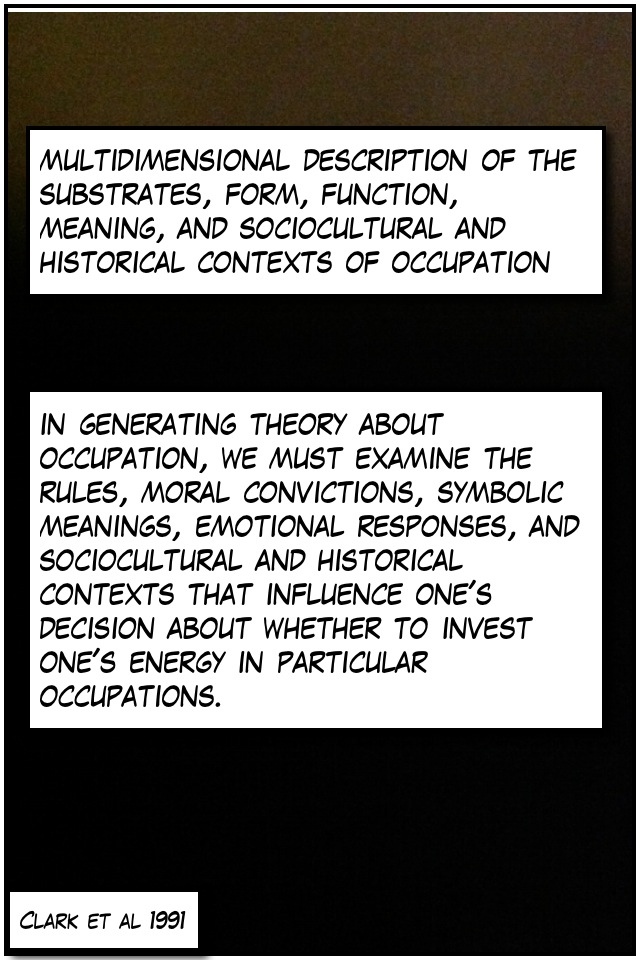
The last pic is direct quotes from the Clark paper.
Full Refs to be added.
Thanks Gillian. I found this technique helpful and therapeutic 😃🎨
Share this on Facebook, Twitter and Google+

A Creative Controversy…
I have recently joined Pinterest and was exploring the site for some images to pin to my ‘Words to Live By’ Board when I came across this image on creativity – I was close to repinning (some of these words may mean nothing to you as they didn’t to me a bare week ago) when two statements in particular stood out as ones I did not believe in at all. They’ve kept me up late to writer this blog post. I’ll let you look at the poster and see if you can pick them out.

Now, you may not have identified the same two as me or may even have identified more. I think perhaps many of the statements could be seen as limited and, although they can be true when applied to creativity, they aren’t the only ways to define it. I do wonder if the author of the original poster was thinking about pure artistic creativity when creating this?
I know of at least one person who agrees with me as they immediately responding when I posted this on Facebook identifying the very statements that had vexed me. And so, because I know you are itching to know if you agree or disagree with me:
1. I do not believe that ‘Creativity is something that some are blessed with & others are simply not.’
Yes, there are people who appear to be blessed with creativity and can be creative with words or paints or a camera or…. but that is a somewhat narrow definition. What about the person who is the only one to notice that someone is in trouble and reaches out by simply saying hello?
Creativity can be expressed in our daily lives and potentially in everything we do; from trying a new toothbrushing technique to improvising with breakfast when the milk has gone sour, to an idea springing from a problem we’ve never encountered before even when we don’t think we’ve ever had a good idea in our lives.
Is creativity always a good thing – is it always a blessing? For me (and I think I am quite creative) sometimes the ideas become too overwhelming because I don’t have enough time to implement them or because there are things blocking me translating ideas into reality, sometimes a fear of doing something wrong or not perfectly.
In relation to the issue of time perhaps I could share my ideas more and allow someone else to jump start their own creativity, sparking off mine.
In relation to the blocks – some are personal things that I need to work to overcome and others are I think are societal – thinking that there is only one way to do something and not always accepting that won’t work for everybody – expecting the person and not the process to conform.
2. I do not believe that ‘Creativity is something that cannot be taught.’
If I did believe this I’d be in the wrong profession!! (Both of them – Lecturing and Occupational Therapy I think are all about this). Maybe it’s the word teaching which can sometimes be considered didactic – “You will be creative today”.
I certainly believe that the learning of creativity can be facilitated. I see this in our students (and have seen it in myself).
Another pin I spotted may help to shed some light on this:

Moving to this type of ‘grey’ learning or thinking I believe comes with age and/or experience – Jean Piaget’s stages of cognitive development ‘stopped’ at the formal operational stage which was suggested to be reached at 11+ . This stage is where people ‘can think logically about abstract propositions and test hypotheses systematically. Becomes concerned with the hypothetical, the future, and ideological problems’ – Atherton, 2011).
For me there is too much focus on logic here which often relies on rules or absolutes.
Kramer et al (1992 cited Santrock 2006) described ‘Postformal’ thought as that which ‘involves understanding that the correct answer to a problem requires reflective thinking and can vary from one situation to another, and that the search for truth is often an ongoing, neverending process. Postformal thought also includes the belief that solutions to problems need to be realistic and that emotion and subjective factors can influence thinking.’ (I have this in quotes because I can’t quite remember if I paraphrased this so this may not be the exact words).
School teaching appears to, in a lot of ways, rely often on logic or rules or rights and wrongs and a number of students when they come to university want to know what is the right answer – most often there isn’t one. Yes occasionally there are wrong aspects but I genuinely believe that in my profession there are many ways to do something ‘right’.
I would hope then that by focusing on skills such as problem solving, critical appraisal, clinical reasoning (from many different viewpoints) etc as well as ‘teaching’ content and knowledge, and allowing opportunities to apply knowledge using those skills developed, that students can approach things creatively and that they in turn do this with clients.
I don’t know much about the Montessori Method but from what I’ve read I think this is a method designed completely to foster creativity and love of learning from an early age. I know there are devotees and critics of this approach but what is clear is that state schooling certainly doesn’t work for everyone. I think I’d like to see slightly less focus on a formal jam packed curriculum for youngsters and some more exploratory time filtered back in.
This exploring shouldn’t stop when you are young. Play is the way children learn – there is no reason adults can’t continue to learn this way too. By simply trying new things, learning and developing new skills and knowledge I think this enables the development of creativity. You do have to be prepared to step outside your comfort zone and feel challenged to reach this though.
Whilst performing a quick search on this topic I came across this website – Creativity for Life – that has lots of activities and suggestions for thinking and acting creatively – why not try some of them out.
I hope I made it clear why I singled those two statements out and I think some of what I’ve said supports the other statements that I do agree with on the whole.
I’m going to leave it there but may well come back to this topic again as I am fairly sure it will be something that I will be exploring as part of my research and if not it’s something I’m interested in anyway.
I’d love to know:
- whether you agree or disagree with me?
- whether you’d add any statements to the poster?
- whether you’d remove or revise any of the others?
- whether you’ve had much experience of the Montessori method or your thoughts about your own or your children’s schooling?
- what has developed your own creativity?
- Anything else that you’d like to add I’d love to hear it.
References
Atherton J S (2011) Learning and Teaching; Piaget’s developmental theory [On-line: UK] retrieved 17 February 2012 from http://www.learningandteaching.info/learning/piaget.htm
Share this on Facebook, Twitter and Google+

COT Conference 2011 (#cot2011) – Brighton
COT Conference 2011 (#cot2011) – Brighton
Yes people it’s that time of year again. I went to my first COT annual conference last year and thoroughly enjoyed it. I presented a seminar on CPD and e-portfolios.
This year I am presenting a facilitated poster discussion (session 46) and in a session on creative occupations (session 53) both on elements of my early PhD literature research (I am currently suffering from severe information overload).
For your tweeting pleasure I present below a list of the sessions I am attending.
| Day/Time | Session No and Title |
| Wed (10.00-11.00) | Opening Plenary – Occupation, evidence and outcomes |
| Wed (12.45-14.25) | Session 7 – Life Stories: use of the Kawa model in a role-emerging setting |
| Wed (15.00-15.45) | Session 35 – Tribalism or collectivism: debating generic vs specialist OT and what this means |
| Wed (15.40-16.40) | Session 46 – My poster discussion – Occupational therapy in practice session |
| Wed (-18.00) | BAOT/COT Annual General Meeting |
| Wed (18.00-18.45) | Twitter Meet up |
| Thu (8.30-10.00) | Session 53 – Creative Occupations (Me) |
| Thu (10.40-12.20) | Session 77- Movies that matter: films as learning activities to engage student’s ethical reflexivity |
| Thu (12.30-13.30) | Kawa Pebble beach meet up |
| Thu (13.55-15.10) | Plenary – Elizabeth Casson Memorial Lecture by Prof Anne Turner |
| Thu (16.00-16.45) | Session 106 – Occupational Therapy Education: an appalling paradox |
| Thu (16.50-17.35) | Session 114 – Responding to reviewer’s comments: the final hurdle of peer review |
| Fri (9.00-10.40) | Session 122 – New Ways of thinking |
| Fri (11.20-13.00) | Session 144 – Occupation and Older People |
| Fri (13.00-13.40) | Final plenary – Occupational Therapy saved my life |
Here’s a link to the Conference programme for more information and to the COT’s annual conference page where there is even more detail of the sessions.
Now, I am going to try and live tweet during the sessions that aren’t too interactive and where I’m not presenting but we have a slight problem. The Brighton Centre doesn’t supply free wifi (I was spoilt at the UDMH conference as Bournemouth Uni has free wifi across both campuses) so I won’t be able to use my iPad to tweet (quick and easy) and will instead have to use my phone (currently slowish and with poor battery that gets eaten up by connecting to 3G). Now COT did kindly find out arrangements for purchasing wifi access but the cost is prohibitive as I am pretty sure I’ll need over 4 hours access across the 3 days (£9.99) and 24 hours access is £39.99 – eek. My hotel also has a similar pricing structure so you may have to wait until the evenings for some key points tweets as I did last year with some more substantial blog posts when I get back to wifi.
Now it’s late and I still need to read through my presentation in a dry run and pack.
Please take a look at the sessions I’m attending and if there is anything specific you’d like me to listen out for/ask add a comment below.


 kirstyes