Category Archives: Kirsty rambles on about life, the universe, tv, and everything!
V is for… (#atozchallenge)
- V is for…
Vampires
For a long time I have been interested in/fascinated by Vampires.
I’m pretty sure it started with reading Bram Stoker’s Dracula at school.
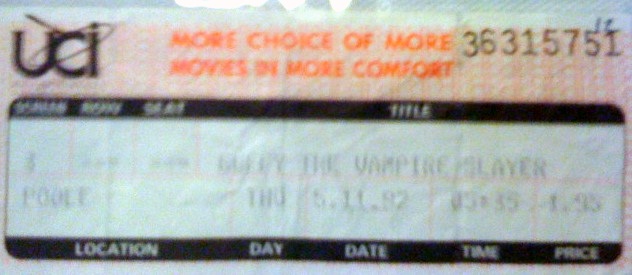
The original Buffy the Vampire Slayer film at the cinema might have been next, in Nov 1992 when I was 14 and the price of a cinema ticket was £1.95!!!!!

The Gary Oldman version of Dracula also came out that year but I was a bit young to have seen it in the cinema (and I have no ticket!).
However I have a feeling I had seen The Lost Boys on TV before this (it was released in 1987). I’m guessing I may had stayed up late without permission.
to watch it (naughty).
This film has one of my all time favourite lines in it: It’s a bit rude so I’m linking to the imdb quote.
In fact this is still one of my all time favourite films.
I also remember seeing a kid’s TV series ‘The Little Vampire‘ based on books by Angela Sommer-Bodenburg. This was dubbed and I’m pretty sure I quite liked the idea of a flying cape!
I read ‘The Secret Vampire’ by L. J. Smith. It came out in 96/97 and I reckon I probably bought it from a small bookshop in Barmouth in North Wales (the best store bar Woolworths that they had there when I was visiting my grandparents). I would have been at university at the time and so it was likely to have inspired the vampire novel idea I had but have yet to complete. [The ending of this book came to me in a dream in about 98 and I have written some of it but am no-where near finished – I do plan to finish it and would like to print myself off a copy from somewhere even if that’s as far as it goes].
I was pleasantly surprised more recently to find out that ‘The Secret Vampire’ was actually the first book in a series, called The Night World. Currently there are nine books with the tenth and final book due out next year (I am itching to read it).
Weirdly I thought I had read this at a much younger age.
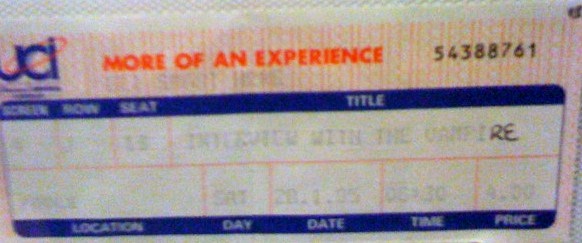

In Jan 1995 I went to see Interview with a Vampire (I have a number of the books which I still have yet to read). I was so impressed with Kirsten Dunst’s performance in this as an old soul in such a young body. I still cry every time I watch this film.
When Buffy the Vampire Slayer the series started in 1997 I was well and truly hooked… Though much of this has to do with the genius of Joss Whedon (see my J is for… Post) to find out more about my love for BTVS and Angel.
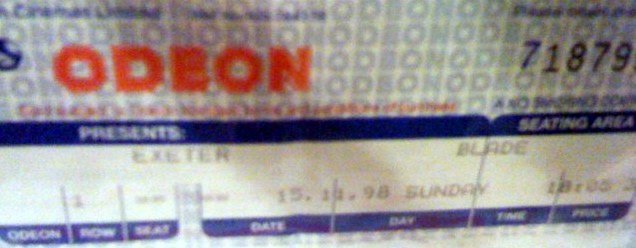
And then there’s Blade and From Dusk to Dawn and Near Dark and Let the Right One In, which are a lot more bloody and violent than I usually like my vampires to be but I enjoyed these too.

Much more recently is of course the Twilight series. I read the books before the films came out. Oddly enough though I am on Team Jacob (Werewolf) and not Team Edward (Vampire). Jacob generally makes Bella seem happier.
I’ve got a number of vampire book series ready to read (more about them on my Y is for… Post).
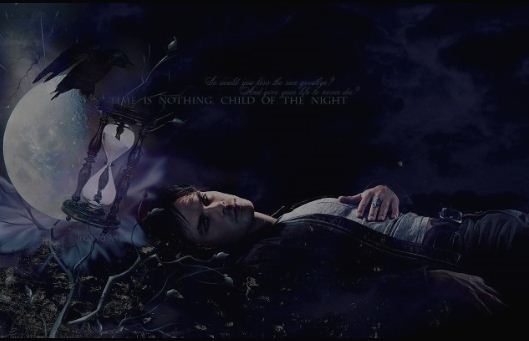
Then finally there are the three current TV series, Being Human (end of series 3, How could they?), True Blood (very saucy vampires indeed) and The Vampire Diaries (based on a series of books by L.J. Smith) in which the very delectable Damon smoulders (below – my apologies can’t remember where I got the pic from). The books really are quite different to the series and I think they’ve done some TV tie in books (Stephen’s Diary) which I might get on Kindle when I’ve read all my thousands of ‘to read’ books.

I’m not entirely sure why vampires fascinate me so much but here are some possible reasons:
- I am a night owl and not a huge fan of the sun so can identify with this ;o) and being pale and pasty
- I’m not keen on looking in a mirror and maybe not having a reflection is appealing
- Vampires live forever – when you have a death phobia this may seem positive (however I am a vegetarian so the thought of drinking blood of even animal origin is yuck yuck yuck)
- Vampires are damn sexy – or at least they are mostly portrayed as such in film/tv
- I’m generally interested in supernatural topics
- I got interested in this topic as a teenager and I still feel like an eternal teenager!
- Honestly I don’t really understand why, I just am!
What vampire films/books/TV etc are your favourites?
Are there any I haven’t mentioned here that you would really recommend?
(I’m 100% percent sure that this is not everything vampire related that I’ve seen/read but what I could remember whilst writing this post).

And for those of you interested in Vampires too the lovely Shah over at WordsinSync has also chosen V for Vampires in the A-Z Challenge and her post can be found <a href="http://here
Share this on Facebook, Twitter and Google+

U is for… (#atozchallenge)
U is for…
Understanding
Today’s post relates to occupational therapy, creative writing and life in general.

To understand: To perceive the meaning or explanation of, grasp the idea of, or comprehend: to be thoroughly acquainted with or familiar with.
(Polatajko 2010, p. 59)
For me, when I was practicing, the most important meeting I had with my clients was the first one. The one where I completed the initial interview, found out what the reason for referral was and what the difficulties for that client were, and also, most importantly, what they wanted to achieve. When first seeing a client I would allow plenty of time for this, time to get to know them. I would often “only” see two new clients in a day (working in a community setting seeing people in their own homes). Now when you have to fill in stats for how many clients you see and when these are compared with the stats of other professions this can possibly look a little lax. I have heard students commenting on facing the same challenge, and believe me it is a challenge. We don’t have unlimited time, budget or resources, sometimes we can cut client meetings a little shorter but do we then really get to understand them or their needs?
Take for example a time when you have had to complain to someone about something. When were you satisfied that the person dealing with your issue understood what it was? Was it when they went, ‘yeah, yeah, have your refund.’ or when the person listened to what you had to say and reflected it back to you. Even if the outcome of the latter wasn’t what you desired I reckon most of us would still consider that to be the more positive outcome.
So why does it take an occupational therapist so much time to understand their clients?
Because we are dealing with their occupations, the things that they do everyday and the activities that form their identity. Polatajko (2010, p.58) suggests that:
Constructing an understanding of occupation requires a careful examination of the doing, the doer, the context or situation in which the occupation is found, and the relationships among these elements.
Could you do this in 30 minutes? Can you even do it in 2 hours (the average length of my first meetings)?
You need to understand a person on their own terms, understanding about their past and present, about their beliefs, values, culture, religion, family, etc. etc.
One thing about social media that has been really interesting for me has been communicating with my friends using facebook, twitter and more recently blogging. The latter has been a revelation and reading my friends’ blogs (their stories) has really helped me understand them a little better. People write about things we don’t talk about. I have suggested to students that blogs can be useful sources of information for understanding the impact of a particular health or social condition on a client. On Twitter at the moment there is a hashtag discussion on the use of social media (generally) in the NHS, #nhssm. Why not check it out.
Understanding a client’s narrative is an important part of clinical reasoning (Boyt Schell and Schell, 2010). I think it helps us connect to our clients by forming trust, they trust that we know them and we can trust that we are providing the best intervention for their needs and in their best interests.
In creative writing I think it is just as important that we get to know and understand our characters. A number of writers create detailed character sheets identifying a whole host of characteristics that may never make it into a completed story. They do this to understand the psyche of their character, to know how they would respond in different situations, what another character’s words might make them feel, what choices they would make when faced with the challenges we throw at them. I have just ordered a Kindle copy of Psychology for Screenwriters: Building the Conflict in Your Script
Returning to the example I gave earlier of you getting someone to address your complaint, if you knew that the person saying, ‘yeah, yeah, have your refund’ had just been made redundant does that make their reaction anymore understandable?
How often do you spend time listening to people, getting to know your characters, reflecting on why people react or live in the way they do? What insights has this given you?
Thanks for reading
References
Boyt Schell, B.A., Schell, J.W. 2008. Clinical and Professional Reasoning in Occupational Therapy. Philadelphia: Wolters Kluwer/Lippincott, Williams & Wilkins.
Polatajko, H.J. 2010. The Study of Occupation. In: Christiansen, C.H., Townsend, E.A., 2010. Introduction to Occupation: The Art and Science of Living, 2nd ed. New Jersey: Pearson, 57-79.
(I have a feeling that a closer read of this chapter will be very useful to my PhD)

Share this on Facebook, Twitter and Google+

T is for… (#atozchallenge)
T is for…
Time Travel

Love this picture (click on it for source link) and it kind of represents the way I want to represent time travel in my book.
My NaNoWriMo novel is about an academy for Time Police or Time Cops.
This inevitably brings with it Time Travel.
Now the idea of time travel blows my mind and I go round and round in circles trying to work out how what happens when you travel back to the past or to the future might affect the present. Sometimes I just give up because I think my brain might explode.
My main time travel influences are:
Harry Potter and the Prisoner of Azkaban
Back to the Future (1,2,3)
The Time Traveler’s Wife
Dr Who
I’m pretty sure I saw Time Cop with JCVD
Stargate (film)
Goundhog Day!
Tru Calling
Now this is going to be my book so I will make up my own lore about time travel but I’d like to know what the generally accepted rules are please, so to aid my research please direct me to any good resources, films, books etc.
What rules do you expect to see followed in time travel stories?
What annoys you/would annoy you in time travel stories?
Thanks for your help in the past, present and future.


