Category Archives: April A-Z Challenge
E is for…Ethics #AtoZChallenge
E is for… Ethics
Before I can start collecting data for my research I need to submit a research proposal to an ethical review board at my university.
The seven principles of ethical research as outlined by the College of Occupational Therapists (2003) are:
Minimising Potential Harm
Maximising Benefit
Respect/Equality/Partnership
Autonomy
Honesty, Integrity and Openness
Impartiality and Fairness
Confidentiality and Anonymity
So, as you can see, Ethics isn’t just about not hurting people, though of course that is very important. It is also about ensuring quality of work (e.g. that the methodology matches the aim/research question) and reviewing that even at the start of research the researcher has considered methods of disseminating that research (not just abandoning it in the thesis section of their university library).
I’m just going to highlight a couple of ethical challenges my research presents below. There is much more to consider than just these though.
Ethical challenges in Qualitative research
With qualitative research it can be very difficult at the start of the research to say exactly what the methods will look like because qualitative research often tends to be an interactive process which constantly involves depending on responses from participants. I am lucky in the fact that my university is used to dealing with qualitative research and therefore appreciates that the design will be emergent (Bailliard et al 2013). This is not, however, an excuse for me not to think about the detail. Bailliard et al (2013 p 160) suggest using a road map that highlights a general direction and goal but leaves some flexibility in the route. In terms of using a writing analogy I like to think of this as a rough but flexible plot outline.
When exploring people’s lives there is always the potential to bring up issues that they may find emotive or distressing and so it will be relevant to give advice on counselling services, etc. In fact I think it is important as a qualitative researcher to consider the same for yourself.
Ethical challenges in Autoethnography
When writing autoethnography (as I intend to) you will inevitably identify other people in your life in your writing. How to manage this will be something I need to consider (including issues such as asking them for consent). Even if names are changed, because I am naming myself, people who know me may be able to work out who those people are.
Because I am planning to work with others I need to address their anonymity – do they wish to be named and if so are they aware of potential consequences.
One way round some of these issues may be to create storied amalgams but then this may ‘interrupt’ the flow of the stories told by mixing up or leaving out crucial details that may be vital to developing a fuller understanding of issues.
Some General Practical Considerations
If you are asked to participate in research (I have been a few times now) – do check these things.
You should be given what is generally known as a ‘Participant Information Sheet’ which tells you about the research and what you will be expected to do. You should also be given the opportunity to ask any questions you don’t think have been covered.
Types of information that this commonly includes:
where ethical consent to undertake the research was gained,
details about the researcher and their qualifications,
details about the research aim/questions (though in some cases it may be appropriate to not go into too much depth here in case it influences the outcomes of the study),
details about what will happen to the information you share, e.g. how it will be stored, who will see it, how your confidentiality and anonymity will be protected,
the statement that you are free to withdraw from the study at any time without prejudice (this is especially important if you are participating in a clinical study).
Following reading this you should also be asked to sign a consent form.
Here’s a personal example: I participated in an asthma study where I had allergy testing and sat in a cubicle to try and induce my asthma symptoms. During routine medical checks they discovered a heart murmur and gave me relevant advice to get this all checked. They would have to have considered aspects like this when getting the study agreed. My murmur was all benign in case you were wondering.
References
Bailliard, A.L., Aldrich, R.M. and Dickie, V.A. (2013) Ethnography and the Transactional Study of Occupation. In Cutchin, M.P., and Dickie, V.A. (eds) (2013) Transactional Perspectives on Occupation. London: Springer, pp. 157 − 168.
College of Occupational Therapists (2003) Research Ethics Guidelines. London: College of Occupational Therapists.
So there we have it a whistle stop tour of research ethics.
Have you ever participated in research – did you receive a participant information sheet? How did you find participating in the research?
Have you ever gone to an ethical review board to conduct research? Can you share any hints or tips?

Share this on Facebook, Twitter and Google+

E is for… Eureka #AtoZChallenge
E is for… Eureka
Known in the UK as A Town Called Eureka this started in 2006 and has five seasons (and I believe it has been cancelled now). I am currently still watching this show and am at the beginning of the fourth season (watched from the pilot though I originally saw the first two seasons years ago). Annoyingly my sky box seemed to glitch and I have missed one of the episodes which always frustrates me.
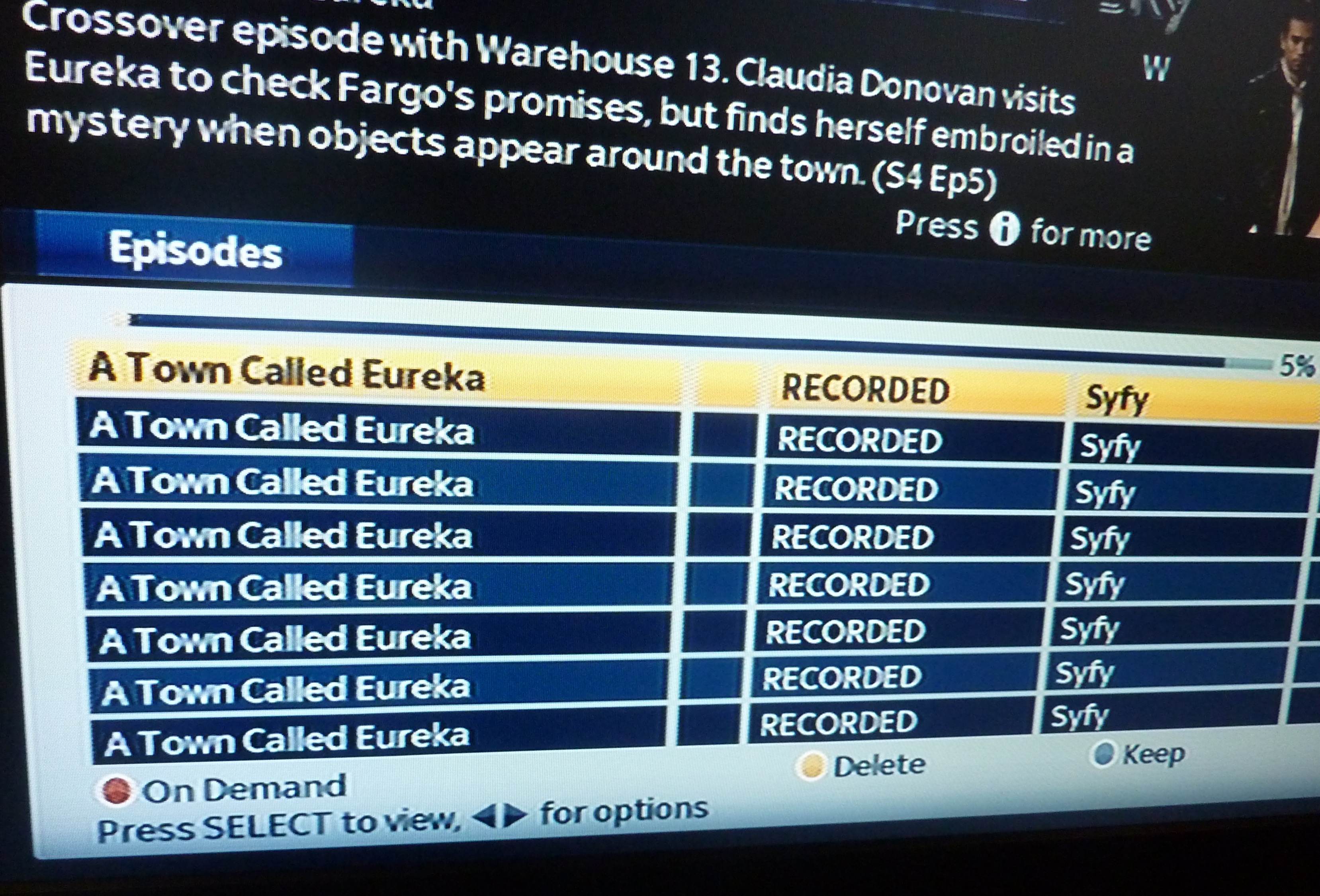
A brief outline of the show is that US Marshal Jack Carter comes to Eureka with his daughter Zoe to investigate a death. He ends up staying on and becoming Sheriff (obviously, there would be no show otherwise) and has to deal with all the sci-fi mishaps created by this town full of genius (and often mad) scientists.
Just a couple of stand out episodes today (I don’t think I’ve watched it enough times to pick out tons though I’ve enjoyed each one).
H.O.U.S.E Rules – Season 1 Episode 11
When Jack considers leaving his house S.A.R.A.H (thanks to imdb for telling me this stands for Self Activated Residential Automated Habitat) decides otherwise. Not letting you go Jack. This show definitely has a knack of warning us about an over-reliance on technology (*cough* should listen *cough*).
Phoenix Rising – Season 2 Episode 1
I like this because it has an Occupational Therapist mentioned in it. It’s a pity they get spontaneously human combusted before the credits though!

A picture from my tumblr blog of the little OT pile of ash
And a quick nod to Eerie Indiana

This only got one season between 1991 and 1992.
I strongly remember an episode where a set of twins were kept in Tupperware – this was actually the first episode called Foreverwhere. A lot of the episodes were equally as random, often fun but definitely eerie.
Are you a fan of either of these shows?
What potential scientific discovery would you like to see? What one scares you most?
Share this on Facebook, Twitter and Google+

D is for… Dialogism: Bakhtin and his world (Book) #AtoZChallenge
D is for… Dialogism: Bakhtin and his world (Book)
I thought I would use this challenge to remind myself why I had bought a few of the books on my bookshelf. Knowing that I wouldn’t be able to read whole books I decided scan reading and providing an overview of each on my A to Z list would be sufficient for now; providing me with a synopsis I could return to.
I bought Dialogism: Bakhtin and his world by Michael Holquist (New Accents series) after attending a session at BU led by someone from the media school. It sounded interesting, possibly relevant and I remember Bakhtin was one of the theorists who cropped up a few times when I was studying for my OU degree in Literature. I bought this book (originally published in 1990) for my Kindle (2002 edition).
I started scanning and reading and quickly I got lost. I was confused and the words on the page didn’t all seem to make sense when combined. I felt stupid – I believe this is a feeling that will occur again on my PhD journey. Occasionally though there was a glimmer of hope and I was highlighting sentences, sometimes even whole paragraphs that I understood and thought could be useful.
I guess the fear is that is where I could stop – only using that which makes sense – in terms of understanding, and with reference to my worldview. I have to be cautious to push myself further – push myself back. Theorists refer to other theorists and so it goes on. I feel I need to make myself a timeline – distinguish how Bakhtin relates to and differs from Kant, Heidegger and the like (names mentioned in this book). Believe me I’m already lost in a sea of names that sound familiar but that I can’t automatically place.
Anyway back to a very brief synopsis of this book and why I think it might be relevant:
Clearly it refers to the idea of writing (particularly the novel) as being a dialogue and one that is context driven. I can’t tell you how much this links to my distrust of learning literature at school – “just read the words” and then the more satisfying experience at university – “yes it is ok to understand the social, political, historical and personal contexts of when the words were written”. Dialogism also refers to a ‘multiplicity’ of perception – again acceptance that opinions and perception will be different.
The book talks about relations (this is becoming more important to me and the direction I am taking) – between an author and their heroes for one, and even goes as far as referring to novels being able to actively shape cultural history. A quote from the book ‘In dialogism, literature is seen as an activity that plays an important role in defining relations between individuals and society.’ (Location 1692 in the kindle edition).
It mentions intertextuality (which I have another whole book on – see the letter I post to come).
Generally this appears to discuss language and books with less discussion for example about what this all means for the author/writer – that is something that I hope to explore.
And that’s it – all I seem to have understood (?!) at the moment. I think this is a book to come back to when I’ve grown more brain!
How do you best tackle books/articles that you just don’t get on a first read, especially if you think you need to understand them?


 kirstyes