Category Archives: Occupational Therapy
A Creative Controversy…
I have recently joined Pinterest and was exploring the site for some images to pin to my ‘Words to Live By’ Board when I came across this image on creativity – I was close to repinning (some of these words may mean nothing to you as they didn’t to me a bare week ago) when two statements in particular stood out as ones I did not believe in at all. They’ve kept me up late to writer this blog post. I’ll let you look at the poster and see if you can pick them out.

Now, you may not have identified the same two as me or may even have identified more. I think perhaps many of the statements could be seen as limited and, although they can be true when applied to creativity, they aren’t the only ways to define it. I do wonder if the author of the original poster was thinking about pure artistic creativity when creating this?
I know of at least one person who agrees with me as they immediately responding when I posted this on Facebook identifying the very statements that had vexed me. And so, because I know you are itching to know if you agree or disagree with me:
1. I do not believe that ‘Creativity is something that some are blessed with & others are simply not.’
Yes, there are people who appear to be blessed with creativity and can be creative with words or paints or a camera or…. but that is a somewhat narrow definition. What about the person who is the only one to notice that someone is in trouble and reaches out by simply saying hello?
Creativity can be expressed in our daily lives and potentially in everything we do; from trying a new toothbrushing technique to improvising with breakfast when the milk has gone sour, to an idea springing from a problem we’ve never encountered before even when we don’t think we’ve ever had a good idea in our lives.
Is creativity always a good thing – is it always a blessing? For me (and I think I am quite creative) sometimes the ideas become too overwhelming because I don’t have enough time to implement them or because there are things blocking me translating ideas into reality, sometimes a fear of doing something wrong or not perfectly.
In relation to the issue of time perhaps I could share my ideas more and allow someone else to jump start their own creativity, sparking off mine.
In relation to the blocks – some are personal things that I need to work to overcome and others are I think are societal – thinking that there is only one way to do something and not always accepting that won’t work for everybody – expecting the person and not the process to conform.
2. I do not believe that ‘Creativity is something that cannot be taught.’
If I did believe this I’d be in the wrong profession!! (Both of them – Lecturing and Occupational Therapy I think are all about this). Maybe it’s the word teaching which can sometimes be considered didactic – “You will be creative today”.
I certainly believe that the learning of creativity can be facilitated. I see this in our students (and have seen it in myself).
Another pin I spotted may help to shed some light on this:

Moving to this type of ‘grey’ learning or thinking I believe comes with age and/or experience – Jean Piaget’s stages of cognitive development ‘stopped’ at the formal operational stage which was suggested to be reached at 11+ . This stage is where people ‘can think logically about abstract propositions and test hypotheses systematically. Becomes concerned with the hypothetical, the future, and ideological problems’ – Atherton, 2011).
For me there is too much focus on logic here which often relies on rules or absolutes.
Kramer et al (1992 cited Santrock 2006) described ‘Postformal’ thought as that which ‘involves understanding that the correct answer to a problem requires reflective thinking and can vary from one situation to another, and that the search for truth is often an ongoing, neverending process. Postformal thought also includes the belief that solutions to problems need to be realistic and that emotion and subjective factors can influence thinking.’ (I have this in quotes because I can’t quite remember if I paraphrased this so this may not be the exact words).
School teaching appears to, in a lot of ways, rely often on logic or rules or rights and wrongs and a number of students when they come to university want to know what is the right answer – most often there isn’t one. Yes occasionally there are wrong aspects but I genuinely believe that in my profession there are many ways to do something ‘right’.
I would hope then that by focusing on skills such as problem solving, critical appraisal, clinical reasoning (from many different viewpoints) etc as well as ‘teaching’ content and knowledge, and allowing opportunities to apply knowledge using those skills developed, that students can approach things creatively and that they in turn do this with clients.
I don’t know much about the Montessori Method but from what I’ve read I think this is a method designed completely to foster creativity and love of learning from an early age. I know there are devotees and critics of this approach but what is clear is that state schooling certainly doesn’t work for everyone. I think I’d like to see slightly less focus on a formal jam packed curriculum for youngsters and some more exploratory time filtered back in.
This exploring shouldn’t stop when you are young. Play is the way children learn – there is no reason adults can’t continue to learn this way too. By simply trying new things, learning and developing new skills and knowledge I think this enables the development of creativity. You do have to be prepared to step outside your comfort zone and feel challenged to reach this though.
Whilst performing a quick search on this topic I came across this website – Creativity for Life – that has lots of activities and suggestions for thinking and acting creatively – why not try some of them out.
I hope I made it clear why I singled those two statements out and I think some of what I’ve said supports the other statements that I do agree with on the whole.
I’m going to leave it there but may well come back to this topic again as I am fairly sure it will be something that I will be exploring as part of my research and if not it’s something I’m interested in anyway.
I’d love to know:
- whether you agree or disagree with me?
- whether you’d add any statements to the poster?
- whether you’d remove or revise any of the others?
- whether you’ve had much experience of the Montessori method or your thoughts about your own or your children’s schooling?
- what has developed your own creativity?
- Anything else that you’d like to add I’d love to hear it.
References
Atherton J S (2011) Learning and Teaching; Piaget’s developmental theory [On-line: UK] retrieved 17 February 2012 from http://www.learningandteaching.info/learning/piaget.htm
Crafty Charity Calendar Challenge to Celebrate World OT Day
Well Hello on this warm Summery October’s Eve!!
I have some very crafty friends and, inspired by them, I have just decided to set all my blogging readers a challenge to help me celebrate World OT Day (World Federation of Occupational Therapists (WFOT)) which is 27th October 2011.
I would love everyone, OTs, writers, friends, bloggers etc to join in please – I will too.
The challenge is this:
1. To design an ATC that celebrates an aspect of Occupational Therapy.
If you don’t know what an ATC is please see my good friend Catherine’s blog post on ATCs (you can see some fantastic examples of ATCs on her blog too – Catherine hoping you take part – hint hint).
If you aren’t too sure what Occupational Therapy is check out my earlier blog post or any of the blog links under the Occupational Therapy category.
2. Once you have done this take as high a resolution photo as possible of your ATC and put it on your blog or on Twitpic or similar if you don’t have a blog (Please don’t use any Copyrighted images on your ATC otherwise we won’t be able to use them for the Calendar – see below)
3. Then comment on this post (I will add my ATC at the top when it has been completed) adding in the URL for your blog post as ‘your website’ so that when people click on your name they get taken to your post. Please do this by the end of 26th October 2011.
4. If we get enough of them my plan is for everyone to vote for the top 12 and to create an OT 2012 calendar to sell for charity (The top 12 will be featured pictures to be used on the front cover and 1 for each month of the year though I hope to use as many pictures as you are happy to let me to have around the featured pics).
I would be wanting to support the Friends of Forest Holme local charity who have been supporting my Auntie through her battle with cancer and who do fantastic work in our local community.
Please do consider joining in – let me know below if you plan to and please spread the word.
Thanks
Kirsty
(Please note that this activity is not currently endorsed by WFOT or Friends of Forest Holme but I am seeking their permission to use their logos on the Calendar – Update – I have permission from both to use their logos on the finished product and if the calendar goes into production I will sign a fundraising deed with the charity).
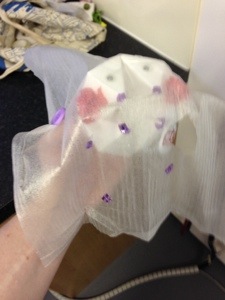
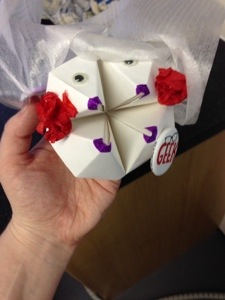
Here is my completed ATC (I need to take a better picture for the actual calendar) – check out the links in the comments below too and don’t forget to link to yours below & tell me if you plan to make one. I’ve received a couple of pictures via Twitter that hopefully will be added here in due course.
COT Conference 2011 (#cot2011) – Brighton
Yes people it’s that time of year again. I went to my first COT annual conference and thoroughly enjoyed it. I presented a seminar on CPD and e-portfolios.
This year I am presenting a facilitated poster discussion (session 46) and in a session on creative occupations (session 53) both on elements of my early PhD literature research (I am currently suffering from severe information overload).
For your tweeting pleasure I present below a list of the sessions I am attending.
| Day/Time | Session No and Title |
| Wed (10.00-11.00) | Opening Plenary – Occupation, evidence and outcomes |
| Wed (12.45-14.25) | Session 7 – Life Stories: use of the Kawa model in a role-emerging setting |
| Wed (15.00-15.45) | Session 35 – Tribalism or collectivism: debating generic vs specialist OT and what this means |
| Wed (15.40-16.40) | Session 46 – My poster discussion – Occupational therapy in practice session |
| Wed (-18.00) | BAOT/COT Annual General Meeting |
| Wed (18.00-18.45) | Twitter Meet up |
| Thu (8.30-10.00) | Session 53 – Creative Occupations (Me) |
| Thu (10.40-12.20) | Session 77- Movies that matter: films as learning activities to engage student’s ethical reflexivity |
| Thu (12.30-13.30) | Kawa Pebble beach meet up |
| Thu (13.55-15.10) | Plenary – Elizabeth Casson Memorial Lecture by Prof Anne Turner |
| Thu (16.00-16.45) | Session 106 – Occupational Therapy Education: an appalling paradox |
| Thu (16.50-17.35) | Session 114 – Responding to reviewer’s comments: the final hurdle of peer review |
| Fri (9.00-10.40) | Session 122 – New Ways of thinking |
| Fri (11.20-13.00) | Session 144 – Occupation and Older People |
| Fri (13.00-13.40) | Final plenary – Occupational Therapy saved my life |
Here’s a link to the Conference programme for more information and to the COT’s annual conference page where there is even more detail of the sessions.
Now, I am going to try and live tweet during the sessions that aren’t too interactive and where I’m not presenting but we have a slight problem. The Brighton Centre doesn’t supply free wifi (I was spoilt at the UDMH conference as Bournemouth Uni has free wifi across both campuses) so I won’t be able to use my iPad to tweet (quick and easy) and will instead have to use my phone (currently slowish and with poor battery that gets eaten up by connecting to 3G). Now COT did kindly find out arrangements for purchasing wifi access but the cost is prohibitive as I am pretty sure I’ll need over 4 hours access across the 3 days (£9.99) and 24 hours access is £39.99 – eek. My hotel also has a similar pricing structure so you may have to wait until the evenings for some key points tweets as I did last year with some more substantial blog posts when I get back to wifi.
Now it’s late and I still need to read through my presentation in a dry run and pack.
Please take a look at the sessions I’m attending and if there is anything specific you’d like me to listen out for/ask add a comment below.
Tweeting from #UDMH2011 a CPD opportunity for me and #OT ?
Today I attended the new University Department of Mental Health’s first conference: ‘Engagement in Life: Promoting Wellbeing in Mental Health’ and I was inspired and frustrated in equal measure. The buzzword used throughout was recovery and it was highlighted that this word often means different things to clinicians and service users. For example with anorexia nervosa, recovery is often measured by clinicians in terms of weight gain, restarting menstruation etc when for a number of service users weight gain has been and is still is associated with failure (see tweets from Ciaran Newell’s session). The service user turned peer support worker who opened discussed a plateau in recovery when without having something to do symptom relief alone is all but meaningless (my analysis). This also links to the ideas of the perils of recovery, something that is often under acknowledged which may lead to lower recovery rates. Now I’m not going to rehash everything that I heard here because I live tweeted during the conference sessions. A lone tweeter on this occasion. I used the hashtag #UDMH2011 so please search out this on twitter or a collation sire such as whatthetrend.
So, what did I find inspiring. Terry Bowyer’s eloquently presented story of his path to recovery and the fact that all of the presenters after him showed that health professionals are finally getting and acting on this message about the importance of working towards what the client sees as important and giving them hope that things will change.
But what was frustrating is that as Occupational Therapists this has been our guiding philosophy for years so why is it not us leading this debate? It was a nursing researcher colleague of mine who has worked with OTs in the past that asked in one of the concurrent sessions can the suggestions from CHIME and REFOCUS (see hashtag timeline for more detail and speaker info) not be mapped to occupational science models. Of course they can. Three elements of the REFOCUS model for example were ‘Understand Value, Assess Strengths and Support Goal Striving’. Immediately I can see that CMOP-E, MOHO, KAWA and the new to me Model of Creative Ability (http://www.otstudent.info/home/models/model-of-creative-ability) would all address this.
Take the CMOP-E (Canadian Model of Occupational Performance and Engagement) for example, which is was developed alongside CPPF (Canadian Practice Process Framework) and the CMCE (Canadian Model of Client-Centred Enablement) (Turpin and Iwama, 2011). A client’s spirituality (which includes their values, beliefs, desires etc) is as the centre , the person is assessed in terms of both their deficits and strengths in relation to Affective, Cognitive and Physical Skills (along with their environment and their occupational performance in self-care, productivity and leisure activities. Goal setting is something to be agreed between client and therapist and if using the COPM tool (Canadian Occupational Performance Measure) they re framed under occupational performance headings rather than symptom related ones (Turpin and Iwama, 2011).
So the question remains, why when our theory and philosophy matches current thinking in Mental Health care are we not leading this revolution and how now can we ensure that our role is recognised and valued during the ongoing process of proposed NHS reform. Of course recovery depends on health professionals working together son we need to highlight our profession’s unique role in this process. There are no clear cut answers and I’d be interested to hear your views but here are some of my personal suggestions.
Encourage explicit implementation of occupational therapy models in practice (whichever works best for your setting or indeed each individual client). Share this with your MDT colleagues.
Research, publish and disseminate not only at OT conferences but setting related or medical or at any conferences where we can raise the profile of our profession (I need to take note of this to).
Promote, promote, promote OT, talk about it whenever you have an opportunity to anyone and everyone you meet.
As a lone tweeter did I feel I wasted my time? It’s true I got a little hand cramp and I’m not going to lie it is hard to multitask and I inevitably lost the track of the talks at times. But I have followers who aren’t OTs and hopefully something will have made its way into their consciousness whilst scanning my tweets. After all societal stigma and misunderstanding of mental health conditions is one of the challenges to recovery. But what tweeting did was make me think about what were some of the key messages and summarise these into concise 140 character tweets (minus the characters needed fir #UDMH2011). I can now go back and collect these tweets as a lasting record which is far more legible than my handwriting.
Now as the HPC audit of CPD fast approaches I would like to ask my Twitter/Blog/Facebook followers or friends a favour. If you’re not an OT I hope you didn’t find the influx of messages too annoying, can you tell me if you learnt anything or if anything struck you on reading/scanning the tweets?
If you are an OT, for a CPD activity for your own audit, either having already read the timeline for #UDMH2011 or taking the time to review it now, reflect on what you learnt or picked up that you might be able to implement in your practice, what insight it gave you to making sense of past experiences etc. Please share them with me in the comments in the blog being sure to maintain confidentiality (I moderate comments and will not approve comments that break this so no patient identifiable information). I look forward to seeing some of your responses to the key messages from the sessions I attended.
I will be live and delayed tweeting/blogging from both the College Of Occupational Therapists conference 29th/30th June/1st July and the Occupational Science Conference in Plymouth on 8th/9th September. Before these events I will put up a timetable of the sessions I am attending so you can follow my tweets on those you are interested in.
Sadly the COT session on tweeting was cancelled but if you were planning to attend session 115 and you are interested in meeting up informally please let me know.
Thanks for reading and hopefully reflecting, even if it’s only on one or two points.
Kirsty
Reference
Turpin, M. and Iwama, M. K. 2011. Using Occupational Therapy Models in Practice: a field guide. Edinburgh: Churchill Livingstone/ Elsevier.
Useful Resources
100 ways to support recovery http://www.mentalhealthshop.org/document.rm?id=8914
REFOCUS project http://www.researchintorecovery.com/refocus/refocusprogramme.html
S is for… (#atozchallenge)
S is for…
Studying
I have a confession…I love learning.
It’s good to get that out; I think it’s an addiction. I know that there are others of you out there.
I went to a Grammar School and I’m not convinced that it was there that inspired me. In fact when I was applying to university one course told me to take a year out and I decided not to because I didn’t think I’d be able to get back into learning if I’d had time out (ha, little did I know). It obviously helps when you are learning things that interest you and I still have examples of school projects where clearly I had been engrossed in the subject. I really enjoyed Sociology at A-Level and won a school prize for it. I studied English and did consider dropping it because I felt we were told to concentrate purely on the words of a text without always considering context.
I do, however, have a tendency to be a little flighty and get more excited about my next course or the next topic to learn. I was initially going to complete my dissertation at uni on autism but then on my mental health placement came across a young man who had drug induced psychosis (caused by cannabis consumption) so I applied to change my topic.
In 2004 I decided that I wanted to go back to study and enrolled on a few Open University courses, An Introduction to the Humanities and Start Writing Fiction and Start Writing Poetry. I was hooked. I then completed: Approaching Literature, Start Writing Plays, Perspectives on Leonardo da Vinci, Creative Writing, Advanced Creative Writing, 20th Century Literature: texts and debates. I got my first class BA (Hons) Literature in 2009 and had to hold myself back from signing up for another course, they have one on Children’s Literature where you can study Harry Potter and the Philosopher’s Stone!! (I did have a year out in 2006-7 to complete my PG Cert in Health and Social Care Education when I started my new job lecturing).
I’m now working towards a PhD and am finding the lack of deadlines challenging (I did sign up to the Writer’s Bureau course years ago and never finished because I didn’t have set deadlines). My supervisor has just suggested one though so hopefully that will push me to stop floundering and get on with it.
Academia then is actually a pretty good place for me to be, I really enjoy attending conferences and seminars and training sessions at work, always coming away with ideas but sadly not enough time to implement them all. I find this frustrating because my body can’t keep up with my mind, and there are only so many hours in a day. I think if I didn’t have to earn money I’d make a good eternal student, alongside my writing of course.
I have always been a strategic learner and learnt with a specific purpose, e.g. To write an assessment or to write a lecture to deliver. I need to set myself goals to work toward otherwise I don’t get anywhere.
I hope that my love for learning comes across to my students and that I inspire them to want to read more and find out more than I tell them. One of the biggest skills I learnt distance learning with the OU was that you need to learn yourself and that as you grow older it is less about being taught and more about picking up a book and reading and applying it to what you know or what you see around you (maybe that’s why although I enjoyed school it didn’t completely grab me then). I think that’s probably why yesterday’s topic of reflection appeals to me too, because it is generally a self managed process.
My learning plans
My friend Stacey has completed some Science courses with the OU and she mentioned a course introducing Forensic Science. As my NaNoWriMo novel is a police story I am sorely tempted to sign up. The next presentation starts in May and there is some flexibility about when you complete it (in 6-8 weeks or 5 months). I just need to check if I’ve got enough Tesco vouchers to help pay some of the cost.
I have a few conference presentations coming up and plan to write journal articles on the topics I will be presenting on so that’s going to be a lot of reading and learning.
I would love to learn how to play the guitar
I would love to learn how to paint
I keep putting off the above two because they are ‘physical’ skills, something that you have to learn to do rather than understand. I know that they will be more difficult for me but I still want to try.
I want to keep learning about writing, I’m going to do that by doing it.
What are you/do you need to be learning at the moment?
Does a love of learning start in school or after? What was it that inspired you? Or turned you off?
R is for… (#atozchallenge)
- R is for…Reflection (and Referencing)
Following on from my C is for… Continuing Professional Development post today I will be discussing a method of CPD that is free – reflection.
If someone asked you to describe your face you might mention eye colour, hair colour/length etc. This is basic description and if you gave that information to someone you were due to meet they might find you difficult to pick out of a crowd.
If you did this whilst looking in a mirror, you might be able to give more specific, distinguishing features, a mole you had forgotten or a scratch that until then you didn’t know you had. You might also then start thinking about how you could have received the scratch, evaluating what you had been doing.
Reflection that enables learning comes from really putting something under the microscope, examining and re-examining it. Reflection should lead to understanding, insight, and goals for development. You might decide, based on ‘research/evidence’ (e.g. that acrylic nails don’t appear to scratch), that you need a manicure!
Reflection or looking at a situation in detail is used widely by health and social care professionals to inform personal and professional development, to learn from events and situations and to make links between theory and practice. When people first start reflecting there may be a tendency to purely describe an event but there is a need to move beyond this to ‘unpick’ what has happened and make conclusions and future action points.
Critical Reflection – some quotes
Critical reflection is: – “using the reflective process to look systematically and rigorously at our own practice.”
And using reflection “to learn from our actions, to challenge established theory and, most importantly, to make a real difference to our practice.” (Rolfe et al 2001, p. xi).
“Emphasis is placed on WHY something happened and an investigation of the issues involved, not on a purely descriptive account of what or how it happened.” (Brown and Rutter 2005, p. 8).
“Reflection aids and enhances deeper learning as it makes us aware of what happened during an experience and helps us make connections with what we already know.” (Brown and Rutter 2005, p. 13).
“We need to reflect not just on the content of the situation but also on our thoughts – those which underpinned judgements and decisions – and also the way we arrived at those thoughts – the processes underpinned by our abilities and values.” (Brown and Rutter 2005, p.13).
“Reflection on some experiences may go even further and change deep or personally held beliefs, assumptions or inner values. If this happens you may need the extra support of someone you trust to help you deal with it.” (Brown and Rutter 2005, p. 22).
Ways to Reflect
Critical reflection and writing are linked. According to Moon (1999 cited Brown and Rutter 2005, p.14), writing:
• Forces us to spend the time
• Helps us focus and sift material by slowing us down
• Forces us to organise and clarify our thoughts so we can sequence them
• Gives us a structure
• Gives control – we choose which points to make – enables identification and prioritising of material
• Helps us to know if we do understand something by attempting to explain it
• Can help a deeper understanding of something as we work through it and explain it
• Can record a train of thought and relate it to the past, present and future
• Can initiate new ideas, connections, questions etc.
Use of structured models of reflection
These take you through events step-by-step aiming to draw information out of you that leads to critical reflection. Often reflective models are used ‘after the fact’ especially when a situation has not gone to plan. It is however, also important to review events when things go smoothly too, to evaluate why and allow successful repetition.
Click on the links or locate the references below to find out more about each approach.
Kolb’s Reflective Cycle (1984) – Concrete experience, reflective observation, abstract conceptualisation, active experimentation.
Gibbs’ Model (1988) – Description, Feeling, Evaluation, Analysis, Conclusion, Action Plan.
Johns’ Model (1996) – A series of questions to answer
Rolfe et al (2001) What? So What? Now What? – questions to consider under each of the three heading
Schön – Reflection in action/Reflection on action (1984) – Schön distinguished between reflection in action and on action with the first being ‘spontaneous, skilful execution’ within a situation and the latter being stepping back and explaining the execution.
More recently I have discovered Boud and Walker’s three stage model of reflection (1990) cited in Jackie Andrews (2000) BJOT article where she demonstrates use of this model. In contrast to many of the other models situations are selected for reflection prior to them occurring. The practitioner then completes preparatory reflection and follows this with reflection in action and reflection on action (as Schön previously suggested). This example shows how supporting references and links to literature can be made to enhance the depth of reflection and make links between theory, research and practice. I strongly suggest reading this article to see how she applies the model.
Additionally you could use more creative strategies for evaluating a scenario (Rolfe et al 2001):
- Writing the unsent letter
- Writing to another person
- Writing as the other
- Story telling
- Poetry as reflective writing
- Audio recording reflection
- Video recording reflection
- Reflecting with others, e.g. Peers in a workplace or even through the use of social media
- (It is important to maintain confidentiality at all times when documenting and sharing reflections and that no client identifiable information should remain. It is also advisable to only mention the clinical area you were working in and not name specific workplaces and colleagues to protect them also).
- Andrews, J. 2000. The Value of Reflective Practice: a Student Case Study. British Journal of Occupational Therapy, 63(8), 396-398.
- Brown, K. and Rutter, L. 2005. Critical Thinking and Analysis: A guide to enhancing Reflection, Learning and Writing for Post Qualifying Social Work Programmes. Bournemouth: Institute of Health and Community Studies, Bournemouth University.
- Gibbs, G., 1988. Learning by Doing: A Guide to Teaching and Learning Methods. Oxford: Further Education Unit.
- Johns, C. 1996. Using a Reflective Model of Nursing and Guided Reflection. Nursing Standard. 11( 2), 34-38.
- Kolb, D. 1984. Experiential Learning experience as a source of learning and development. New Jersey: Prentice Hall.
- Rolfe, G., Freshwater, D. and Jasper, M. 2001. Critical Reflection for Nursing and the helping professions: a user’s guide. Hampshire: Palgrave.
- Schön, D. 1983. The Reflective Practitioner: How Professionals Think in Action. London: Basic Books.
Reflective statements on your CPD evidence
Not all evidence in a CPD portfolio needs to be a written reflection, you may include evidence on you from other people, examples of leaflets you have developed, assessments you have completed, etc. For each piece of evidence in your CPD portfolio ensure you know WHY you have included it and HOW it affects your DEVELOPMENT. Try to make this clear to the anyone who might read your portfolio. You can use brief reflective statements on the evidence itself, e.g.
• I chose to include this because it demonstrates that I have…
• I was really happy with this because…
• I think this shows my development in (type of skill) because…
It is important to recognise that reflection is a personal thing and you will not want to (and indeed it may not be appropriate to) share all reflective writing you complete. You may just highlight a few key points to share.
References
Please share your comments/questions; I hope this has been a helpful post.
Q is for… (#atozchallenge)
Q is for…
Quintessential
I love this word because it is so fun to say. According to the Oxford Dictionary of English (2003) it means: ‘representing the most perfect or typical example of quality or class.’
I think it can be used colloquially to suggest indicators that are typical of a particular person or group of people. I’ve most heard it said in relation to something being quintessentially British.
And because quint relates to 5 I would like to know from you, any of the following:
Five indicators of the quintessential writer
Five indicators of the quintessential occupational therapist
Five indicators that are quintessentially you
My 5 quintessential Kirsty indicators are:
- I am always, at least, 5 minutes late to everything
- I am always blowing my nose or sneezing (especially in the last two weeks)
- I talk with my hands and make odd gestures to represent what I’m blathering about (you turn the gas down – anyone?)
- If I stay anywhere overnight I don’t come alone
- I am glued to my gadgets
(those of you who know me would you agree or is there anything else that is quintessentially me?)
Looking forward to your quintessential quintessentials!