Blog Archives

Letters to the Lost by Bridget Kemmerer – Book review
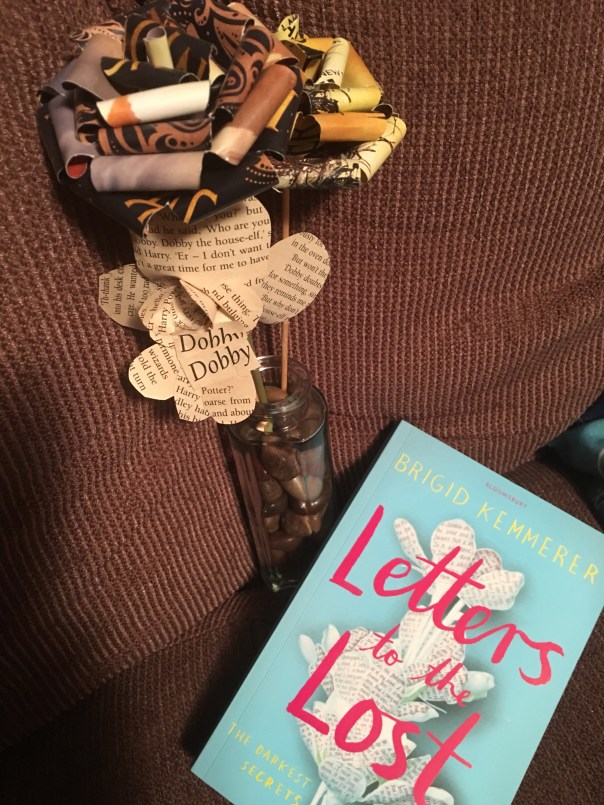
On Wednesday I’m part of the Bloomsbury Spring Titles blog tour and I will be reviewing the follow up to Letters to the Lost – More Than We Can Tell. I’ve heard you can read the books as standalones but I’ve had the first book on my shelf for ages so wanted to pick that up first.
And I am very glad I did. Now I’m not a big romance reader with regards Adult Fiction but throw me some YA Contemporary Romance and I get the gushies. I find contemporaries so much quicker to read than the sci-fi/fantasy books I usually go for so I’d highly recommend if you’ve hit a bit of a slump and want a pacy and emotional read.
This romance is fairly complex. Juliet writes letters to her dead mother which she leaves on her grave. One day she gets a response to her letter – from a stranger.
At first she is so angry and, rightly so – her privacy has been violated. So she writes back telling the mysterious author what she thinks of them.
Soon the pair of them come to realise that the other person they are communicating with share similar feelings of loss and anguish and eventually they share e-mail addresses and start chatting about life, the universe and everything.
But little do they know that they’ve actually already met in real life, and they really don’t like each other.
Declan thinks Juliet is a preppy snob and he’s known as the school’s most likely to end up in prison, after all he’s already doing community service.
Author Bridget Kemmerer creates two troubled teens searching for meaning, finding it in each other but being scared to take that next step. As an occupational therapist I also liked how the author explored the meaning people find in doing valued occcupations and the loss they feel when they are prevented from taking part in them.
There’s a shock twist towards the end of the book that I can’t help but wonder how their relationship would play out if the author had chosen to pick the alternative. We would have needed a much longer story to play that out and I was satisfied with the ending but left pleased with the knowledge that we get to delve into Declan’s best friend Rev’s back story in the follow up. Come back on Wednesday for my stop on the blog tour to read what I thought about More Than We Can Tell and check out the other blood tour stops reviewing three of Bloomsbury’s Spring titles.

Share this on Facebook, Twitter and Google+

The Artie Conan Doyle Mysteries Series So Far – Book Review
Yesterday was my stop on the Blog Tour celebrating the release of the second book in the Artie Conan Doyle Mysteries series. Check out the guest post by author Robert J Harris here.
Arthur Conan Doyle is the author of Sherlock and in this middle grade series he is imagined as a young boy having a series of adventures that will later lead him to write his infamous detective series. There are two books in the series so far with more to come.
Book 1 – The Gravediggers’ Club
A ghostly lady in grey.
The paw prints of a gigantic hound.
This case can only be solved by the world’s greatest detective.
No, not Sherlock!
Meet boy-detective Artie Conan Doyle, the real brains behind Sherlock Holmes.
With the help of best friend Ham, Artie discovers the secrets of the Spooky Gravediggers’ Club.
Can Artie solve the mystery – or will his first case be his last?
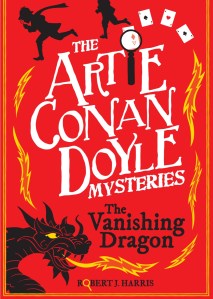
Book 2 – The Vanishing Dragon
A world-famous magician.
A sabotaged illusion.
This case can only be solved
by the world’s greatest detective.
No, not Sherlock!
Boy-detective Artie Conan Doyle, the real brains behind Sherlock Holmes, is once again investigating the impossible.
With the help of best friend Ham, Artie must reveal the secret of the Vanishing Dragon and unmask the villain.
Can Artie solve the mystery – before it’s his turn to disappear?
What I thought
These were a lot of fun and very much in the vein of a couple of other series I have read recently – Robin Steven’s Murder Most Unladylike and Chris Priestly’s Maudlin Towers. It also reminds me of series such as Nancy Drew, The Famous Five and The Secret Seven that I read when much younger.
In the guest post yesterday author Robert said he didn’t want Artie to simply be a young Sherlock and Artie is definitely learning to develop skills of logic and deduction but relying a lot on guesswork and jumping to conclusions.
Despite some wrong turns he perseveres and is determined to solve the mysteries which he does, in the first book mostly with his friend Ham, but in the second with some help from other people too.
Both stories are set in Edinburgh and Robert makes excellent use of the setting – from Greyfriars Cemetery to underground streets. There are also more than a few nods to Sherlock to keep older fans amused. I really should read them but I got enough references from the many tv adaptations I’ve seen.
I slightly preferred the second book because of the magic tricks and theatrics and the introduction of Rowena who is although a little annoying to the boys, is a welcome female addition, and more than proves her worth.
I felt for poor Ham whose love of cake is often ridiculed but loved how that also became a useful plot device in the first book.
As someone who is an advocate for representation of mental health issues I was impressed by the focus on Artie’s father’s depression and the impact this has on both him and his family. I look forward to the continued exploration of that.
As for future developments I’d love to see more of Rowena, and also Artie and Ham’s boarding school would be a welcome setting for one of their adventures.
I would highly recommend this to the target age group and if you are a fan of Sherlock see if they’ll let you keep them for bedtime stories as you will be sure to enjoy the nods to stories such as Hound of the Baskervilles.
Thanks to Floris books/Discover Kelpies for The copies of the books I received for the purpose of this honest review.
Share this on Facebook, Twitter and Google+

Being Miss Nobody by Tamsin Winter – #YAShot2018 Blog Tour
Happy International Women’s Day everyone.
Today I’m pleased to be hosting an interview with author of Being Miss Nobody Tamsin Winter as part of the blog tour for #YAShot2018.

YAShot is the brainchild of author Alexia Casale and is a one day book convention taking place this year on April 14th. The theme for the programme this year is Human Rights and Being Miss Nobody is a perfect selection.
Synopsis
I have not been a very nice person
I have lied to a lot of people I know
I have done some bad things
All of these things I have done pretty much deliberately
…I am Miss Nobody.
Rosalind hates her new secondary school. She’s the weird girl who doesn’t talk. The Mute-ant. And it’s easy to pick on someone who can’t fight back. So Rosalind starts a blog – Miss Nobody; a place to speak up, a place where she has a voice. But there’s a problem…
Is Miss Nobody becoming a bully herself?
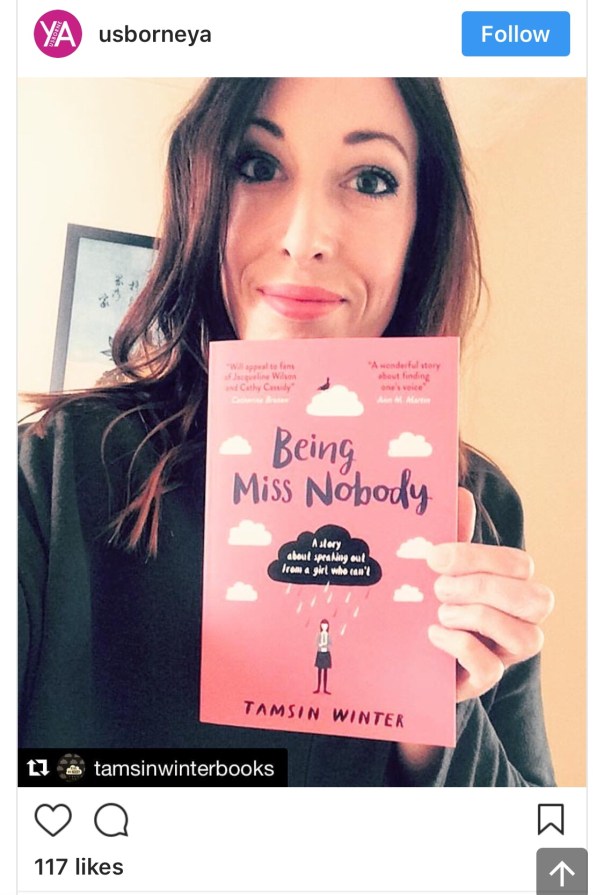
Interview with Tamsin Winter
What is selective mutism?
Selective mutism (SM) is an anxiety disorder which makes it very difficult or impossible for someone to speak in certain situations. In Being Miss Nobody, Rosalind can speak completely normally in front of her immediate family, and her slightly batty next door neighbour, Mrs Quinney. In front of anyone else she can’t say even one word.
What is the worst thing about having it?
Not being able to ask for help, not being able to make friends, not being able to express yourself freely. SM is a condition which makes so many situations incredibly difficult. During my research for Being Miss Nobody I read about a young girl with SM who broke her arm at school but was unable to tell anyone, and nobody noticed she was in pain. For Rosalind, the worst thing is the terrible bullying she experiences at school. She is known as the weird girl who can’t speak and, because she remains silent, the bullying goes (mostly) entirely unnoticed.
What is the most positive aspect of having it?
SM is an anxiety disorder which, believe me, is not very much fun! But, people who have anxiety are usually hyper-sensitive. I can remember being called sensitive like it was a bad thing, and I used to think so too. But now I don’t agree. Being sensitive means you have a high level empathy, that you experience emotionsdeeply, and that you know what it’s like to not find life very easy. An anxiety disorder is not exactly a party, but it isn’t a death sentence either. Living with a mental health condition can make achieving things really, really hard. But it doesn’t make it impossible. Rosalind finds an awesome friend in Ailsa, who accepts her condition, supports her and most importantly of all – shows her kindness.
One of our human rights is the right to freedom of speech and peaceful protest. How do you think Rosalind’s blog Miss Nobody fits into that?
For Rosalind, her Miss Nobody blog is the only way she can speak out about what’s happening to her at school. She names the bullies and exposes them for what they are. She reaches out to other people who are being bullied, and she tells everyone exactly how it feels to be a victim of bullying. But she does all of this anonymously. Social media can be a wonderful way of speaking out but, as Rosalind discovers, it can easily spiral out of control.
Another right is the right to education. What would be your top tips to teachers and fellow students on helping someone with selective mutism to access school life?
The first step when teaching or communicating with a child who has SM is always acceptance of the condition. Accept that your student or classmate may not be able to respond through speech, but provide alternative ways for them to communicate their thoughts and ideas. Do not put them in a situation where they are expected to talk, or put under pressure to talk, as this will only make them feel more anxious. Do not exclude them from discussions or group work, instead find ways for them to join in. You have to be creative and you have to find out what will work for the individual student in your class because obviously, they are all different. Rosalind is given a set of cards she can use to signal different things like she needs help, or she needs the toilet, but she finds it very hard to use them at first because she doesn’t want to draw attention to herself. She is given a notepad by her teacher which she uses to have silent conversations with her classmate Ailsa. Many young people with SM get excluded from activities, so it is important to involve them in the lesson and in conversations, but allow them to express themselves without speaking. The absolute most important thing is to show them kindness. Living with a mental health condition is really hard, especially at school. It makes an enormous difference when people are kind.
Obviously speaking up is a big theme of the book. Why was that important to you?
I’ve worked with so many young people who find it very difficult or even impossible to stand up and say what they think. It’s something I found extremely difficult as a teenager. I think we’ve all been in situations where we’ve been unable to speak up for ourselves but, for me, it is a crucial thing to be able to do. It’s important for friendships, for protecting ourselves, for showing people our true selves, for romantic relationships, for achieving what you want in your career, for sticking up for your beliefs and values. Speaking out takes an enormous amount of courage sometimes. But if you can do it, even for a moment, then you have the power to change your life.
Bullying is also a major issue in this book. What advice would you give to someone being bullied?
Tell someone you trust. Then tell someone else, and then tell someone else. Keep telling people until something is done about it. So many victims of bullying stay silent. It’s one of the ways bullies operate so effectively. I’ve read so many heartbreaking stories of bullying that ended in tragedy, and the question is always the same – why didn’t they tell anyone? People stay silent about being bullied for all kinds of reasons. They are scared it will get worse, they feel ashamed, they don’t think it will make any difference. We need to make it a lot easier for young people to speak out if they are being bullied.
And what advice would you give to someone who has realised they might be bullying someone else?
I don’t believe that anyone is born mean. I don’t think that bullies are happy, fulfilled people. I think there are some young people who have had hate poured into them, and it comes out in bullying behaviour towards others. If someone gets kicks out of being mean to someone, then they’re probably in a home environmentwhere they don’t get shown very much kindness. If you’ve realised that you’re bullying someone, then I’d suggest owning up and asking for some help. Your victims may not be ready to hear an apology directly, so the best apology is changing your actions. I hope Being Miss Nobody ultimately has a positive and important message about bullying. We always have a choice in anything we do, so we can always choose to be kind.
What I thought
I really loved this. Ironically Rosalind had a very strong voice throughout and she really went on a journey of development, but one with a realistic ending, where everything isn’t completely perfect.
I adored her brother Seb and once again thought that it was a wise decision not to have Rosalind’s selective mutism arise as a result of his ill health.
The power of social media to give people a voice is explored so well and is balanced alongside the notion that it can also be used to silence or speak over others. It’s a tool that can be used in many ways and I think this book does a great job of addressing how to use it morally.
Huge thanks to Tamsin for taking the time to answer the questions. Join her and a host of other authors at #YAShot2018 – http://www.yashot.co.uk/.
To win a signed copy of Being Miss Nobody (UK only – winner selected after Sun 11th 5pm). Post the following to Twitter with your own response to the …
Being Miss Nobody by @MsWinterTweets is about speaking up. I found my voice when … (#yashot2018, @kirstyes @yashotmediateam)


 kirstyes