Blog Archives
Artificial Wisdom by Thomas Weaver – Blog Tour Book Review
About the Book
SALVATION HAS A PRICE
It’s 2050, a decade after a heatwave that killed four hundred million across the Persian Gulf, including journalist Marcus Tully’s wife. Now he must uncover the truth: was the disaster natural? Or is the weather now a weapon of genocide?
A whistleblower pulls Tully into a murder investigation at the centre of an election battle for a global dictator, with a mandate to prevent a climate apocalypse. While a former US President campaigns against the first AI politician, is someone trying to tip the balance?
Tully must convince the world to face the truth and make hard choices about the fate of the species. But will humanity choose salvation over freedom, whatever the cost?
An enthralling murder mystery with a vividly realised future world, forcing readers to grapple with hard hitting questions about the climate crisis, our relationship with Artificial Intelligence and the price we’d be willing to pay, as a species, to be saved. Perfect for fans of Blake Crouch, Neal Stephenson, Philip K. Dick, Kim Stanley Robinson and RR Haywood.
About the Author
I write stories about tomorrow to help make sense of today.
Aside from writing, I’m a tech entrepreneur. My last startup was acquired by Just Eat Takeaway; my new one is still in stealth but backed by a major Silicon Valley tech accelerator. I also invest in multiple early-stage startups.
Despite all that, I never thought I’d use my degree in Computer Science. I left university to run the UK branch of one of the world’s largest student organisations before spending many years working on and building expertise in the evolution of physical environments, and in particular how tech could change the kind of experiences we have in schools, shops, theatres, council service centres and other places.
This all led directly to his tech startup in the restaurant hospitality space, transforming payment and ordering experiences, before pivoting to a platform to enable other technology to interface with the restaurant. I exited in 2018-2019 and realised I had no more excuses not to do what I always wanted to do: write fiction.
It’s Roald Dahl’s fault. When I was seven, I read the BFG. Remember the scene where Sophie reads the description of a dream of writing a book so exciting that no-one can put it down? Airline pilots are getting lost. Drivers are crashing.
I wanted to write that book. I want to write page-turners. If I achieve nothing more than giving one person the experience within the BFG’s dream, I’ll have succeeded. Hopefully without the car crashes, though. Despite swearing to friends and family (none of whom apparently believed me) that I’d never run another startup again, I recently started a new one focussed on bringing some of the ideas in Artificial Wisdom, my debut, to life, specifically around communicated in augmented reality.
In my spare time, I’m an avid father, husband and cook, and have a bunch of hobbies my wife claims makes me sound like I’m 80, including drawing, painting and chess. I collect more books than I have time to read, especially if they have beautiful covers, like Folio editions. I’m a sucker for great covers.
Follow me on Twitter @tom_weaver for my thoughts on where the world is headed.
Thomas R. Weaver
(from – https://thomasrweaver.com/about-thomas-r-weaver/)
What I Thought
Is Artificial Intelligence our salvation?
In this tense climate dystopia, humanity’s hope for survival is being pinned on one individual. Each country has been able to put forward a candidate for Ultimate Dictator of the World, in charge of preventing climate catastrophe, and the votes have finally whittled down to the final two. One man – a former US President and one Artilect – a male identifying Artificial Intelligence.
But neither of them are the man that we directly follow. That honour goes to Journalist Tully, who lost his pregnant wife to a sudden heatwave ten years ago. He gets approached by a whistleblower, someone that has evidence that the heatwave was more intentional than the world has been led to believe. Did his wife and child need to die? This question haunts him as he literally enters a holographic reenactment of the devastation, turning over body after body trying to find his beloved.
I also enjoyed the complex relationship explored between Tully’s team member Livia and her sister and super boffin Martha.
I’ll have to be honest, there are so many echoes here to the current COVID-19 pandemic (and its mismanagement) that I did feel a fair bit of discomfort when reading. But good dystopia echoes back our current world.
And grief is a major theme too. Individual grief, collective grief. As a second war erupts in today’s world and the threat of impending climate catastrophe gets put to the bottom of politician’s agenda there is a certain gloom in reading this. Important books often aren’t as escapist as the average reader wants but if you want something more than the average book pick this up.
There’s an intriguing criticism of the AI Solomon having been programmed by an “infallible” human (who happens to be a woman) – but of course the likely corrupt ex president considers himself perfectly balanced! Irony.
The concept of the Floating Cities – where rich people have the province of taking more positive climate actions, as well as knowing they would be safer if anything were to happen perfectly shows that dichotomy. Those with the power to do something good are the least likely to suffer negative consequences for not doing good. Hmmmm wonder who that sounds like 🤔.
If you are a fan of political thrillers, climate fiction, science fiction, dystopias – or a good old fashioned game of Cluedo – then you will likely enjoy this. It’s the human story at the heart that keeps us reading after all.
Huge thanks to LiterallyPR for the gifted copy and fun package for the purposes of an honest review. Check out the rest of this tour and the bonus information on the author’s website
Share this on Facebook, Twitter and Google+


Feast of Ashes by Victoria Williamson – The Write Reads Blog Tour – Book Review
Add to Goodreads
About the Book
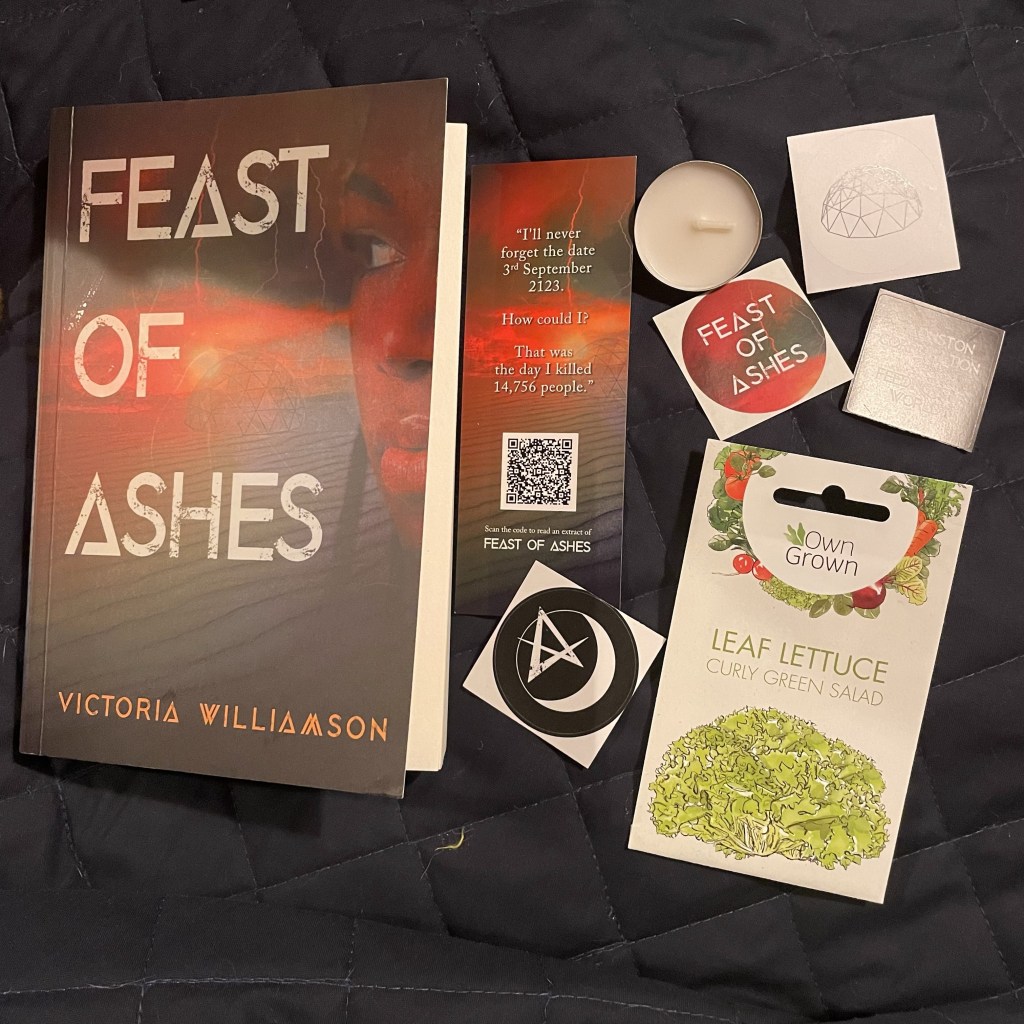
The Earth’s ecosystems have collapsed and only ashes remain. Is one girl’s courage enough to keep hope alive in the wastelands?
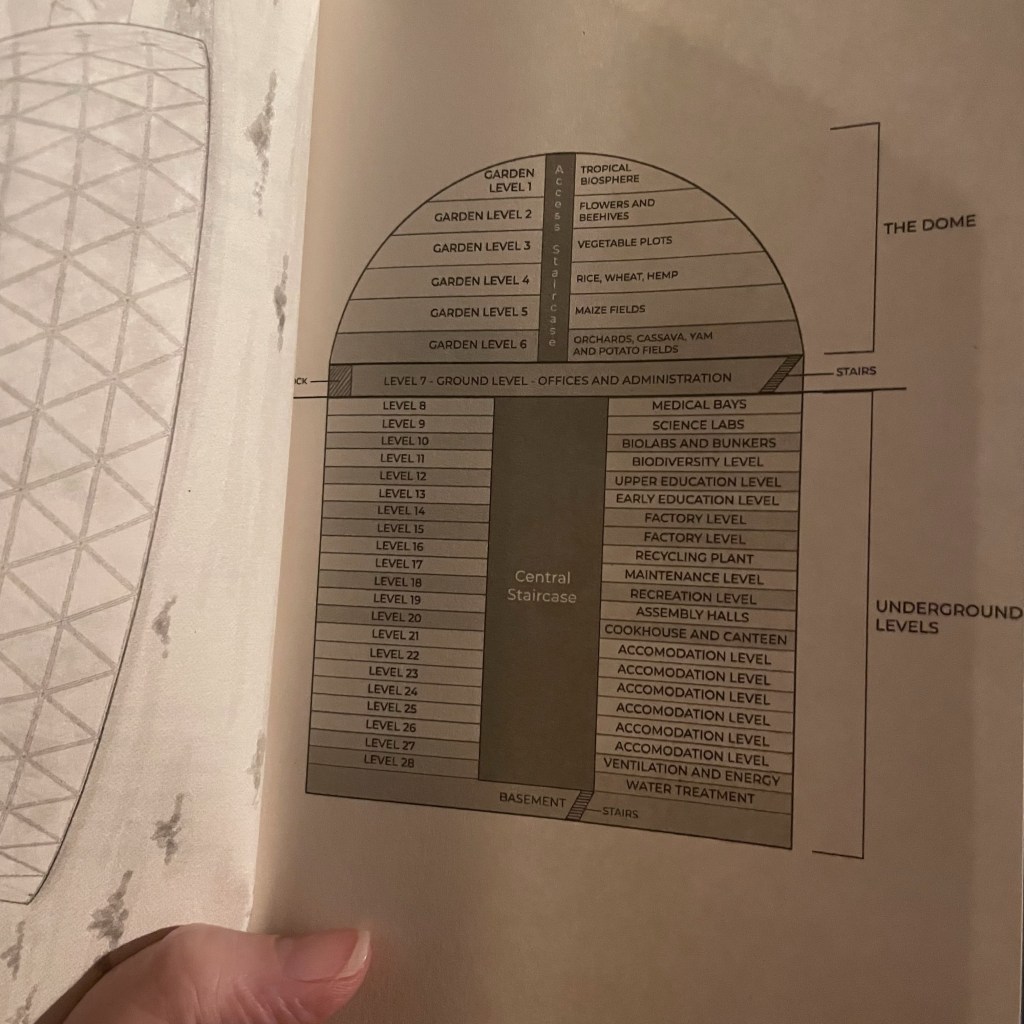
It’s the year 2123, and sixteen-year-old Adina has just accidentally killed fourteen thousand seven hundred and fifty-six people. Raised in the eco-bubble of Eden Five, Adina has always believed that the Amonston Corporation’s giant greenhouse would keep her safe forever. But when her own careless mistake leads to an explosion that incinerates Eden Five, she and a small group of survivors must brave the barren wastelands outside the ruined Dome to reach the Sanctuary before their biofilters give out and their DNA threatens to mutate in the toxic air.
They soon discover that the outside isn’t as deserted as they were made to believe, and the truth is unearthed on their dangerous expedition. As time runs out, Adina must tackle her guilty conscience and find the courage to get everyone to safety. Will she make it alive, or will the Nomalies get to her first?
About the Author
Victoria Williamson is an award-winning author who grew up in Scotland surrounded by hills, books, and an historical farm estate which inspired many of her early adventure stories and spooky tales. After studying Physics at the University of Glasgow, she set out on her own real-life adventures, which included teaching maths and science in Cameroon, training teachers in Malawi, teaching English in China and working with children with additional support needs in the UK. Victoria currently works part time writing KS2 books for the education company Twinkl and spends the rest of her time writing novels, and visiting schools, libraries and literary festivals to give author talks and run creative writing workshops.
Victoria’s previous novels include The Fox Girl and the White Gazelle, The Boy with the Butterfly Mind, Hag Storm, and War of the Wind. She has won the Bolton Children’s Fiction Award 2020/2021, The YA-aldi Glasgow Secondary School Libraries Book Award 2023, and has been shortlisted for the Week Junior Book Awards 2023, The Leeds Book Awards 2023, the Red Book Award 2023, the James Reckitt Hull Book Awards 2021, The Trinity School Book Awards 2021, and longlisted for the ABA South Coast Book Awards 2023, the Waterstones Children’s Book Prize 2020, and the Branford Boase Award 2019. Her latest novel, The Pawnshop of Stolen Dreams, is a middle grade fantasy inspired by classic folklore.
Twenty percent of the author royalties for this book are donated to CharChar Literacy, an organisation working to improve children’s literacy levels in Malawi.
You can find out more about Victoria’s books, school visits and free resources for schools on her website: http://www.strangelymagical.com
What I Thought
As a huge fan of Victoria Williamson’s middle grade books and the dystopia genre in general I was excited to read her YA debut.
This is actually a really dark novel and quite horrifying in places. Think the harshest, creepiest parts of Hunger Games, Divergent, Maze Runner and another underrated fave of mine – Under the Never Sky – rolled into one.
The darkness was suitable for the themes the book explores such as food poverty, ecosystem collapse, genetic modification, death, and exploitation of the African people and lands. I’m intrigued to find out more about Victoria’s research for this book.
What we do have in our protagonist Adina is very much a stroppy teenager who doesn’t take life all that seriously, and she isn’t the most likeable at the start – particularly in how she acts toward one character. This does seems in stark contrast to how she acts toward others such as the Dome’s resident confused man of visions, and her younger sister Tash, so it does have us holding out – deserved – hope for her character development.
The story is told from Adina’s point of view from a future point in time and she does provide a commentary that gives us a heads up for some of the action that I might like to have been a little more surprised by, although thinking about it maybe my heart wouldn’t have coped.
I believe this is the first of a trilogy and although the ending certainly wrapped up the first part of the journey there are so many questions still to explore. If possible it would be good to see some slightly lighter points in future books just to balance the devastation.
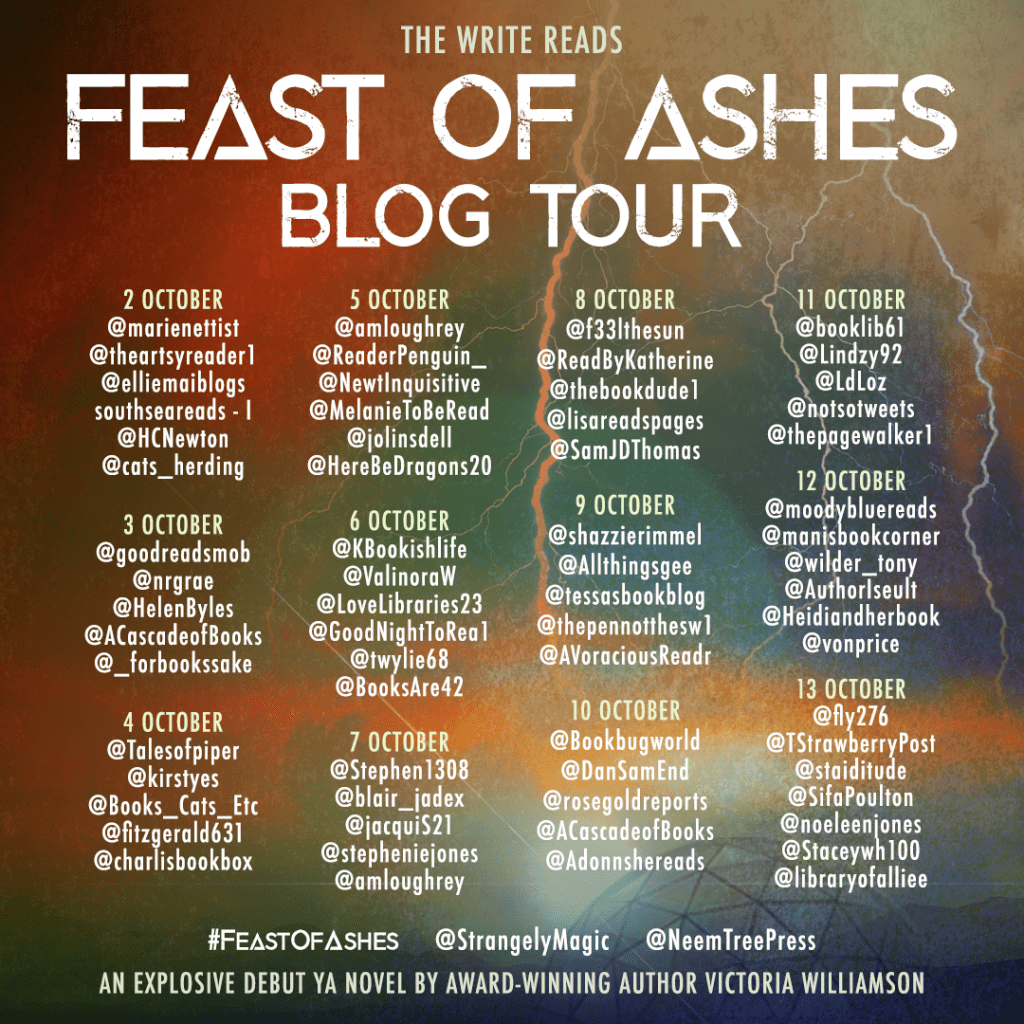
Huge thanks to The Write Reads and the publisher Neem Tree Press for the gifted copy (and goodies) for the purposes of an honest review.
Share this on Facebook, Twitter and Google+


Mirror, Mirror by David Allott – Blog Tour Book Review
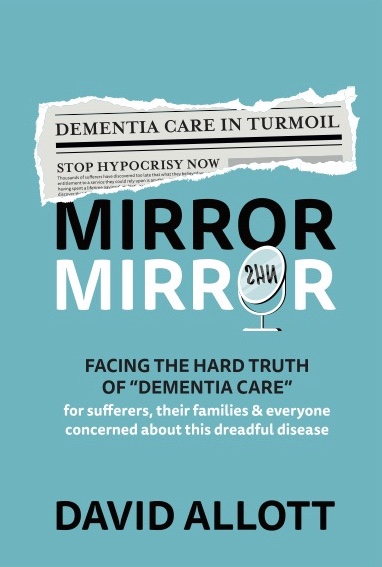
A bit of a different book review from me today with a non-fiction book. This one looking at experiences of “Dementia Care”.
About the Book
The true cost of anything is the price we pay for the alternative.
David and Margaret’s story is, sadly, not unique. Margaret was diagnosed with Alzheimer’s in early 2018. This is the real-life story of the husband and wife’s journey to seek support and care over the past few years. David shares their experience of dementia “care” so that anyone caring for – or living with – dementia can learn from what happened to them, and hopefully avoid the many obstacles, challenges and pitfalls that they had to overcome. One in every 14 people aged 65+ have dementia, that’s around 900,000 people, and the numbers are increasing rapidly every year. This book is an invaluable resource for anyone embarking on the journey to seek care and support for their loved one once symptoms of dementia set in. From getting a diagnosis to getting the right kind of support for them – and you – written with raw passion and from the heart, Mirror, Mirror is dedicated to the memory of Margaret. And to help every other person feeling lost right now.
An important read released around the time of World Alzheimer’s Month in September, and World Alzheimer’s Day on 23rd September.
An essential book for readers of Gail Sheey, Steph Booth and Marie Williams.
About the Author
David Allott learned his trade in Hotel and Catering Management at Blackpool Catering College. It was a short time after this, whilst working as a Senior Assistant Manager in a newly opened large restaurant in Levenshume
that he met Margaret, who was soon to be, his lifelong and forever loved partner of over 51 years. They were married in December 1971 and embarked on a joint career in Hotel Management. Over the years, David and Margaret lived and worked in all three home nations, as well as spending three years in the USA. David’s book Mirror Mirror is not only a record of this final chapter in Margaret’s life, but is written in honour and remembrance of her, and in the hope that it will be of help to others who also must travel this long and lonely road, whilst at the same time throwing a spotlight of the disgraceful conduct of all those involved in trying to deprive the most needy people in society of their legal rights.
Twitter/X – @inkpublishingservices
Instagram – @inkpublishingservices
What I Thought
As an Occupational Therapist who has worked in the NHS, as well as someone with chronic illnesses that means I am a user of NHS services, like many in this country, I am a full supporter of this National Institution and its founding principle to be free at the point of delivery. There can however, be no doubt that over the 13 years the Conservative government have now ruled, alongside the additional disasters of Brexit and the COVID-19 Pandemic, that our NHS has taken a battering. David talks also about the impact of successive Governments’ failure to protect this vital service. Care offered sadly often seems to not be what we expect, nor as staff members, what we want to give. The NHS has always been stronger at urgent care and dealing with non chronic conditions. Anyone who cannot be ‘cured’ by traditional ‘medical’ means or that have complex and multifactorial needs often slip through the gaps and David tells his and Margaret’s story here.
David does acknowledge the individual staff who have supported them and this is a critique of services and not individuals, although as individuals we all certainly play our part – whether in a positive or negative way is up to all of us to determine. David suggests wearing the NHS logo upside down so it reads SHN – its corresponding catchphrase then becomes ‘Stop Hypocrisy Now’. Be warned that this is a political book because healthcare is a human right and as such it is political. If you are not ready to engage at this level I would love to challenge you to do it anyway but this isn’t simply a personal story of struggle but a rallying call. You may not agree with everything David says – but you cannot deny his passion.
At the heart of this book though is a love story between husband and wife, and David’s righteous anger about how Margaret was treated (or not) is palpable. He shares details of the early indications of the disease taking hold through to letters between him and the healthcare team and assessments of her function at different stages of the disease.
In the book at large though is a discussion of societal ableism and the seeming determination that disabled lives simply mean less. My colleges and I at AbleOTUK often hear stories of disabled colleagues being treated inequitably and of course if this happens to our own, how do these attitudes filter out to those for whom we care? David talks about the false dichotomy between medical and social needs – a dichotomy often reinforced because social care is means tested and healthcare is not! (Currently I would say this is somewhat debatable).
David underpins what he is saying with a discussion of concepts such as justice and injustice and looks at the legal protections that people can try to enact and at the concept of NHS Continuing Healthcare (something I only actually got involved in a couple of times in my career and honestly didn’t know too much about before then). This book provides a comprehensive overview where David has used his personal insights, his and Margaret’s experience and learning and works this into practical tips on how to work within a broken system, in the hopes that others supporting loved ones with Dementia don’t face the same battle.
In my personal experience with Long Covid, even as someone with a healthcare background I have found it challenging to access the right care. In my work in Long Covid Advocacy I am collaborating with others to make good healthcare something that isn’t reliant on postcode or the Individual practitioner you get. David says in Chapter 2 – “If you can’t ask the right question, you will find it extremely difficult to get the right knowledge. You are then reliant on gaining knowledge purely by chance.”
The level of detail on the specific policies does mean that the reader in years to come will have to review the current framework as these things often change (and that change at a policy level takes ….a while…. to filter out into general practice. But this provides an excellent framework for using knowledge as power and will remain a good starting point for families facing these issues.
In this book David focuses on Dementia, a truly challenging disease that sadly can take a person away from their loved ones years before their life has ended. But there are supports that can be put in place to improve the quality of life for the individual and their loved ones. This relies on early detection, continual monitoring, truly listening to and understanding needs and this takes time which clinicians are not often allowed. I still professionally believe that it is better to give someone one or two hour-long appointments on diagnosis with a new condition and find about them, their life, their wants and work collaboratively on a plan and over a 10 minute consultation and a lifetime of trying to chase for answers. David does share Margaret’s story and like any others could find the content triggering where it reflects their own experience or where it appears to lay out a challenging experience to come. But for more it will echo their lives back to them and make them feel not as alone.
This book to me demonstrates the immense power of lived experience to shape and inform quality healthcare. As healthcare professionals we can work generally seeing people with a wide variety of conditions or we can specialise, but honestly without that personal insight of living something day in and out our education is not complete. Sure someone facing a new diagnosis may need more guidance and support but give those families 3 months, 6 month, a year, 5 years etc. and they become the expert. Where people have the skills they read up and learn everything they can, to give them and their loved ones the best chances at living a quality life. But again the NHS does need to be able to offer this level of insight to families who can’t – for whatever reason – get an honorary degree in Dementia.
Using peer support and peer groups can seemingly be frowned upon by some healthcare practitioners but it is key for many in accessing the knowledge and rallying troops to face the many battles people have to face – let’s not get into the discussion of benefits here or I might not shut up. David shares some key charities and organisations that may be able to support individuals.
David also makes the excellent point about having discussions of what you might do in these sorts of situations early including topics such as Power of Attorney but in the U.K. in particular we are particularly avoidant of talking about disease and death and then those conversations are left to when emotions are running high or sadly to times when individuals no longer have the capacity to make decisions.
There is a lot of information in this book which could be quite overwhelming. But it doesn’t have to all be read at once and can certainly be referred back to. But who is the book for?
Just people who have familial experience of Dementia.
I say No.
Anyone who has the potential to influence the lives of someone with Dementia?
Yes.
For Politicians and Senior Health and Social Care Managers definitely.
For Individual Health and Social Care Practitioners whether they work in Dementia services or not – Yes.
I would certainly recommend to fellow OTs who want to become more aware about the impacts of the day to day decisions we make for individuals and wider society at large. Sadly these troubles are replicated with other conditions and we can learn much from David and Margaret’s story.
Apologies that this has become more of a reflection that a pure review of the book but in itself I believe that demonstrates the power narratives like this can bring. Publishers take note. Stories can change the world but we need a critical mass of them so they are not able to satisfy our ableist view of these as ‘inspiration porn’ about the brave families doing battle with the system but they are used as manuals to break down and build up systems that truly work for all.
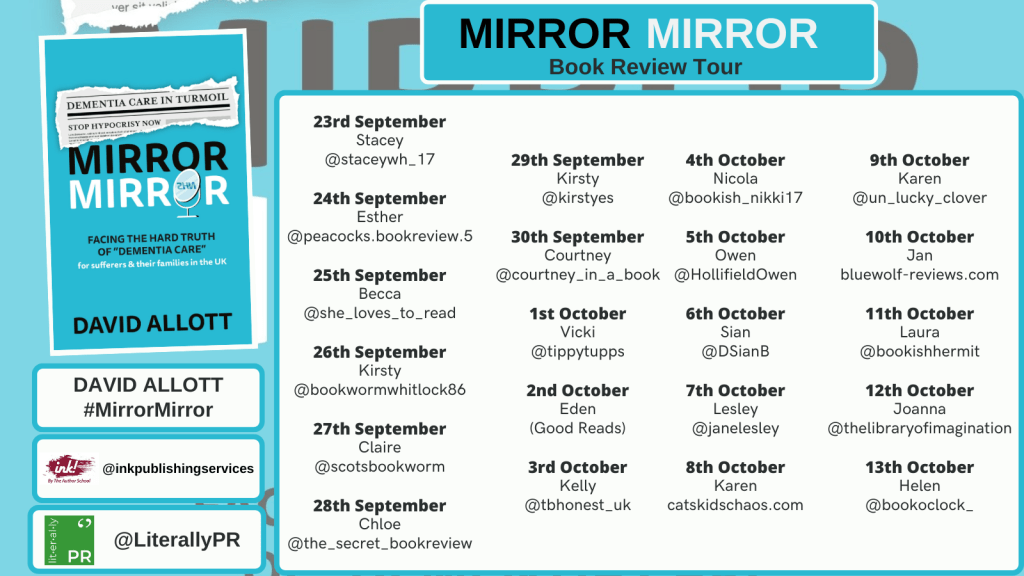
Huge thanks to Literally PR for the gifted copy for the purposes of an honest review and to David for sharing his and Margaret’s Story. Do check out reviews from others on the tour to see how they responded too.


 kirstyes