
Letters to the Lost by Bridget Kemmerer – Book review

On Wednesday I’m part of the Bloomsbury Spring Titles blog tour and I will be reviewing the follow up to Letters to the Lost – More Than We Can Tell. I’ve heard you can read the books as standalones but I’ve had the first book on my shelf for ages so wanted to pick that up first.
And I am very glad I did. Now I’m not a big romance reader with regards Adult Fiction but throw me some YA Contemporary Romance and I get the gushies. I find contemporaries so much quicker to read than the sci-fi/fantasy books I usually go for so I’d highly recommend if you’ve hit a bit of a slump and want a pacy and emotional read.
This romance is fairly complex. Juliet writes letters to her dead mother which she leaves on her grave. One day she gets a response to her letter – from a stranger.
At first she is so angry and, rightly so – her privacy has been violated. So she writes back telling the mysterious author what she thinks of them.
Soon the pair of them come to realise that the other person they are communicating with share similar feelings of loss and anguish and eventually they share e-mail addresses and start chatting about life, the universe and everything.
But little do they know that they’ve actually already met in real life, and they really don’t like each other.
Declan thinks Juliet is a preppy snob and he’s known as the school’s most likely to end up in prison, after all he’s already doing community service.
Author Bridget Kemmerer creates two troubled teens searching for meaning, finding it in each other but being scared to take that next step. As an occupational therapist I also liked how the author explored the meaning people find in doing valued occcupations and the loss they feel when they are prevented from taking part in them.
There’s a shock twist towards the end of the book that I can’t help but wonder how their relationship would play out if the author had chosen to pick the alternative. We would have needed a much longer story to play that out and I was satisfied with the ending but left pleased with the knowledge that we get to delve into Declan’s best friend Rev’s back story in the follow up. Come back on Wednesday for my stop on the blog tour to read what I thought about More Than We Can Tell and check out the other blood tour stops reviewing three of Bloomsbury’s Spring titles.

Share this on Facebook, Twitter and Google+

The Artie Conan Doyle Mysteries Series So Far – Book Review
Yesterday was my stop on the Blog Tour celebrating the release of the second book in the Artie Conan Doyle Mysteries series. Check out the guest post by author Robert J Harris here.
Arthur Conan Doyle is the author of Sherlock and in this middle grade series he is imagined as a young boy having a series of adventures that will later lead him to write his infamous detective series. There are two books in the series so far with more to come.
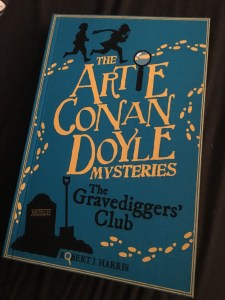
Book 1 – The Gravediggers’ Club
A ghostly lady in grey.
The paw prints of a gigantic hound.
This case can only be solved by the world’s greatest detective.
No, not Sherlock!
Meet boy-detective Artie Conan Doyle, the real brains behind Sherlock Holmes.
With the help of best friend Ham, Artie discovers the secrets of the Spooky Gravediggers’ Club.
Can Artie solve the mystery – or will his first case be his last?
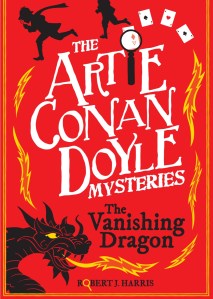
Book 2 – The Vanishing Dragon
A world-famous magician.
A sabotaged illusion.
This case can only be solved
by the world’s greatest detective.
No, not Sherlock!
Boy-detective Artie Conan Doyle, the real brains behind Sherlock Holmes, is once again investigating the impossible.
With the help of best friend Ham, Artie must reveal the secret of the Vanishing Dragon and unmask the villain.
Can Artie solve the mystery – before it’s his turn to disappear?
What I thought
These were a lot of fun and very much in the vein of a couple of other series I have read recently – Robin Steven’s Murder Most Unladylike and Chris Priestly’s Maudlin Towers. It also reminds me of series such as Nancy Drew, The Famous Five and The Secret Seven that I read when much younger.
In the guest post yesterday author Robert said he didn’t want Artie to simply be a young Sherlock and Artie is definitely learning to develop skills of logic and deduction but relying a lot on guesswork and jumping to conclusions.
Despite some wrong turns he perseveres and is determined to solve the mysteries which he does, in the first book mostly with his friend Ham, but in the second with some help from other people too.
Both stories are set in Edinburgh and Robert makes excellent use of the setting – from Greyfriars Cemetery to underground streets. There are also more than a few nods to Sherlock to keep older fans amused. I really should read them but I got enough references from the many tv adaptations I’ve seen.
I slightly preferred the second book because of the magic tricks and theatrics and the introduction of Rowena who is although a little annoying to the boys, is a welcome female addition, and more than proves her worth.
I felt for poor Ham whose love of cake is often ridiculed but loved how that also became a useful plot device in the first book.
As someone who is an advocate for representation of mental health issues I was impressed by the focus on Artie’s father’s depression and the impact this has on both him and his family. I look forward to the continued exploration of that.
As for future developments I’d love to see more of Rowena, and also Artie and Ham’s boarding school would be a welcome setting for one of their adventures.
I would highly recommend this to the target age group and if you are a fan of Sherlock see if they’ll let you keep them for bedtime stories as you will be sure to enjoy the nods to stories such as Hound of the Baskervilles.
Thanks to Floris books/Discover Kelpies for The copies of the books I received for the purpose of this honest review.
Share this on Facebook, Twitter and Google+


BEYOND THE FINAL PROBLEM – CONTINUING THE TRADITION OF SHERLOCK HOLMES #ArtieOnTour – guest post by author Robert J Harris
The most famous crime in all of the Sherlock Holmes stories takes place in The Final Problem when Arthur Conan Doyle attempts to kill off his fictional detective, sending him over the Reichenbach Falls in the clutches of his arch-enemy Professor Moriarty. Doyle felt that Holmes had become a distraction from his more serious works. However, it only turned out to be a case of attempted murder. Such was Holmes’ popularity that Doyle was finally forced to resurrect him and bring him back to Baker Street for yet more adventures.
Such is the irresistible appeal of those gas lit tales, many other people have taken up the task of telling Holmes’ further adventures in books, films, radio and television. Some have been worthwhile, others not so much.
My own tribute to the Great Detective has not been to place him in a story of my invention but to find another way to recreate the atmosphere and excitement of Doyle’s masterpieces. I imagined that while he was still a schoolboy in Edinburgh, the young Conan Doyle (‘Artie’) had a series of adventures which would provide him with the inspiration for the stories he would write some years later. This would also give the reader some insight into the man behind the detective.
From letters he wrote in his boyhood we gain a picture of young Artie as an active, sporty young boy, who occasionally gets into fights and scrapes and loves reading adventure stories. Adding to this the details of his family life and the world of Victorian Edinburgh created the background for these new adventures.
And then came the first story itself: The Gravediggers’ Club.
The most notorious criminals in the history of Edinburgh are surely Burke and Hare, the body-stealers. This suggested the central mystery of the novel: why is someone digging up dead bodies from graveyards all over Edinburgh? By adding plenty of fog and borrowing a gigantic hound from The Hound of the Baskervilles (by far the most famous Holmes novel) I had all the elements of a classic thriller.
It was important to me, however, that my Artie should be true to life and not simply a miniature version of Sherlock Holmes, spotting clues the police are too dim to notice and making brilliant deductions at every turn. What he does have is courage and determination and a powerful sense of what is right.
Detective stories as such were not a recognised genre at this time – it was Conan Doyle who really established them as such. So Artie couldn’t possibly be attempting to imitate some fictional detective he’d read about. Only gradually does he develop those skills, a process that will continue throughout the series.
In The Gravediggers’ Club Artie has his own reason for pursuing the mystery. In The Vanishing Dragon he is actually hired to investigate a series of suspicious accidents that have befallen a magic show. These are his first steps on the road to becoming the man who will create Sherlock Holmes. I hope everyone enjoys joining him on that journey.
Do come back tomorrow to see what I thought of the first two adventures in the series and make sure to check out the other stops on the tour.



 kirstyes