Category Archives: PhD
K is for… King – On Writing (Book) #AtoZChallenge
K is for… King – On Writing (Book)

If I recall correctly I think this book was one of the first I bought about writing (it didn’t stop there!). I think it must have been around the time that I started studying creative writing with the Open University (or ‘taking it seriously’).
Anyhoo the book goes like this:
Two humorously contrasting quotes
Followed by three forwards
C.V (The memoir/autobiography bit)
A couple of pages called What Writing Is …Telepathy
Toolbox (On vocabulary, grammar, style,
On Writing (the bit about writing)
On Living: A Postscript (About his accident and recovery)
Furthermore, Part 1: Door Shut, Door Open (an insight into editing)
Furthermore, Part 2: A Booklist (Stephen’s Goodreads bookshelf ;o) – including the first three Harry Potters [this was published in 2000]
Finally it ends with the winning entry of a short story competition – Jumper by Garrett Addams.
What writing is – Telepathy. This relates back to the discussion on the I post of writers seemingly getting into our heads.
Stephen King’s Prime Rule is Write a Lot and Read a Lot – I’m trying – have been succeeding more with the latter than the former at the moment but it’s all food and nourishment.
Now it is a long time since I read this book but I remember it being good. I need to read it again, I want to after skimming for the purposes of writing this. It isn’t laid out like a how to guide (according to the man himself p.xiii – ‘most books about writing are filled with bullshit.’), there is no index to help you find the section on writing dialogue or which tense to use. It is, as the subtitle says ‘A memoir on the craft.’ It reads like a story, it engages for the full duration then – that is what I hope to do with my thesis.
After his accident Stephen didn’t want to go back to work – he thought it would be too painful. His wife helped him. He ends the postscript section with this quote (p327) –
‘Writing is magic, as much the water of life as any other creative art. The water is free. So Drink.
Drink and be filled up.’
Stephen suggests that why most books on writing are bullshit is because most writers don’t understand what they do – do you agree?

Share this on Facebook, Twitter and Google+

J is for… Journalling and Reflexivity #AtoZChallenge
J is for… Journalling and Reflexivity
One of the first pieces of advice I received when starting my PhD was to start keeping a reflective diary or journal (sorry sidebar giggle thinking back to the diary(ladies)/journal(mens) scenes in A Very Potter Senior Year that I watched yesterday). I did do this for a while (by hand) but then stopped for whatever reason, I also haven’t been back to read through in a while).
This challenge is meant to be restarting this for me and hopefully I’ll keep going. I do have a private blog set up which I will probably use more of the time because I’m sure that often I will be journalling incoherent ramblings and also I wonder about how much I should be sharing openly. A benefit of keeping it electronically will be that it is searchable too. I hope to most occasional, more coherent thoughts here too.
In ‘academic’ terms journalling is about reflexivity. Tracking thought processes, noting biases and how this relates to decisions made. How I influence my research. In qualitative research these reflections often become integrated into the thesis, sometimes as a separate chapter, other times throughout.
‘Thus reflexivity involves not getting rid of the self, but doubling the self: distancing ourselves from ourselves to a greater or lesser extent, so that we have a sense of standing outside ourselves and observing what we are doing and thinking.’ (Hunt and Sampson 2006 p4).
Some of this reflexivity might leave us feeling vulnerable and that might be a reason to hide this processes, however Hunt and Sampson (2006) suggest that we learn to be more objective when we share and invite comments from others. They say this more about creative writing but it probably rings true with thoughts on the research process.
One of my current thoughts as I am writing this is about the juxtaposition (at least I think this is the right word) about writing about creative writing. The book I am referencing is about reflexivity with creative writing rather than research so it is speaking to me on two levels, as a guidebook to the process and as a reflection back on meaning and why I engage with writing so much.
Hunt, C. And Sampson, F. (2006) Writing: self and reflexivity. Hampshire, UK: Palgrave Macmillan.
What do you think about PhD (or research in general) blogging – do we give up our secrets too soon, leaving us open to ‘originality poaching’, or does transparency throughout aid early dissemination with the potential of reaching a wider audience?
I’ve just joined bloglovin to make it easier to follow the blogs I like – it has a tablet app and you should see a widget in the sidebar which will add my blog to your bloglovin feed. Here’s my profile.
Share this on Facebook, Twitter and Google+

I is for… Intertextuality #AtoZChallenge
I is for… Intertextuality (Book)
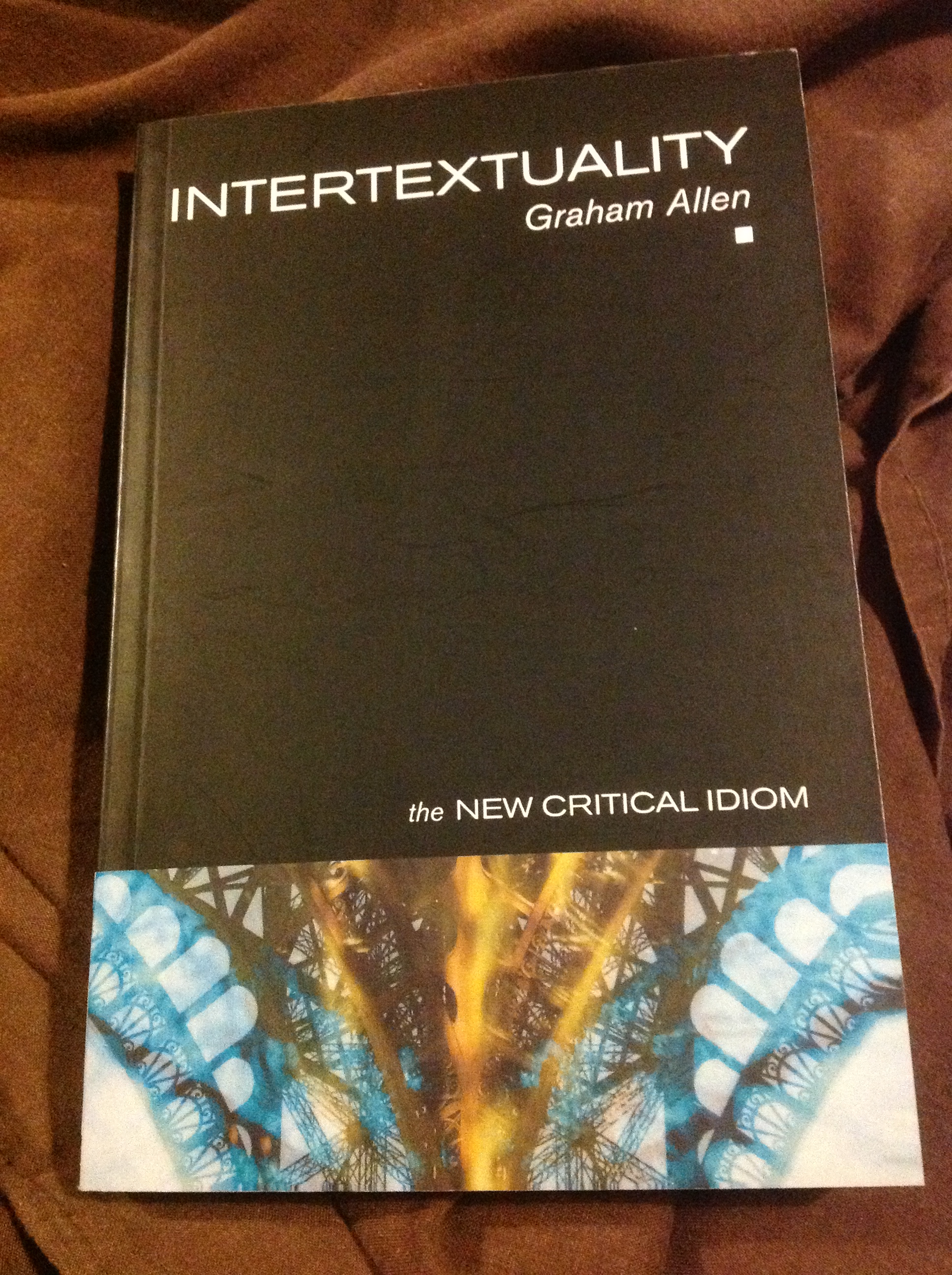
Image taken by me
On the back cover of Intertextuality by Graham Allen (2000) it is written that:
‘No Text has meaning alone.
All texts have meaning in relation to other texts.’
I’ve mentioned before that I sometimes struggle with analysing writing in relation to only that text alone preferring in some cases to better understand context or being very accepting of multiple analysis. Comparison to previous texts I’ve read also plays its part.
This text is an academic one, a study of intertextuality within the context of literary criticism.
It discusses Bahtkin and Dialogism (again), Roland Barthes and the idea of the Death of the Author, feminism, postmodernism and lots of isms and textualities in general.
I think this book will be of interest to my PhD because of its discussion about relations between books. I also wonder whether the idea of the Death of the Author might be interesting to explore more with reference to what happens post publication. We now have unprecedented access to authors of new books and can ask them their meanings and intent – maybe the author is on the rise from the grave? Does this mean we have to zombie follow them and not accept our own creation of meaning? I know that as a writer some of my writing appears subconscious and I then read meaning back into it.
If you have ever been to a psychic you will probably have heard people say that we cling to aspects that relate to us and ignore the bits where they go totally off track. I wonder if this is how we relate to books too.

Image from: http://cinderellainrubbershoes.tumblr.com/post/23815224624/writing-is-perhaps-the-greatest-of-human
For example I have seen the quote above a lot recently and it really can feel like this is happening sometimes, that someone is writing out the thoughts in your head. But I suspect that often books have as much that we don’t relate to as that which we do – but the relations are more powerful and longer lasting though.
Another book I need to read properly rather than skim so apologies if I have misrepresented any of the theories – my comments are just rambles at the moment.
If you are a writer what other books do you nod to in your work?
When looking back at the meaning of things you have written do your ideas change over time or stay static?
As a reader do you find yourself making links to other books you’ve read, films and TV series you’ve seen and, of course your own life experiences?


 kirstyes