Category Archives: April A-Z Challenge
X is for… (#atozchallenge)
X is for…
X-Files
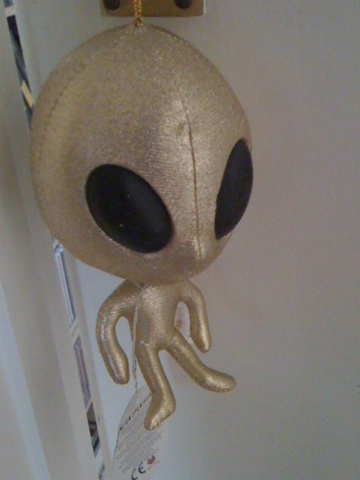
Once upon a few years ago everyone knew what to buy me for Christmas and Birthdays -anything X-Files related. My favourite ever gift was this gold alien that makes a screaming sound if you bang its head against something (I used to scare my sis doing that).
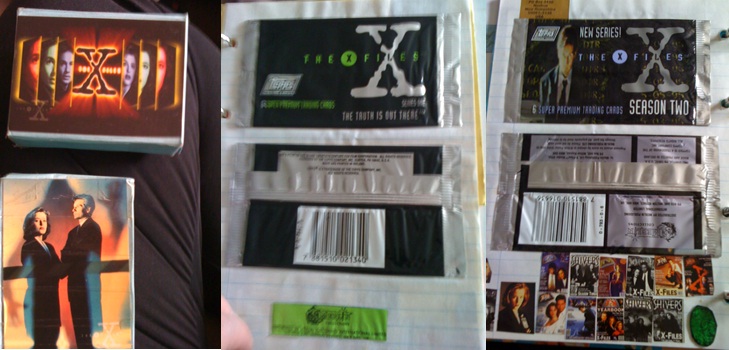
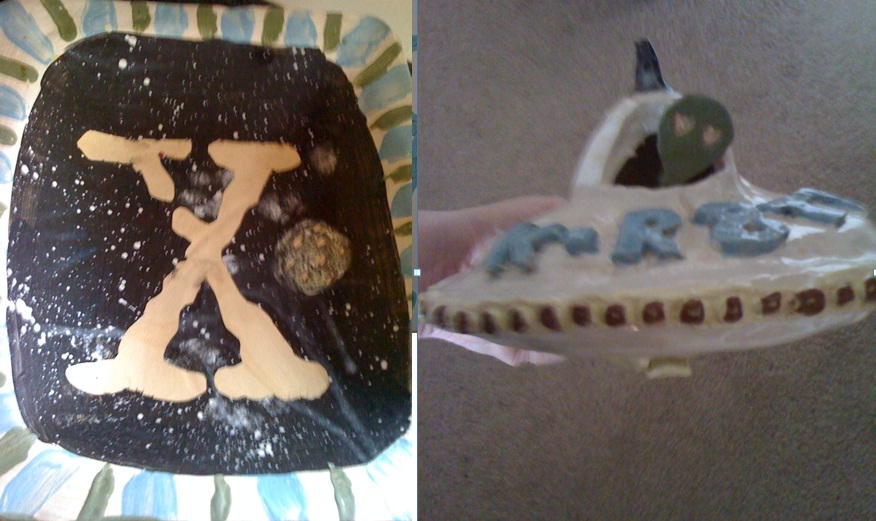
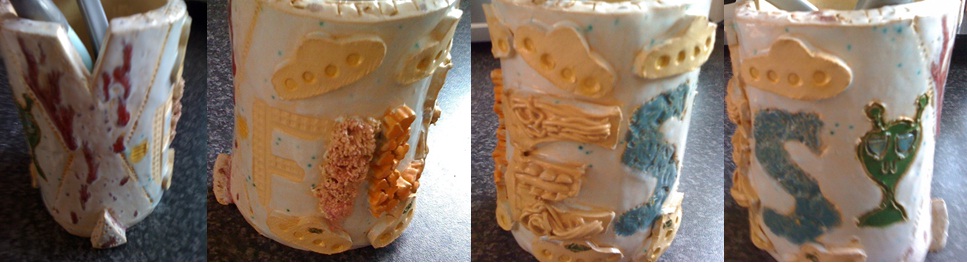
I even collected X-Files cards and made them a box to go in, which I must still have somewhere. Sad, I know. Funnily enough yesterday I went to a session on what the speaker termed ‘Fanish activities’, her focus being Vampire based knitting. I cant knit and I don’t write fan fiction (perhaps surprisingly as a writer) but go mad on the whole collecting thing. I even ‘drew’, and I use the word loosely, a cartoon Mulder and Scully. At University when learning about the therapeutic uses of pottery I made some X-files bits including a fruit bowl (currently in use in our house) and a Spaceship complete with Alien on a stand. The stand holds our washing up brushes now. I am still very proud of the X on that, I like the effect of the dripping glaze. I hope to add photos of my geekishness for you to see but will need to do that later when i can find the picture and spaceship that are packed away somewhere, so I will schedule this post for early and tease you with a later reveal.
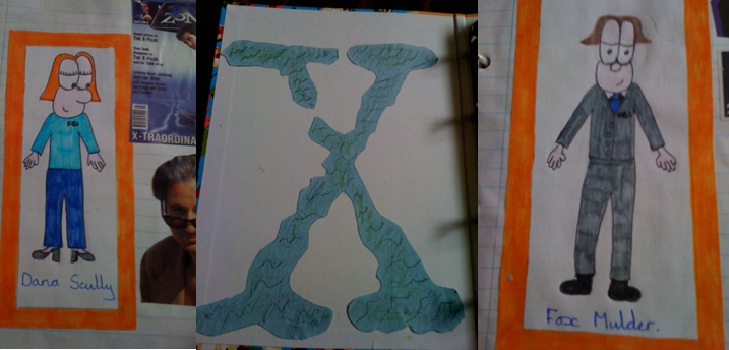 OK – now I’ve found the drawings I’m not convinced I actually did draw them – did any of you oh friends?
I guess for me, as with any fan, part of the enjoyment of being a fan of a particular tv series, book/book series or movie or genre is about interacting with it in some way outside the media itself. That can be by taking part in activities that aim to recreate aspects of the media or to talk to or create a narrative (story) with the media, to make it part of your life and your story maybe. I wonder how much being a fan and engaging in fan activities is acknowledged as an occupation by occupational therapists and their clients.
Anywho for those of you who don’t know this show and what I’m blathering on about, where were you during 1993-2002ish?
The X-Files stars David Duchovny as Fox Mulder, a believer in extra-terrestrial life and Gillian Anderson as Dana Scully a skeptic. They work for the FBI to solve/investigate X-Files, unexplained or spooky cases and they are dab hands at holding torches and guns at the same time! Other notable characters were Alex Krycek (who I thought, along with Mulder, was somewhat dishy), Skinner, The Cigarette Smoking Man and The Lone Gunmen (men!!).
Now, I am ashamed to admit that despite owning the DVDs I have never actually watched all of the X-Files. To be honest I know I watched up to S6 but after that just looking at the episode titles on http://www.imdb.com I’m not sure. I haven’t watched S9 or the second film for sure. The thing is it’s now too late down the line to just watch the last few series, I’m going to have to start from the beginning to get back into it (how I wish I could be paid to sit at home, watch Tv and read and write).
Now the series spawned two major catchphrases, ‘The Truth is Out There’ and ‘I Want to Believe’. The first in the show refers mainly to Mulder’s search for the truth about what happened to his sister who he believes was abducted by aliens, and obviously more generally for the process of discovery or solving the spooky cases (which Dana likes to attribute to a neat scientific cause). The catchphrase has been used by conspiracy theorists to refer to government ‘cover-ups’ such as Area 51 and the Roswell alien crash landing and alien autopsy video. The second ‘I Want to Believe’ is on a poster along with a picture of a flying saucer in the agents’ office. Now I’m not entirely sure that personally I want to believe. For all of my ‘love’ of this genre when people start talking to me about real life ghosts or if I stop too long to consider the existence of any extra-terrestrials that are not ET or the kids from Escape to/Return From Witch Mountain (love these films) then I get a bit freaked out (though I still sit and watch things to fuel these fears like Independence Day, V, War of the Worlds etc etc -idiot!).
Despite the show being about aliens and the paranormal the episode that most clearly sticks out in my mind as being the most creepy and scary was Home (S4, E2). This concerns an icky case of serious in-breeding and is more akin to a horror film, deformed monsters in the woods type, not my favourite type of horror at all. I like my horror all self-referential and comic and jumpy like the Scream franchise (go see Scream 4 it is fab). As a side note when watching back Scream 1,2&3 with a friend the films are actually far less gory than I remembered and so much of it must have been done through suggestion which is far more powerful (for scaring the bejeebus out of me anyway).
The other thing that The X-Files did was to make me notice that some series creators give actual titles to episodes, this is something I enjoy (with Buffy, Angel, Charmed, Gilmore Girls etc) in seeing what meaning they may place on an episode and what pop-culture references they make with them.
But the element of The X-Files that I enjoyed the most was the will they, won’t they relationship tension between Mulder and Scully. Their relationship made this otherwise otherworldly show seem real and their characters got me invested in their search.
I see echoes of this in Bones between Booth and Brennan. Does anybody reckon their ‘We will be together on such a such a date’ piece of paper burning is going to come true? Now this is something ‘I want to believe’!
Thanks for reading: this waffly post was bought to you by Kirsty and the letter X (should have done this on V – could have got in a mention for the Sesame Street counting vampire count!)

Share this on Facebook, Twitter and Google+

W is for… (#atozchallenge)
W is for…
Wicca
As you saw in yesterday’s post V is for…Vampires I have a fascination for the supernatural and as such coming into contact with shows such as Buffy the Vampire Slayer, Charmed and films such as The Worst Witch, Practical Magic and The Craft etc has also introduced me to Wicca. This is a topic that I have and will no doubt write about within my creative writings.


I have recently discovered one of my friends is Wiccan and conversations I have had with her reminded me of this essay on religion I wrote in 2004 when studying the now discontinued Open University (S is for…Studying) course A103 – An Introduction to the Humanities (Please do not use this work as your own, I have acknowledged my sources – plus I’m not telling you what grade I got so this may well be a load of rubbish!). It actually only mentions Wicca very briefly and references one quite nice basic introduction text for any readers interested in starting their own academic study into this fascinating religion.
This post also links to U is for…Understanding as one of the things that inspired me to pick Wicca as the religion to examine for this was the news story I reference where the cliché and incorrect image of the actions of Wiccans was represented. I hope you find the essay interesting for examining any unfamiliar religion.
Religious Studies
In an essay of no more than 1200 words explain how a student of religion who may or may not have religious convictions would set about examining a religion with which they are unfamiliar. (Open University, A103, TMA 06 question, 2004)
Study of religion should be academic in the sense that it is not of practical relevance to the individual but only of theoretical interest (The Oxford Dictionary of English, 2003). Study of an unfamiliar religion should be undertaken following the same methodologies that for example a student of an unfamiliar period of history would utilise.
Objectivity and careful examination of the textual evidence must guide their approach, whether these texts are sacred books, accounts from followers of the religion, works of art or observation of festivals and ceremonies.
The student of religion will undoubtedly face a number of difficulties when examining an unfamiliar religion. It may be complicated for them to view certain values and beliefs without judgement, and this may be compounded with comparisons to their own religious beliefs. A student may use study to ‘find a religion in which to believe’ (Block 4, p. 27), but this type of study is not likely to be academic in approach due to its practical, subjective aim and is therefore not advised in this instance.
Further problems may arise when viewing religions in cultures and societies alien to those that were around at their inception, and therefore care should be taken to place religion within its historical, social and cultural contexts (Block 4, p. 9).
Initially great importance should be placed on setting a definition of religion which is to guide study. Without a definition how is the student to know what and how to study?
Religion as a concept is a relatively new and Western term and most dictionary definitions emphasise those characteristics of religion that only Christianity embraces but these definitions often exclude other religions (Block 4, p. 32-34). Followers of ‘religions’ such as Hinduism actually refute this term preferring to consider their faith as more of a way of life or in their own language dharma (Block 4, p. 56). However a student of religion has to have a definition on which to base study and this definition should be specific, flexible and free from prejudice (Block 4, p. 33).
Many different definitions have been offered, each with their own strengths and limitations and on balance a combination of two different definitions appears to provide the religious studies student a broad enough basis for study, enabling them to identify the particular characteristics of religion they need to study.
Firstly we will utilise the substantive definition (pointing to distinguishing characteristics) supplied by Steve Bruce (1995, p. xi in Block 4, p. 37),
Religion, then, consists of beliefs, actions, and institutions which assume the existence of supernatural entities with powers of action, or impersonal powers or processes possessed of moral purpose.
This combined with Ninian Smart’s seven-dimensional model of religion will assist the student to expand on their knowledge of religion and hopefully direct them in their approach. The seven dimensions are the, practical and ritual, experiential and emotional, narrative or mythical, doctrinal and philosophical, ethical and legal, social and institutional and finally the material (Resource Book 3, A5, p. 34-45).
The Arts Good Study Guide (2002, p. 219) suggests that Religious Studies is an inter-disciplinary subject in which many different types of texts are analysed. Religion is complex and encompasses many aspects of human life and because of this a student of religion will use elements of historical, psychological, sociological, anthropological and linguistic research as well as examining religious texts, works of art, philosophies and places of worship (Block 4, p. 48). The use of such varied academic disciplines, as Art History, Psychology, Literature and Architecture brings with them certain principles of methodological research for the student to adhere to.
The academic discipline of Sociology is used to study Religion in relation to society as a whole and looks at the origin and evolution of Religion in relation to this (Haralambos, 1991). It examines the development of religion in response to humans trying to make sense of the world around them. Malinowski (in Haralambos, 1991, p. 649) identified that religious ritual tends to centre on ‘life crises’ such as birth, puberty, marriage and death. It would therefore be necessary for the student to investigate these ceremonies and their relationship to religion.
Anthropological studies have identified that in all known societies there is some sort of belief in the supernatural (substantive definition) and certain rituals related to this, whether in worship or to placate spirits (Haralambos, 1991, p. 645).
Historically new religious movements and sects have developed around the time of great social change (Haralambos, 1991) and it would be necessary to discover what needs (emotional, social and psychological) developed at these times that would drive people to look for new forms of religious expression.
An ideal place for the student to start their research would be by investigating the written texts surrounding a religion. This could involve reading a generalised book to garner a basic knowledge of the religion which may in turn help with the formulation of questions and aims for further study.
It would most certainly involve study of the sacred texts of the religion and in some cases this may involve use of copies translated into the student’s own language. Specialised terminology would need elucidation in order for the student to understand testimonies from the religions followers.
Methodologies utilised in Sociology would be particularly relevant to apply to the study of religion. Questionnaires and Interviews (Haralambos, 1991) could be carried out with leaders and followers of religions allowing comparison between ideologies in different geographical areas without the costs involved in travel to these areas. The student would have to be careful to account for differences in experiences presented and would have to be aware of other factors for that diversity such as, in the Hindu tradition, differing social status provided under the caste system (Resource Book 3, A6, p. 46-52).
Study of religion through written sources alone may however provide the student with a stilted, one-dimensional view of the religion and would not allow complete understanding of the functional benefits of the religion claimed by its followers.
Scientific methods may be used for example to test the benefits of Transcendental Meditation (Block 4, p. 53).
In an ideal situation then, a student of religion, in order to truly understand a religion would have to participate actively in it. It has been identified that this act of participation is the only way for an ‘outsider’ to truly understand what a religious ceremony or ritual ‘feels’ like. Observation and testimony gives only generalised accounts. The student has to become an ‘insider’. There have also been debates about whether a student who holds no religious beliefs of their own can even, in becoming an ‘insider’, understand that religious experience with nothing to compare it to (Block 4, p. 48-50).
A benefit of participant observation (Haralambos, 1991, p. 741) is that a student is less likely to impose their reality on it; they have to gain the trust of other participants in order to be allowed to share in their rituals. A student who clearly doesn’t respect them will not be allowed to participate. There is one clear difficulty that a student may have in arranging this participation. Gender issues could exclude women from participating in male dominated religious ceremonies and this exclusion in turn could lead to the student developing negative views of such a dividing religion.
The student themselves would then have to demonstrate personal values of open-mindedness, respect, objectivity, impartiality and subscribe to being non-judgemental in approaching unfamiliar religions (Block 4, p. 46). Humans are fallible and despite all attempts to follow the proceeding guidelines there may be elements in the religion in question that are in direct contrast with their own moral beliefs and therefore difficult to accept.
One example of an ethical difficulty a student may face could be in observing a Sikh who carries the kirpan, or dagger. The student may because of moral/legal guidelines in Britain regarding a dagger as an offensive weapon may believe that the Sikh is demonstrating anti-social tendencies and is incorrect in their belief.
However if they were to objectively study the reason behind this, they would be able to identify that this is symbolic of the time when Sikhs were under threat from Muslims and had to wear the kirpan as protection (Resource Book 3, A3, p. 20). Even with this information the student may still disagree with this aspect of the religion but they should be able to offer more understanding of the importance of this aspect of faith to the Sikh based on the cultural/originating traditions behind this action.
Another problem that may be experienced is when study starts in response to a sensationalised representation. Portrayal of minority religions in the media can present the student with a biased and often negative view of the religion creating a negative approach to study. Fear of the unknown often leads to a negative portrayal and wish to dismiss the claims of the religion as false. An article in The Sunday Mail (27th June 2004) describing the inclusion of followers of Wiccan and pagan religions in the development in government policy was presented in clearly negative terms. The article was presented alongside a picture of a semi naked woman on a pentagram with a dagger and littered with phrases such as ‘costing the taxpayer’, ‘fears that young people might convert to the ‘faith’’ and ‘this Government seems prepared to take any religion seriously, except Christianity’.
This narrow-minded view of the Wiccan faith marred by negative connotations would need, in an academic study, to be reviewed with caution. When critically analysing this as a source for evidence of the acceptability of Wicca as a religion hopefully it would be in parts disregarded as political propaganda. For example the fact that the inclusion of Wiccans in government policy is ‘costing the taxpayer’ should be irrelevant as Wiccans are also taxpayers.
When simply examining an introductory guide to Wicca enough evidence could be found to fit all seven dimensions of Smart’s definition and Bruce’s substantive definition (Crowley, 2000). Wicca shares a belief in Gods and Goddess’ (supernatural belief, substantive definition and narrative/mythical dimension), practitioners celebrate annual events through worship and ritual (practical/ritual and social/institutional dimension). They have a respect for all life and nature (doctrinal/philosophical and ethical/legal dimension) and the ultimate goal of achieving a personal tranformatory experience of the Divine (experiential/emotional dimension). The use of daggers (material dimension) is like in Sikhism symbolic rather for the sacrificial reasons most people associate with Satanism (which is nothing to do with the Wiccan tradition). Academic study of religion clearly helps to refute some of the negative preconceptions people may hold about these religions.
To conclude a student of religion despite having or not having their own religious convictions would be expected to set about examining an unfamiliar religion in the same way as they would any other academic subject. They would be expected to use methodologies from all relevant humanities and scientific disciplines in order to give them an all encompassing view of the religion which they are studying. A definition of religion and its characteristics needs to be identified as a guide to this study. As well as studying the religion in the students own society they would also need to attempt to understand the religion in context, historically and geographically, for example TV14 and TV15 clearly show that the Hindu religion as manifested in Liverpool and Calcutta is diverse, despite coming from the same mythical tradition.
It has been shown, in relation to Wicca that even when approaching a religion from a negatively biased stance that by applying an appropriate definition of religion to guide study an objective, respectful view of that religion can result.
Religions naturally evolve over time and between societies and the student needs to demonstrate an awareness of this when making judgements especially in the controversial area of truth and falsity.
They will need to accept that even if they are not on a religious quest any beliefs/non-beliefs they have may be challenged.
In Block 4 (p. 52) when looking at how the student may come across evidence that demonstrates the truth or falsity of religion it was noted that,
… religious conviction, even when it appeals to reason and logic, more often that not assigns a greater importance to acts of faith, to personal experience and/or to the authority of a religious teacher or sacred book.
I would class myself as a Christian and I also believe I am able to approach other religions with objectivity and respect. I find myself drawn to certain practices from many different religions and also accept the scientific explanation of evolution (which disputes the Christian story of creation). However I still find myself in challenging times praying to the Christian God for guidance. Religion, in whatever form appears necessary to all societies and therefore the Academic Study of Religion remains vital.
References
Chambers, E. and Northedge, A. (1997) The Arts Good Study Guide, Milton Keynes, The Open University.
Crowley, V (2000) Thorsens First Directions: Wicca, London, Thorsens (Harper Collins Publishers)
Haralambos, M. and Holborn, M (1991) Sociology: Themes and Perspectives, (3rd ed), London, CollinsEducational (Harper Collins Publishers)
Lewis, J (2004), Blair Witch Project, The Mail on Sunday (27th June) p. 15
The Open University (2003) An Introduction to the Humanities: Religion & Science in context (Block 4), Milton Keynes, The Open University
A3: John Bowker, ‘I live by faith: the religions described’
A5: Ninian Smart, ‘The nature of a religion and the nature of secular worldviews’
A6: David R. Kinsley, ‘Introduction: Benares’
The Open University (2003) An Introduction to the Humanities: Resource Book 3, Milton Keynes, The Open University.
The Open University (2004) An Introduction to the Humanities: TV14: What Is Religion, BBC2.
The Open University (2004) An Introduction to the Humanities: TV15: Looking For Hinduism In Calcutta, BBC2.
Soanes, C. and Stevenson, A (ed.) (2003) Oxford Dictionary of English, (2nd ed), Oxford, Oxford University Press
Bibliography
Living TV (2004) Joan of Arcadia, Living TV
Sears, N (2004), Girl of 15 fights for her ‘human right’ to go to school in this dress, The Daily Mail (Friday 28th May) p. 11
The Open University (2003) An Introduction to the Humanities: Audio-visual Notes 1, Milton Keynes, The Open University.
The Open University (2003) An Introduction to the Humanities: Resource Book 3, Milton Keynes, The Open University.


Share this on Facebook, Twitter and Google+

V is for… (#atozchallenge)
- V is for…
Vampires
For a long time I have been interested in/fascinated by Vampires.
I’m pretty sure it started with reading Bram Stoker’s Dracula at school.
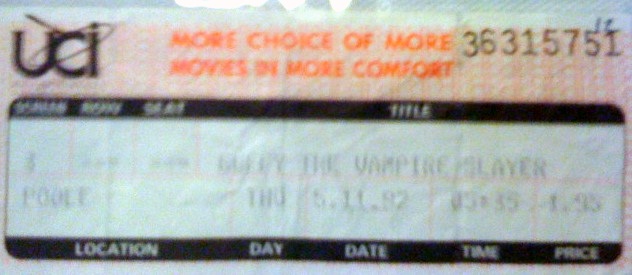
The original Buffy the Vampire Slayer film at the cinema might have been next, in Nov 1992 when I was 14 and the price of a cinema ticket was £1.95!!!!!

The Gary Oldman version of Dracula also came out that year but I was a bit young to have seen it in the cinema (and I have no ticket!).
However I have a feeling I had seen The Lost Boys on TV before this (it was released in 1987). I’m guessing I may had stayed up late without permission.
to watch it (naughty).
This film has one of my all time favourite lines in it: It’s a bit rude so I’m linking to the imdb quote.
In fact this is still one of my all time favourite films.
I also remember seeing a kid’s TV series ‘The Little Vampire‘ based on books by Angela Sommer-Bodenburg. This was dubbed and I’m pretty sure I quite liked the idea of a flying cape!
I read ‘The Secret Vampire’ by L. J. Smith. It came out in 96/97 and I reckon I probably bought it from a small bookshop in Barmouth in North Wales (the best store bar Woolworths that they had there when I was visiting my grandparents). I would have been at university at the time and so it was likely to have inspired the vampire novel idea I had but have yet to complete. [The ending of this book came to me in a dream in about 98 and I have written some of it but am no-where near finished – I do plan to finish it and would like to print myself off a copy from somewhere even if that’s as far as it goes].
I was pleasantly surprised more recently to find out that ‘The Secret Vampire’ was actually the first book in a series, called The Night World. Currently there are nine books with the tenth and final book due out next year (I am itching to read it).
Weirdly I thought I had read this at a much younger age.
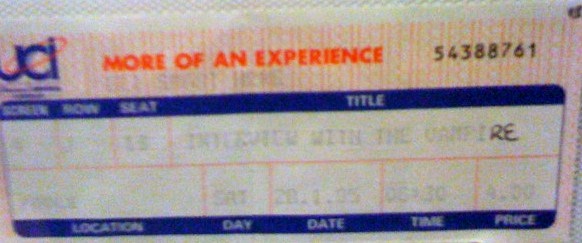

In Jan 1995 I went to see Interview with a Vampire (I have a number of the books which I still have yet to read). I was so impressed with Kirsten Dunst’s performance in this as an old soul in such a young body. I still cry every time I watch this film.
When Buffy the Vampire Slayer the series started in 1997 I was well and truly hooked… Though much of this has to do with the genius of Joss Whedon (see my J is for… Post) to find out more about my love for BTVS and Angel.
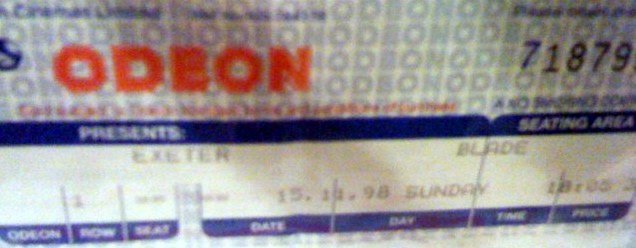
And then there’s Blade and From Dusk to Dawn and Near Dark and Let the Right One In, which are a lot more bloody and violent than I usually like my vampires to be but I enjoyed these too.

Much more recently is of course the Twilight series. I read the books before the films came out. Oddly enough though I am on Team Jacob (Werewolf) and not Team Edward (Vampire). Jacob generally makes Bella seem happier.
I’ve got a number of vampire book series ready to read (more about them on my Y is for… Post).
Then finally there are the three current TV series, Being Human (end of series 3, How could they?), True Blood (very saucy vampires indeed) and The Vampire Diaries (based on a series of books by L.J. Smith) in which the very delectable Damon smoulders (below – my apologies can’t remember where I got the pic from). The books really are quite different to the series and I think they’ve done some TV tie in books (Stephen’s Diary) which I might get on Kindle when I’ve read all my thousands of ‘to read’ books.
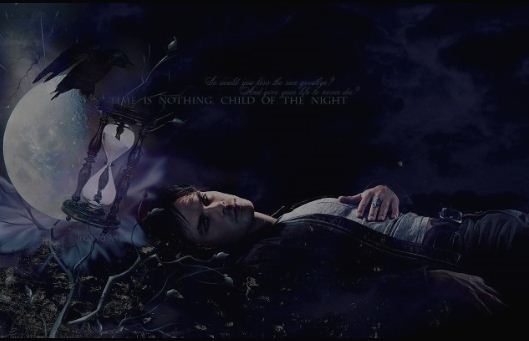

I’m not entirely sure why vampires fascinate me so much but here are some possible reasons:
- I am a night owl and not a huge fan of the sun so can identify with this ;o) and being pale and pasty
- I’m not keen on looking in a mirror and maybe not having a reflection is appealing
- Vampires live forever – when you have a death phobia this may seem positive (however I am a vegetarian so the thought of drinking blood of even animal origin is yuck yuck yuck)
- Vampires are damn sexy – or at least they are mostly portrayed as such in film/tv
- I’m generally interested in supernatural topics
- I got interested in this topic as a teenager and I still feel like an eternal teenager!
- Honestly I don’t really understand why, I just am!
What vampire films/books/TV etc are your favourites?
Are there any I haven’t mentioned here that you would really recommend?
(I’m 100% percent sure that this is not everything vampire related that I’ve seen/read but what I could remember whilst writing this post).

And for those of you interested in Vampires too the lovely Shah over at WordsinSync has also chosen V for Vampires in the A-Z Challenge and her post can be found <a href="http://here


 kirstyes