Category Archives: #am writing (and all things writing related)

#FromDaughtertoWoman by Kim McCabe – Blog Tour Guest Post

Guest Post – Social Media Safety
by Kim McCabe, author of From Daughter to Woman, parenting girls safely through their teens
My daughter’s phone died. I braced myself for her panic at being disconnected. It didn’t come, she quite liked having a social media ‘holiday’… for a few weeks. Then she needed to get back in the loop, she was missing conversations, photos, gatherings. But after not having a phone for a while, she was a bit more aware of how easy it was to lose time on it and how it didn’t always make her feel too brilliant.
Teen depression. We all like to blame social media. We’re a bit afraid of it when we see the hold it has over our kids. We’re right to be cautious, it’s definitely having an impact on teen mental health. We don’t want our girls to be basing their opinion of themselves on how many ‘likes’ they can earn. Or ending up exhausted before the day has begun because they were messaging until 2am. Or doing things for the boys because that’s what they’ve all seen online.
Our children are growing up in a world that’s populated by digital delights that we never knew. We’re going to have to learn about how they work before we can teach our kids how to stay healthy in this new culture. This is nothing new, parents have always struggled with whatever’s the latest craze. Kids love it and we tend to see the downsides of it.
If you want to be able to influence your child’s social media habits you can’t be completely down on it. Think about it from your child’s point of view: if you don’t have control over your home, own a car, or have much money and here is a device which puts you in touch with your friends and a world that you don’t have easy access to any other way. What’s not to like?
Here’s the way forward:
• Ask her to teach you about the platforms that she likes.
• Sign up to some yourself so that you can see what’s going on.
• Find out what you need to teach her to stay safe (like turning off location functions, not giving personal details and not meeting people you’ve encountered online; there’s more, find out).
• Ask her what she sees online that bothers her and discuss it without being judgmental or she’ll clam up.
• Find out what happens to everything digital, so you can explain it to her.
• Give her the 1-second-check idea, suggesting she pause before pushing send to ask herself what would my granny or boss think of this?
• Show her videos of how photoshop changes what we’re shown.
• Reassure her that it’s normal to be curious but if ever she sees or hears anything she wishes she hadn’t, she can come to you, no blame.
• Have a night-time parking place downstairs for phones. No phones at bedtime; buy an alarm clock.
• Suggest a ‘mood check’ after time spent with social media so she’s aware of when it’s doing her good and when it’s not. Encourage her to notice what feels positive (the connection, the fun) and what doesn’t (comparing, mean comments).
• Set a good example yourself.
Our duty as parents is to take care of our children and gradually to hand that job over to them. So, when she’s little you install software safeguards and set rules. As she gets older, the safety filters are going to have to come from inside her, so your job turns into how to help her do that. First. She’s going to need to understand why she’d want to. Then, you’ll need to guide her how to use social media safely.
If you think she’s running into difficulties, you need to show that you’re on her side. If she’s not having a nice time online, chances are she’ll feel like it’s her fault and shame will make it harder for her to tell you. If she seems to be relying on ‘likes’ to feel good, and then feels low after the high, help her to notice that. If you think she’s got a bit hooked and you judge her, she’ll just get defensive. Telling anyone of any age that they’re addicted to something is the last way to get them to stop. Never make her wrong. If you want to get through to her, the two of you have to be able to talk to each other without accusing or criticizing. If you want an easy way to get these conversations going, go on a Mother-Daughter Date once a month.
It’s the way to get real-life ‘likes’ from her!
Wow. What a great post. Thanks Kim. Some useful pointers for social media using adults here too!
Summary:
This book aims to make the adolescent’s journey just that bit safer, kinder, and better supported – so parents and teens can enjoy the teenage years more.
The teen years are tough – for teens and for parents. Many parents dread the moodiness, dishonesty, preference of friends over family, exam stress, and the push for greater independence. Mothers have a pivotal role to play; this is a guidebook for parents and mothers of girls in particular as they navigate the rocky teenage landscape with their daughters aged 8 to 18. It aims to help them embrace the potential of their child’s teenage years by marking this time of growing maturity for girls and celebrating it with them. We celebrate birth, marriage and death, but this important life-transition from child to young adult is nowadays rarely acknowledged within an appropriate community.
Author

Kim McCabe is the founder of Rites for Girls. As the originator and facilitator of Girls Journeying Together groups, she offers guidance to preteen and teen girls and simultaneous support for their mothers. In training other women to facilitate these groups, her dream is that every girl grows up expecting to be supported and celebrated in adolescence. Kim was commissioned to write a section in Steve Biddulph’s latest best-selling book, 10 Things Girls Need Most: To Grow Up Strong and Free.
Kim is a home-educating mother of two boys, one girl, two cats and a colony of aloe vera plants; she is wife to a Kiwi, daughter to itinerant parents, friend to a cherished few, and lover of time alone, too. She lives in the Ashdown Forest in Sussex. She sometimes shouts at her children, accidentally steps on the cat’s tail and forgets to water the plants, but she loves her work, her family and her life. She has always had deep affinity with teenage girls, and by sharing her wisdom and compassion she infects the reader with her enthusiasm for this life stage.
From Daughter to Women is out July 18th published by Little Brown and is sure to be invaluable for those raising teenagers. It includes topics such as puberty, periods, relationships and wellbeing and I love the concept of Mother-Daughter dates.
Do check out the rest of the blog tour.

Thanks to Faye Rogers for also proving a PDF which I’m looking forward to reading.
Share this on Facebook, Twitter and Google+


Writing Retreat – Guest Post

Have you ever wanted to be whisked away somewhere remote to get that book inside you written? And do you wish that you had expert guidance and support to help you while you did it?
If you answered yes to the above questions then you should definitely continue reading this post which is going to tell you all about the Atelier des Ecrivains (Writers’ Workshop) retreat.
Becky and Sarah who are co-hosting the writing retreat, and are both writers themselves, know that there are lots of people who harbour a desire to write a book but may either lack the confidence, the skills or the headspace to actually do it. They also know from experience that removing yourself from your daily life, with all of its pressures and interruptions, and coming together with like-minded people can be a great way to overcome those barriers. Where better to do that than in a beautiful 18thcentury manor house outside one of France’s prettiest villages, Aubeterre?
Helen Cross, author of My Summer of Love, which was turned into a Hollywood film starring Emily Blunt and whose other novels, screen and radio plays entertain people all over the world will be leading the workshop. She is an experienced teacher of creative writing and currently teaches on the MFA in Creative Writing at the University of East Anglia, UK. The combination of skills and experience offered by Helen, Becky and Sarah will be invaluable to authors at all stages of their writing journey.


ABOUT THE WORKSHOPS
Getting started – Thursday 20 to Monday 24 September, 2018
For people at the beginning of their writing journey, this workshop will help you develop your writing skills, find your creative voice, thematic material and literary style: create credible characters and reveal them through dialogue and active, dramatic scenes: and build your world – structure, point-of-view, and narrative voice. With a small group of up to 10 writers, we are promoting an environment of creativity and support with one-to-one feedback sessions and time for questions and answers.
Keeping going – May, 2019
For people who have already started their writing journey, this workshop will enhance your skills even further, help you overcome barriers and enable you to shape your words into the brilliant piece of work you know it has the potential to be.
Getting published – September 2019
For people reaching the conclusion of a writing project, this workshop is designed to support the final stages of writing and editing, and will contain lots of useful information about how to get published and successfully market your book.
You can find out more information about the hosts, venue and workshops here. To book your place or to contact the hosts, you can visit the website here.


I don’t know about you but I would very much like to go on this writing retreat. Maybe I should start doing the lottery.
Have you ever been on a retreat of any kind? How was it?
@fayerogersuk
Share this on Facebook, Twitter and Google+


Digging Up Bone,Digging Up Secrets – Guest Post by Nicola Ford for The Hidden Bones Blog Tour
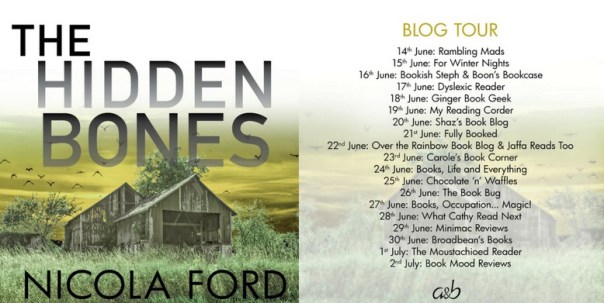
I’m delighted to be hosting a guest post by author of the The Hidden Bones Nicola Ford. Nicola is a real life archaeologist and has used the adage “Write what you know” to share a thrilling mystery with us. I’m just over half way through (and needing to know what happens!!!) and will share my thoughts soon. But for today let’s hear from Nicola.
Digging Up Bone, Digging Up Secrets
The dead can tell fascinating tales if you know how to listen. It’s a truth at the heart of many modern murder investigations. And it’s also central to the way Clare Hills, David Barbrook and their team of archaeologists in the Hidden Bones go about their work.
Twenty first century forensic science draws heavily on the techniques employed by today’s archaeologists. So important is it to police investigations that over the past two decades forensic archaeology has become a discipline in its own right. A discipline that has not only introduced archaeologists into police inquiries, but to the investigation of war crimes, and the aftermath of major disasters. And those techniques have revolutionised what we can learn about the lives of individuals who lived and died, in some cases, many centuries ago.
In the Hidden Bones the ability of Californian osteo-archaeologist Dr Jo Granksi to read the remains of the dead reveals secrets both ancient and modern. The scientific techniques that she applies are approaches that I rely on in my day job as the National Trust Archaeologist for the Stonehenge and Avebury World Heritage Site. As an archaeologist I’ve sometimes been called upon to investigate the scenes of ancient killings. And it’s that experience that I draw upon in my crime writing.
I worked on a Bronze Age enclosure site at Velim in the Czech Republic that contained the remains of over a hundred people who’d died over three thousand years ago. Some were adults – men and women – but the vast majority were children. Skulls and parts of skeletons had been strewn across the site, and thrown into ditches. Whether we’re archaeologists working on the skeleton of a child killed millennia ago or forensic archaeologists working as part of a scene of crime team we want to answer the same questions. Who were they? How did they live? How did they die, and why?
When Velim was first discovered there was a raft of theories about what had happened here. Had the site been attacked? Were these the victims of warfare? Some of the remains were disarticulated. Could they have been victims of cannibalism?
That’s where meticulous excavation and the work of the osteo-archaeologists applying the same approaches as Jo Granski come in. Many of the people who died at Velim had been subjected to severe head trauma which was visible on the crania. But there were repeated patterns in the fracturing of the limb bones too. And the wear and disarticulation on some of the bones, taken with a host of other evidence gathered by the bone specialists suggests that the children that I excavated, and their companions, were the victims of ritualised sacrifice.
The past worlds I unearth as an archaeologist can sometimes prove to have been dark and dangerous places. But the present too has its shadowy secrets. And it’s some of those secrets that I dig deep to reveal in the Hidden Bones.
Synopsis
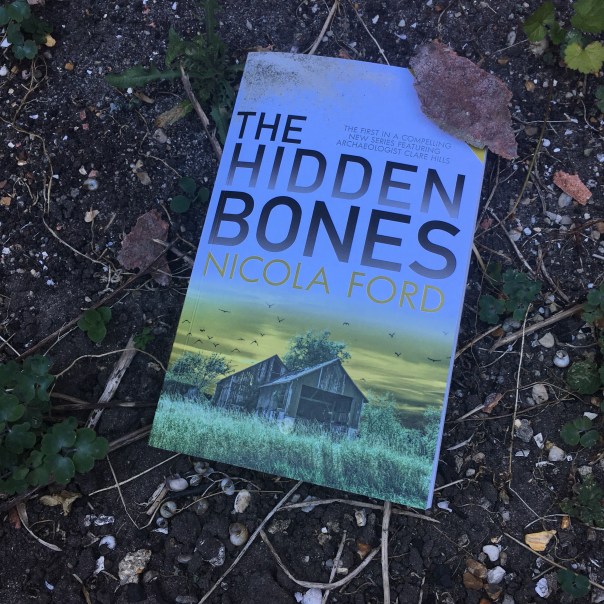
Following the recent death of her husband, Clare Hills is listless and unsure of her place in the world. When her former university friend Dr David Barbrook asks her to help him sift through the effects of deceased archaeologist Gerald Hart, she sees this as a useful distraction from her grief. During her search, Clare stumbles across the unpublished journals detailing Gerald’s most glittering dig. Hidden from view for decades and supposedly destroyed in an arson attack, she cannot believe her luck. Finding the Hungerbourne Barrows archive is every archaeologist’s dream. Determined to document Gerald’s career-defining find for the public, Clare and David delve into his meticulously kept records of the excavation.
But the dream suddenly becomes a nightmare as the pair unearth a disturbing discovery, putting them at the centre of a murder inquiry and in the path of a dangerous killer determined to bury the truth for ever.
Huge thanks to Nicola and to Ailsa from Allison & Busby for my review copy. Do check out the other posts on the tour and come back soon for my review.


 kirstyes