Category Archives: Author Interviews
Glaze – Character (Petri, Ethan, Kiara) and Author (Kim Curran) Interview
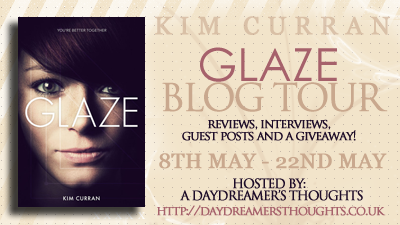
Today I am delighted to be taking part in the blog tour for Kim Curran’s Glaze which was released on Amazon on the 15th May. The blog tour has been organised by Faye at A Daydreamer’s Thoughts. Kim is also over at Uncorked Thoughts today. See below for the full list of stops.
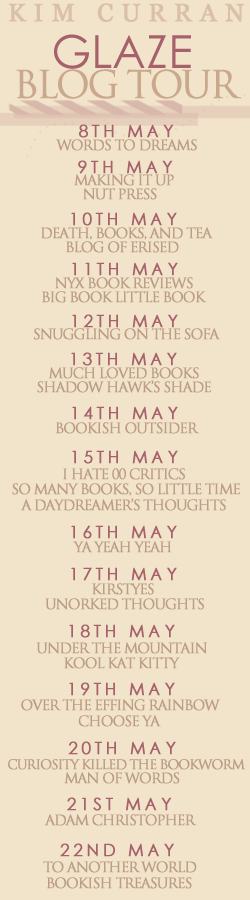
Tonight there is a twitter chat happening at 8-9pm BST – Do join in by following Kim and the hashtag #GlazeChat
There’s also a blog wide giveaway – here’s the rafflecopter entry. Prizes up for grabs include a limited edition hardback edition, chance to meet or skype with Kim, bookmarks and more. I think I might need to enter.
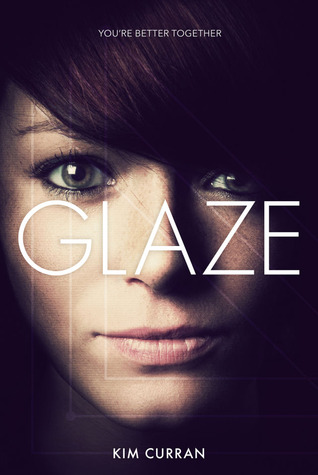
Blurb:
Petri Quinn is counting down the days till she turns 16 and can get on GLAZE – the ultimate social network that is bringing the whole world together into one global family. But when a peaceful government protest turns into a full-blown riot with Petri shouldering the blame, she’s handed a ban. Her life is over before it’s even started.
Desperate to be a part of the hooked-up society, Petri finds an underground hacker group and gets a black market chip fitted. But this chip has a problem: it has no filter and no off switch. Petri can see everything happening on GLAZE, all the time. Including things she was never meant to see.
As her life is plunged into danger, Petri is faced with a choice. Join GLAZE… or destroy it.
I have been lucky enough to be able to ask questions of three of Glaze’s characters: the book’s protagonist Petri, her close friend Kiara and the mysterious Ethan. I even snuck in a couple of questions for Kim, the author. I hope you enjoy.
Petri
Do you wish you had been called Petra?
*sighs* I wish I’d been called ANYTHING other than Petri. Zizi, that’s my Mum, thought naming me after the method of my conception was hilarious in the way that only she could. She also has this joke about getting ‘half-price on ginger sperm’ that she tells like fifty times a day.
Why the fascination with numbers?
I guess it’s because they make sense. They’re constant and comprehendible in a way humans never will be to me. Prime numbers. Patterns. I find them comforting. And sometimes, when everything feels like it’s too loud, I sit and recite Pi in my head till I calm down. Weird, I know!
What do you think of the idea ‘You’re better together’?
Zizi came up with that line, so, I was a little bored of it before the rest of the world heard it. But at first, I totally bought into it. I really believed that everyone would become their best, most brilliant self when part of something bigger than just them. I was always hearing about how all the great thinkers in the world only got to where they were because they were working with the ideas of others. How no one can really achieve something alone. But now… I’m not so sure. I guess it all comes down to what we mean by ‘better’. And who is the one making that decision.
What does family mean to you?
To me, it means belonging. Having a sense that you are safe and that no one is judging you for who you. They just love you – the way you are. It’s not something I’ve experienced all that much, to be honest.
What do you really think about kissing now?
Like anything. It’s about doing it with the right person. :oD
Ethan
How did you feel when you were saved by a girl on the first day of school?
You mean when Petri stopped those guys from bullying me? I guess I could have handled the situation myself; I’ve been in my fair share of fights after all. But I thought it was really brave of her to step in. I mean, she didn’t even know me. She just knew that what they were going to do was wrong. It’s one of the reasons I like her so much. She’s this tiny thing with all this rage inside her. You do not want to be standing in the way when it explodes.
What’s it like being invisible?
I like it. I like solitude and being able to think clearly. I spent a long time surrounded by other people and having all of my decisions decided by everyone else. So being invisible means I don’t have to worry about that anymore. It can be lonely too, for sure. But I’ll take that over noise. And it means I don’t have to worry about the government watching my every move.
Kiara
Do you think Glaze contributed to your depression?
I don’t know for sure. The doctors tell me that it’s to do with an imbalance with the chemicals in my brain and so maybe I would have been depressed with Glaze or not. But I know it made me feel a whole lot worse about it. It was like everyone else in the world was having the best time of their lives while I was having the worst time in mine and I thought that there must be something so very wrong with me to not be able to join in with all that fun. So yeah, it made it worse.
What is it about the stars?
To me, they symbolise hope, they’re a point of light in the darkness. My dad used to take me outside to the garden at night and point out all the constellations. The bucket. The leaping frog. The laughing elephant. I didn’t know till I was older that he was making all the names up! So now, when I look up at the stars, I remember the stories he told to make his little girl happy. And that feels nice.
Why do you write?
There are a lot of writers who say they write because they can’t imagine not writing. I’m totally not one of those writers. I can absolutely imagine not writing. I can imagine myself running off and becoming a Mongolian Eagle Hunter and never writing another word. I can imagine myself becoming an astronaut and spending all my time watching the world rather than writing about it. But… that’s also exactly the reason I do write. Because I’m never going to run off and become a Mongolian Eagle Hunter or an astronaut. So I write to go on exciting adventures. I write to try and live other lives for a while. I write to entertain myself and work out what I think about things. I write because I love it. (I adore this answer although feel that Kim underplayed her skills of ‘premonition through writing’ – Google Glass and riots happened in real life shortly after she wrote Glaze!!! Spooky!)
You’ve turned to self publishing for Glaze so it must be important to you. Why write this book?
That’s a brilliant question. And yes, my decision to self publish rather than just let Glaze live in my bottom drawer was precisely because this book is so important to me. I wrote it to deal with a lot of confusion in my own head about trying to find myself amid the noise of other people’s opinions. I wrote it to try and understand how I feel about the world we’re living in today and where it’s taking us. I spend so much of my time online that I end up feeling really angry with myself for not getting out and living. So, I guess I wrote it to try and claim something back from that wasted time. And once I’d written it, I believed that other people might have the same worries as me. Which is why I wanted to share it with them. (I think there can be lots of positives from online interactions but it’s definitely a challenge balancing time online with interacting with the real world. I think the book shows this really well).
Huge thanks to Kim (and Petri, Ethan and Kiara) for giving us a further insight into the world of Glaze. I really enjoyed this fast paced read. Interested to hear everyone’s views on the interview here today.
Share this on Facebook, Twitter and Google+

#Countdownto5thJune – Matt Whyman – Author Interview
Firstly huge thanks go to Jim Dean at YAYeahYeah for organising this Countdown to 5th June blog tour and for allowing me to be a part of it. You can find links to all of the previous posts and the posts to come on the Countdown Blog.
Next I’d like to thank Matt Whyman for taking the time to answer my questions about War Girls (UK Amazon Link). I’ve added a couple of comments in red – mainly as a private joke with Matt – I promise none of them are “Must Try Harder” though ;o)

Via Amazon
War Girls is a collection of short stories told from the perspective of women during the period surrounding WW1 and Matt is one of the contributing authors. His story Ghost Story was particularly powerful.
At the end of June this year it will have been 100 years since the start of WW1. Why do you think it was important to consider the experience of women in the war and why now in particular?
It’s very easy to think of Tommy in the trenches when it comes to WW1, but the fact is women played a vital role in so many different ways. This centenary has certainly embraced wider aspects of the conflict, in terms of coverage in the media, and the anthology seemed like a fitting means of exploration.
We’ve also reached a point where most people with first-hand experience of the war have now passed. Without a direct link to that generation, handing down their stories, it falls to writers to bring the past into the present – and there is some responsibility that comes with that. (There certainly is, and one which I think this set of writers handles very well).
How did the collection come about and how did you get involved?
I’d like to tell you that my incisive knowledge of WW1 made me an obvious candidate to contribute, but that would be, well… lies. (Lies, like the dog ate my homework – tut). I’ve watched a lot of action movies, but I don’t think that counts. In fact, having just published a memoir about life with a sausage dog (riiiiiggghhhht?!) when the author approaches went out, I still think there might have been a mix up somewhere. On the upside, I’m always drawn to a writing challenge. The research was intense and enlightening. It involved reading history books, papers and journals, uncovering news cuttings and talking to historians in a bid to get a clear picture of the event I planned to write about. In the end I found myself doing the same amount of groundwork as I would for a novel. (Well then you definitely deserve an A for effort as well as execution).
Your story in particular considers an experience I don’t think I’ve come across before. What did you learn from writing this piece?
The story is set during the Gallipoli campaign – a disastrous attempt by the Allies to open a new front against the Ottoman Empire. Getting my head around the history took some time, but what compelled me to write about it was an account by a shell-shocked British soldier of an attack from a sniper he claimed to be female. It’s a convincing case, but also called into question by historians who doubt Turkish women took arms.
It left me with a dilemma. The last thing I wanted to do was make claims for the existence of a markswoman who was essentially the product of mistaken identity or a traumatised imagination. At the same time, the defence of the soldier’s account has a great deal of merit. As we’ll never know, given where we are in history, I decided to write the story from the point of view of a grieving mother and widow who picks up a gun by circumstance only to question her purpose. So, she’s there, looking down the sights of a sniper as our soldier claimed. It’s just things aren’t as they might appear. Ultimately, I know what it’s about in my mind, but never like to tell a reader what I’m trying to convey. That’s the role of the story and the pleasure that comes from reading. In other words, I’m terrible at summarising. (No, I think you’re right, it is good to allow readers to form their own views too).
Which other story in the collection do you think brings a new insight?
This is a powerful anthology. Every contributor has sought to shine light on aspects of the war effort that are often side lined. What strikes me above all is that nobody falls into portraying their characters based on our moral outlook today. It’s uncomfortable sometimes, but the only way to truly get under the skin of individuals who served their country one hundred years ago.
You start your story with a short factual piece, do you think this freed you up to then enter into the narrative without the need for explanation during the story itself?
The story was finished before I wrote the introduction. I just wanted to be transparent about the contention surrounding the origin of the story. You could say I was keen to show my workings. As you’re a teacher, I’m hoping this answer will earn me a big tick in the margin. √
In your story was it important that the woman remained nameless?
Yes. She has no name and no life ahead of her. Everything she loves has been taken away. She’s a lost soul, waiting to join her loved ones, and effectively dead from the moment we join the story.
At the end of the book are some adverts for other short story collections. How do you relate to short stories in comparison to novels, both as a reader and a writer?
As a writer, short stories are hard work. Every word feels like the compression of a sentence. What you leave out says more than what you keep in. You’re working with less but aiming to say more. I find it to be one of the more rewarding nightmares of the writing process. As a reader, I devoured short stories in my twenties by authors such as Angela Carter and Raymond Carver. I’ve written a lot over the years, but not by choice. I’ve always been approached, never learned to say no, and remain very glad of that whenever I see the finished anthology or collection.
And finally the question I always ask – Why do you write?
For the same reason that I was drawn to put pen to paper in the first place – because there’s nothing to hold back the imagination – no costs or crew to consider, or practical stuff to arrange. With some time and self-discipline, you can sit in a crappy bedsit creating a story that might cost millions to film, but won’t cost a penny. It inspired me as an impoverished 21 year old and I’m still mindful of that today.
Huge thanks to Matt for his excellent Grade A ‘Homework’. Matt has been working hard because he is also over at Winged Reviews talking about a solo project on Sunday 25th May.
Tomorrow’s stop on the tour is Nigel McDowell over at A Daydreamer’s Thoughts with Faye.
Faye is also the organiser of Kim Curran’s Glaze blog tour which I will be taking part in next Saturday, the 17th, with a character interview from Glaze.
Share this on Facebook, Twitter and Google+

Author/Character Interview – Sean Williams/Clair Hill
Twinmaker by Sean Williams is a thrilling fast paced YA sci-fi novel and today I’ve got the author here for questions. Here by d-mat is Clair Hill the protagonist of Twinmaker. Thanks to both of you for your time.

My copy of Twinmaker (also known as Jump in some places)
Sean Williams
Firstly congratulations on the PhD.
As someone who is signed up to do one what advice can you give, especially with respect to maintaining balance and getting some creative writing completed alongside it?
Thanks heaps (as we say down here). I’m very excited that my examiners liked it and recommended it be lodged without amendments (very impressive – well done). It was a creative writing PhD, so a large chunk of my thesis is fiction. In fact, it’s a massively rewritten version of Twinmaker called Making and Remaking Iteration 113, which tells the same story but from Q’s point of view (oooh would love to read that). There’s also an exegesis focusing on the history of d-mat in literature, arguing that it’s an important trope of science fiction that’s been unfairly overlooked. Does that sound dry? (No – but then you are talking to a fellow PhD and creative writing geek) It probably is! (You can read the intro here.) I had a lot of fun researching and writing it, even though it was a bit stressful keeping up with it on top of other deadlines and everyday life (little things like cleaning do you mean – she says surrounded by piles of paper and books?). Over the course of the PhD I published six or so books and wrote four, so finding that balance was critical. I actually took a year off over the course of the PhD to fit everything in.
Secondly (and maybe more importantly??) congratulations on Twinmaker. I was impressed to see you’ve used the science from your PhD in your novel. How important is it to you that the science fiction is possible science?
Thanks again! The question of whether d-mat could ever be real is a tricky one. I have a section in my exegesis where I argue that the sheer unlikelihood of it being practical any time soon is a strike against it ever being taken seriously in literature (although time travel gets over that hurdle somehow – that’s good she says having written a time travel novel). Let me quote myself (like a first rate tosser)(Not tosser like at all – you’ve done the work so why not use it):
Writers grappling with matter transmission eventually must find a way to approach the problem that “[e]ven an educated layman must realize that one can’t simply disassemble a living body at one point, reassemble it at another, and expect life to resume” (Schmitz 1961). The data storage required to create a copy of a person to the atomic level is immense: “About 10^28 kilobytes would be needed to store a human pattern in a memory buffer” (Johnson 2002). Given that the standard practical unit for measuring memory is the terabyte (10^9 kilobytes) and the current capacity of our entire culture is estimated at in excess of 600 exabytes (10^15 kilobytes), present-day technology falls short of the task by a factor of 10^13, or ten trillion (Adams 2011). That doesn’t take into account the difficulties associated with reliably transferring that data from one place to another without taking longer than the estimated lifetime of the universe (Clarke and Baxter; Leinster 1961).
So there’s that (love it). But the idea itself is plausible if not practical, particularly with 3-D printing a thing now (I need to watch a video of this – I still don’t believe it exists ;o)), and quantum teleportation also, and all that. You can see a natural convergence. Helping that sense of plausibility is the fact that just about all the other stuff in the book is real too. Here’s a post that details just how little of it I actually made up. With science fiction, as with all fiction, it’s important to find a balance between the real and the imagined that works best for most readers.
In the novel social media has become even more invasive than it has now – not even out of sight – what’s your relationship with social media?
I prefer to think of the social media as more available in Clair’s world rather than intrusive, just like it is today. No one’s forcing anyone to use Facebook or Twitter (I’m a social media lover/addict). I like the former and struggled a bit with the latter, and there are a whole bunch of others, like Pinterest and Google+, that I barely look at all (You really should look at Pinterest – great for pinning pictures of characters and things and pudding recipes!). But yes, there’s a media thread running all the way through Twinmaker, and I hope it resonates with today’s users (and avoiders) of social media.
If Improvement were real would you use it and how?
Hmmm. I’d give myself a full head of pure-white hair (fabulous). That is my greatest desire, on a superficial level. More meaningfully, I’d probably want to make my brain younger–and my body too, while we’re at it. Getting older sucks. (Having worked with older people in my career as an OT I heard the phrase ‘Don’t get old dear a lot’. Personally I’m not too keen on the alternative though).
If you could Dupe as anyone who would it be and why?
I would dupe Tony Abbott, the current Prime Minister of Australia. I would take his pattern, strip out all of his monstrous policies and ambitions and try to bring something more forward-thinking, rational, and compassionate to my country. (A political answer – I like it – so do we have religion in here somewhere as well? ;o))
The start of the meme:
You are special.
You are unique.
And you have been selected.
speaks very much to our culture at the moment. Although I feel that everyone deserves the opportunity to be an individual I wonder if we’re losing a sense of social responsibility. Clair seems to realise her social responsibility in the book. I wonder if this was a theme you’d planned to explore?
The idea of social responsibility is an interesting one. I think we could use a lot more of it these days, but is the cult of the individual to blame? I’m not sure. There’s undoubtedly some kind of very complex feedback loop between people and the group they belong to that rewards either selfish or altruistic behaviour. If society isn’t promoting the latter, is the individual to blame for not exhibiting it? (Excellent points well made) If most individuals aren’t interested in being altruistic, why would society encourage them to be? Like a lot of people, I think we could all be more compassionate and considerate of those around us, but I know at the same time that I have a way to go before I get there myself. Clair is pushed there by extreme events. I think it’s very easy, if you’re not pushed, to let it slide. The media, which plays a large role in influencing our social behaviour, could supply those pushes, if it wanted to. I wish it did. (Me too).
There was a comment by Clair later in the book about her hair going into an afro after getting wet, I’d forgotten the earlier mention of her skin colouring and it made me query who I’d been visualising throughout the book. As an author how do you take it when someone perceives a character differently to you?
The reader brings their own baggage to every novel. I can’t control that side of the process, and I don’t want to. I love it when people mentally elaborate on what I’ve written, just as I’ve done to very book I’ve read. Clair is African American, but she doesn’t have to be for the story to work, in the same way that Gemma has an Indian background (i.e. from India, not Native American) and Mallory is ABC. Twinmaker isn’t a book about race, but it is interested in how we perceive people, including ourselves. If readers have a “huh” moment when it twigs that Clair is not white, then that’s good for me. As long as it doesn’t drop them completely out of the book in the process . . .
How long do we have to wait until Crashland and how many books are planned in the series?
Crashland is due November 2014, followed by the third and final book in the series the same month in 2015. There are tons of related stories out there to help plug the gap–ranging from the quite long to the very short. You can find a list of them here.
And finally my favourite question and subject of my PhD – Why do you write?
Because I want to. Because in some ways I have to. Because I’m not very good at anything else. Because I see myself as a writer, and in order to be a writer I have to write. Ultimately it’s about loving stories and wanting to be part of them, if only in my mind. When I’m writing a story, a very large part of me is thinking of the craft and the mechanics of getting it onto the screen, but there’s always part of me living everything that I’m imagining. It’s the ultimate escape. (Brilliant answer)
Clair Hill
If you’d had a birthmark like Libby do you think you would have been more inclined to try Improvement?
“Maybe. I mean, I hate my nose so I was tempted, just a little bit, but it’s not like I’m ugly or anything. My face is perfectly ordinary, and what’s wrong with ordinary? It’s who I am. I don’t think I’d like to look in the mirror and see someone who didn’t look like me. Hell, I don’t even like to cut my hair!” (Funny you say that, until I was twelve I cried at most of my haircuts – even when it was just a trim).
Why did you think Q was male to start with?
“Ouch. Good question. I’ve read too many adventure stories, I guess, where the big bad is always a guy. And Q sounded a bit like a guy at first, before her real voice kicked in . . . Hey, now I think about it, that original voice sounded a bit like Ant Wallace. That’s disturbing.”
If you could only choose one person to keep would it be Zep, Jesse or Libby? Why?
“My friends are the most important thing in the world to me. I wouldn’t accept that I could only choose just one. Try to make me and you’ll regret it!” (Backing away slowly)
Can you tell us why being a Crashlander is seen as important?
“I guess people like being part of groups, particularly the most popular new groups that pop and cause a scene then fade away. It seems like a bit of a waste of time to me, always chasing after something that won’t last forever. I wonder what the people it really matters to, like Libby, are actually looking for. My mum has this saying: ‘If you’re not happy now, you never will be.’ I love a good party like anyone, but I don’t think it’s the point of my existence.”
Now you’ve tried a few which is your favourite mode of transport?
“D-mat, definitely. Why would any sane person choose to bust their backside on an electrobike or mooch about doing nothing in a Skylifter or a train when they could step into a booth and jump instantly wherever they like? D-mat isn’t perfect, but it’s a whole lot better than the alternative.”
What more can we expect from Clair 2.0?
“I really can’t say. So much has already happened–it blows my mind. My friends aren’t safe, the world is a mess, Q is . . . I don’t even know where to start there. I made some bad decisions and I have to deal with the fall-out of those. After that, who knows? Maybe Jesse and I will get to see where that’s going to go. Hopefully he’ll like Clair 2.0 just as much as he did Clair 1.0. Hopefully I will. Time will tell, I guess.”
Thanks to both (cough – Sean twice) of you for the enlightening answers. Hope you didn’t mind my little comments.
I said I was going to keep this to myself – but always one to show off my idiocy here goes. For some reason I hadn’t picked up on the fact Sean’s PhD was a creative writing one, I thought he was really looking into the science behind the possibility of d-mat. And there was me thinking ‘I don’t think I’d ever trust that in my lifetime when my iPad keeps crashing all the time’!! But I’m glad I asked the question about the science because we got to see some of Sean’s PhD.
I’m very impressed with the writing output over the course of the PhD and jealous of the year out, trying to do it alongside work is challenging to say the least.
Thanks too for all the links – looking forward to reading them and the next two books.
Hope you’ve all enjoyed reading the answers to my questions as much as I did. I’m always overwhelmed by the generosity of writers to entertain my random queries.


 kirstyes