Monthly Archives: September 2023

Mirror, Mirror by David Allott – Blog Tour Book Review
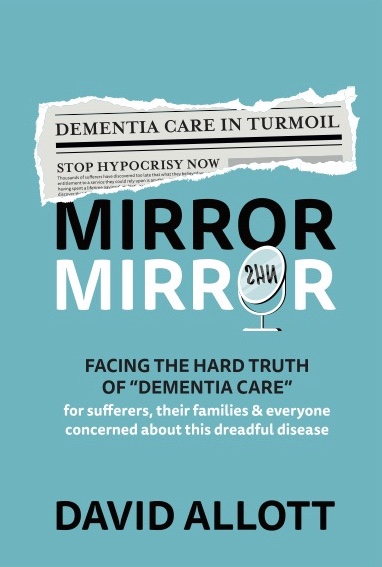
A bit of a different book review from me today with a non-fiction book. This one looking at experiences of “Dementia Care”.
About the Book
The true cost of anything is the price we pay for the alternative.
David and Margaret’s story is, sadly, not unique. Margaret was diagnosed with Alzheimer’s in early 2018. This is the real-life story of the husband and wife’s journey to seek support and care over the past few years. David shares their experience of dementia “care” so that anyone caring for – or living with – dementia can learn from what happened to them, and hopefully avoid the many obstacles, challenges and pitfalls that they had to overcome. One in every 14 people aged 65+ have dementia, that’s around 900,000 people, and the numbers are increasing rapidly every year. This book is an invaluable resource for anyone embarking on the journey to seek care and support for their loved one once symptoms of dementia set in. From getting a diagnosis to getting the right kind of support for them – and you – written with raw passion and from the heart, Mirror, Mirror is dedicated to the memory of Margaret. And to help every other person feeling lost right now.
An important read released around the time of World Alzheimer’s Month in September, and World Alzheimer’s Day on 23rd September.
An essential book for readers of Gail Sheey, Steph Booth and Marie Williams.
About the Author
David Allott learned his trade in Hotel and Catering Management at Blackpool Catering College. It was a short time after this, whilst working as a Senior Assistant Manager in a newly opened large restaurant in Levenshume
that he met Margaret, who was soon to be, his lifelong and forever loved partner of over 51 years. They were married in December 1971 and embarked on a joint career in Hotel Management. Over the years, David and Margaret lived and worked in all three home nations, as well as spending three years in the USA. David’s book Mirror Mirror is not only a record of this final chapter in Margaret’s life, but is written in honour and remembrance of her, and in the hope that it will be of help to others who also must travel this long and lonely road, whilst at the same time throwing a spotlight of the disgraceful conduct of all those involved in trying to deprive the most needy people in society of their legal rights.
Twitter/X – @inkpublishingservices
Instagram – @inkpublishingservices
What I Thought
As an Occupational Therapist who has worked in the NHS, as well as someone with chronic illnesses that means I am a user of NHS services, like many in this country, I am a full supporter of this National Institution and its founding principle to be free at the point of delivery. There can however, be no doubt that over the 13 years the Conservative government have now ruled, alongside the additional disasters of Brexit and the COVID-19 Pandemic, that our NHS has taken a battering. David talks also about the impact of successive Governments’ failure to protect this vital service. Care offered sadly often seems to not be what we expect, nor as staff members, what we want to give. The NHS has always been stronger at urgent care and dealing with non chronic conditions. Anyone who cannot be ‘cured’ by traditional ‘medical’ means or that have complex and multifactorial needs often slip through the gaps and David tells his and Margaret’s story here.
David does acknowledge the individual staff who have supported them and this is a critique of services and not individuals, although as individuals we all certainly play our part – whether in a positive or negative way is up to all of us to determine. David suggests wearing the NHS logo upside down so it reads SHN – its corresponding catchphrase then becomes ‘Stop Hypocrisy Now’. Be warned that this is a political book because healthcare is a human right and as such it is political. If you are not ready to engage at this level I would love to challenge you to do it anyway but this isn’t simply a personal story of struggle but a rallying call. You may not agree with everything David says – but you cannot deny his passion.
At the heart of this book though is a love story between husband and wife, and David’s righteous anger about how Margaret was treated (or not) is palpable. He shares details of the early indications of the disease taking hold through to letters between him and the healthcare team and assessments of her function at different stages of the disease.
In the book at large though is a discussion of societal ableism and the seeming determination that disabled lives simply mean less. My colleges and I at AbleOTUK often hear stories of disabled colleagues being treated inequitably and of course if this happens to our own, how do these attitudes filter out to those for whom we care? David talks about the false dichotomy between medical and social needs – a dichotomy often reinforced because social care is means tested and healthcare is not! (Currently I would say this is somewhat debatable).
David underpins what he is saying with a discussion of concepts such as justice and injustice and looks at the legal protections that people can try to enact and at the concept of NHS Continuing Healthcare (something I only actually got involved in a couple of times in my career and honestly didn’t know too much about before then). This book provides a comprehensive overview where David has used his personal insights, his and Margaret’s experience and learning and works this into practical tips on how to work within a broken system, in the hopes that others supporting loved ones with Dementia don’t face the same battle.
In my personal experience with Long Covid, even as someone with a healthcare background I have found it challenging to access the right care. In my work in Long Covid Advocacy I am collaborating with others to make good healthcare something that isn’t reliant on postcode or the Individual practitioner you get. David says in Chapter 2 – “If you can’t ask the right question, you will find it extremely difficult to get the right knowledge. You are then reliant on gaining knowledge purely by chance.”
The level of detail on the specific policies does mean that the reader in years to come will have to review the current framework as these things often change (and that change at a policy level takes ….a while…. to filter out into general practice. But this provides an excellent framework for using knowledge as power and will remain a good starting point for families facing these issues.
In this book David focuses on Dementia, a truly challenging disease that sadly can take a person away from their loved ones years before their life has ended. But there are supports that can be put in place to improve the quality of life for the individual and their loved ones. This relies on early detection, continual monitoring, truly listening to and understanding needs and this takes time which clinicians are not often allowed. I still professionally believe that it is better to give someone one or two hour-long appointments on diagnosis with a new condition and find about them, their life, their wants and work collaboratively on a plan and over a 10 minute consultation and a lifetime of trying to chase for answers. David does share Margaret’s story and like any others could find the content triggering where it reflects their own experience or where it appears to lay out a challenging experience to come. But for more it will echo their lives back to them and make them feel not as alone.
This book to me demonstrates the immense power of lived experience to shape and inform quality healthcare. As healthcare professionals we can work generally seeing people with a wide variety of conditions or we can specialise, but honestly without that personal insight of living something day in and out our education is not complete. Sure someone facing a new diagnosis may need more guidance and support but give those families 3 months, 6 month, a year, 5 years etc. and they become the expert. Where people have the skills they read up and learn everything they can, to give them and their loved ones the best chances at living a quality life. But again the NHS does need to be able to offer this level of insight to families who can’t – for whatever reason – get an honorary degree in Dementia.
Using peer support and peer groups can seemingly be frowned upon by some healthcare practitioners but it is key for many in accessing the knowledge and rallying troops to face the many battles people have to face – let’s not get into the discussion of benefits here or I might not shut up. David shares some key charities and organisations that may be able to support individuals.
David also makes the excellent point about having discussions of what you might do in these sorts of situations early including topics such as Power of Attorney but in the U.K. in particular we are particularly avoidant of talking about disease and death and then those conversations are left to when emotions are running high or sadly to times when individuals no longer have the capacity to make decisions.
There is a lot of information in this book which could be quite overwhelming. But it doesn’t have to all be read at once and can certainly be referred back to. But who is the book for?
Just people who have familial experience of Dementia.
I say No.
Anyone who has the potential to influence the lives of someone with Dementia?
Yes.
For Politicians and Senior Health and Social Care Managers definitely.
For Individual Health and Social Care Practitioners whether they work in Dementia services or not – Yes.
I would certainly recommend to fellow OTs who want to become more aware about the impacts of the day to day decisions we make for individuals and wider society at large. Sadly these troubles are replicated with other conditions and we can learn much from David and Margaret’s story.
Apologies that this has become more of a reflection that a pure review of the book but in itself I believe that demonstrates the power narratives like this can bring. Publishers take note. Stories can change the world but we need a critical mass of them so they are not able to satisfy our ableist view of these as ‘inspiration porn’ about the brave families doing battle with the system but they are used as manuals to break down and build up systems that truly work for all.
Huge thanks to Literally PR for the gifted copy for the purposes of an honest review and to David for sharing his and Margaret’s Story. Do check out reviews from others on the tour to see how they responded too.
Share this on Facebook, Twitter and Google+


Starter Villain by John Scalzi – Blog Tour Book Review
About the Book
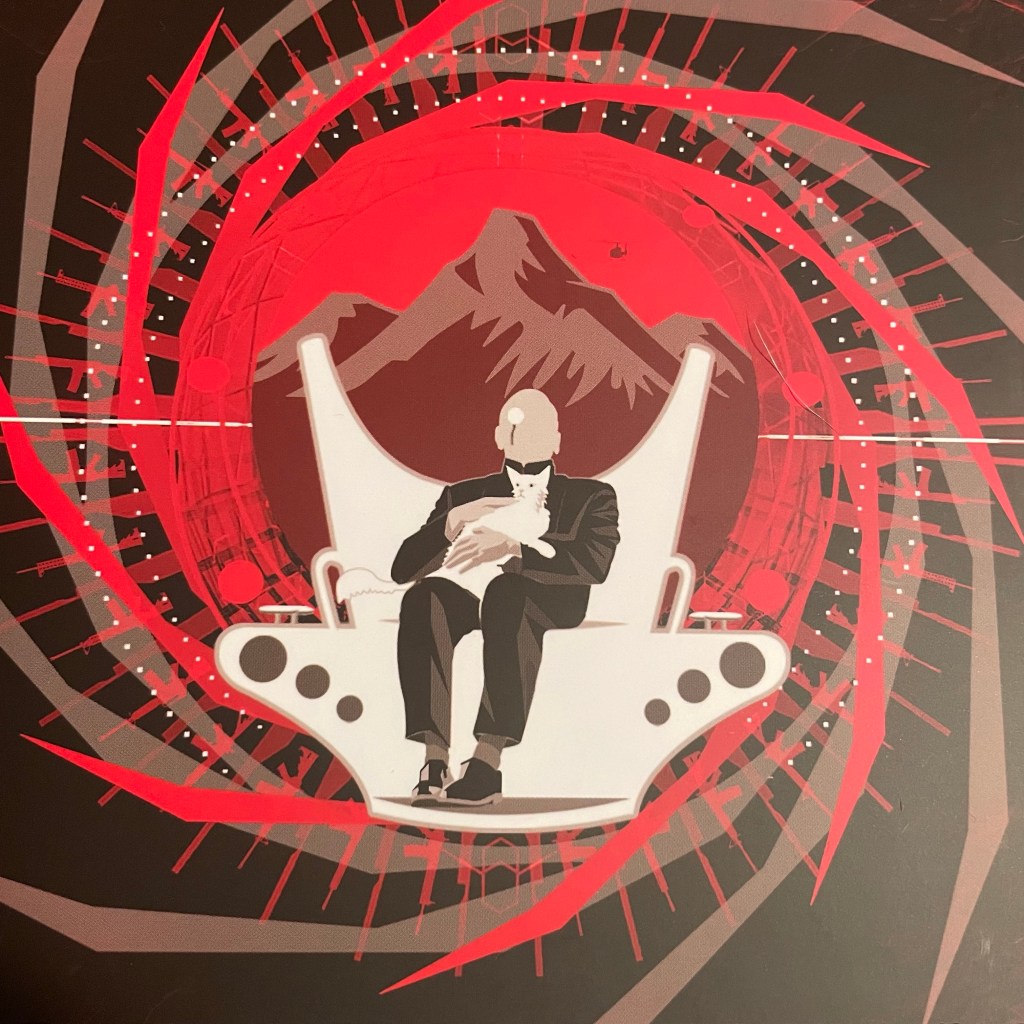
Inheriting your mysterious uncle’s supervillain business is more complicated than you might imagine.
Sure, there are things you’d expect. The undersea volcano lairs. The minions. The plots to take over the world. The international networks of rivals who want you dead.
Much harder to get used to… are the sentient, language-using, computer savvy cats. And the fact that in the overall organization, they’re management.
About the Author
John Scalzi is one of the most popular and acclaimed SF authors. His debut, Old Man’s War, won him science fiction’s John W. Campbell Award for Best New Writer. His New York Times bestsellers include The Last Colony, Fuzzy Nation, The End of All Things and Redshirts, which won 2013’s Hugo Award for Best Novel. Material from his widely read blog Whatever has also earned him two other Hugo Awards. He lives in Ohio with his wife and daughter, and many cats. @scalzi
What I Thought
I have read and really enjoyed a couple of John Scalzi’s books before. Redshirts and The Kaiju Preservation Society. Starter Villain falls into the same category of creating a loving pastiche of the relevant genre, with a richly imagined world and entertaining plot to hang the humour on.
In Starter Villain we follow Charlie, a divorced substitute teacher who finds out about the demise of his estranged uncle, and along with his cat Hera gets thrown into a villainous world of volcanic lairs, assassination attempts and more. But it’s okay because Hera knows all about it and can …talk!
Dr Evil, Goldfinger and Thanos all get a nod but I got Gru from Despicable Me vibes too. Can mild mannered Charlie draw on his villainous side and keep his uncle’s businesses afloat when really all he wanted to do was run a pub?
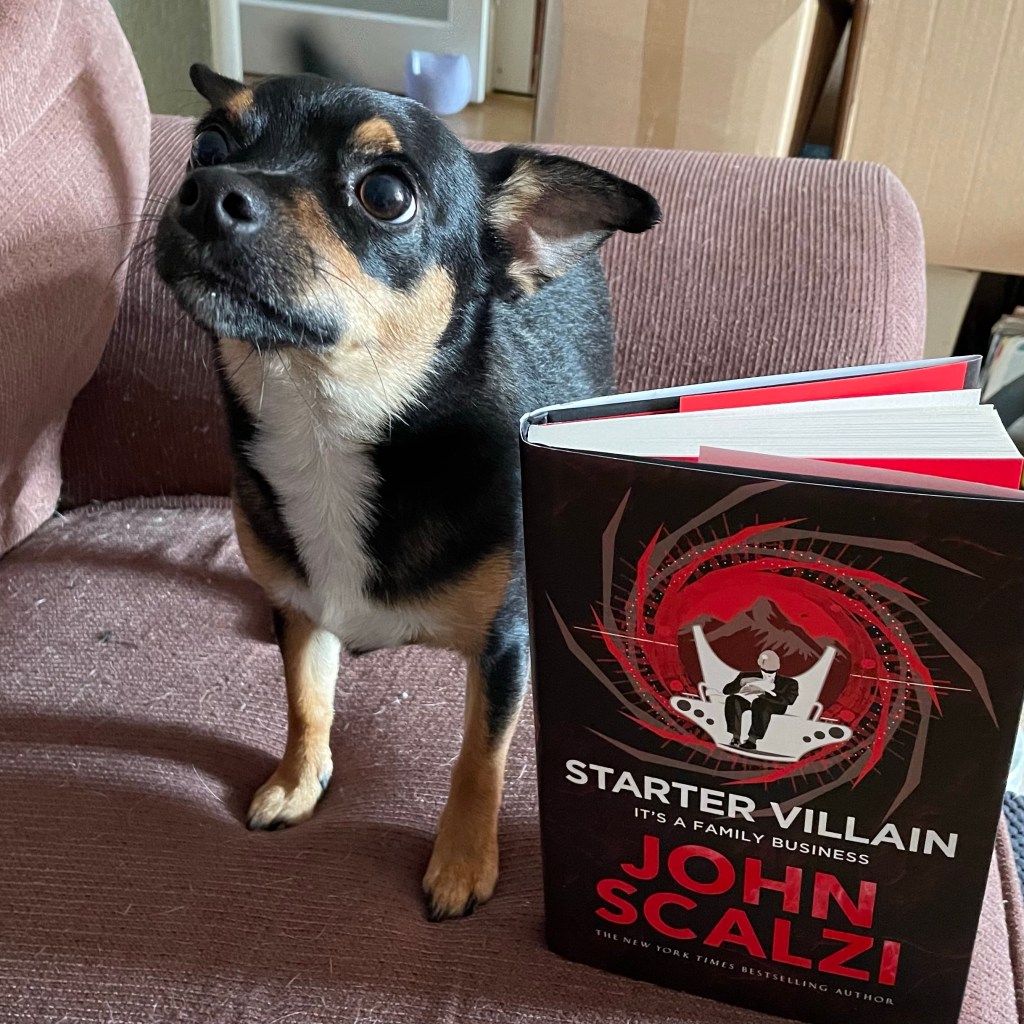
Not only do we get sentient cats but we get unionised dolphins too. And supposedly dogs make the worst villains because they will betray you for a head rub and a treat. Not sure Daire is expressing Villain in the picture above tbh!
Although I was gifted a copy, in the end I did end up downloading the audiobook too because it is narrated by Wil Wheaton who does a great job at capturing Charlie’s incredulousness at what is happening to him.
There is a lot of action, explosions and peril. There’s even a villainous conference alongside an entrepreneurial one. Is there overlap between members?
Charlie faces off against henchmen, CIA agents and whales and at the end does he decide to stay and take over the family business? Does he even survive? There’s no saving of cats in this rather the cats do the saving.
In the afterword, John Scalzi mentions his experience of cognitive challenges post Covid and how he found writing this book took more effort than previous books would have taken. As someone living with Long Covid myself it is so important for people to be aware of some of the challenges that can face people who don’t bounce back from COVID-19 infection and I thank John for speaking out and hope he is feeling much better now. As ever he’s written a brilliant book and if you are a fan of Bond Villains or Austin Powers do be sure to pick this up.
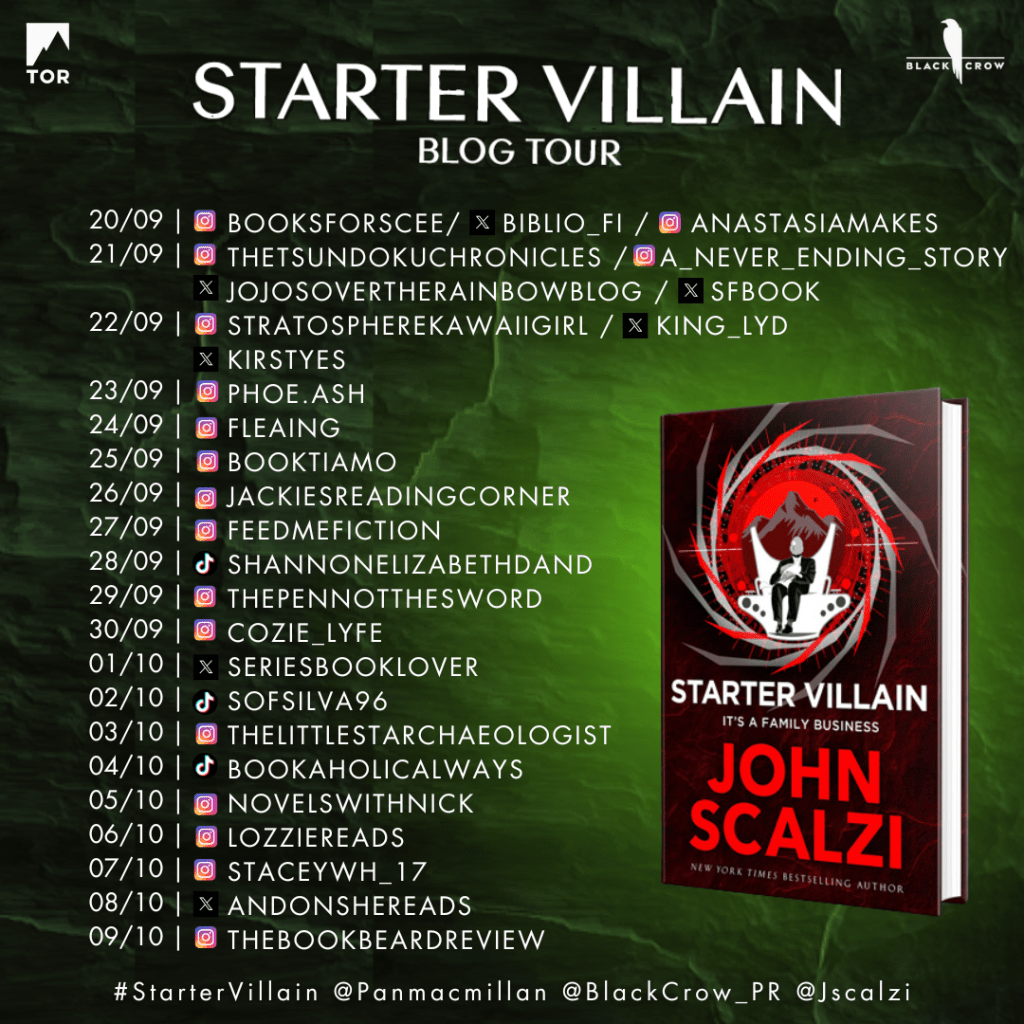
Thanks to Black Crow PR and U.K. Tor for the gifted copy for the purposes of an honest review. Check out the rest of the tour using #StarterVillain
To everyone who could make someone else’s day worse, but tries to make it better instead.
John Scalzi – dedication of Starter Villain
Share this on Facebook, Twitter and Google+


Channel Fear by Lisa Richardson – Book Review
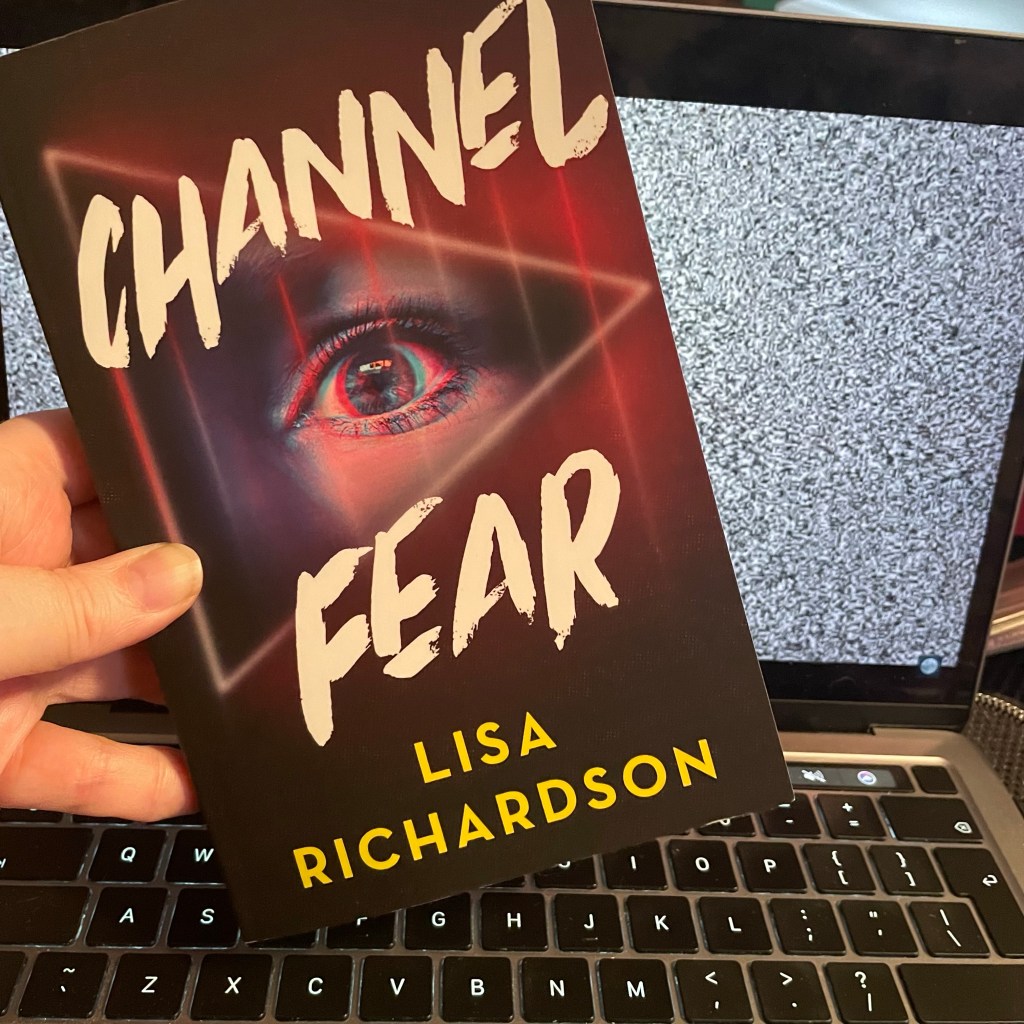
About the Book
A Heart-in-mouth YA Horror-Thriller, perfect for teen fans of The Haunting of Hill House.
Iris is obsessed with star YouTube ghost hunting duo, Zach and Lucas, who disappeared at an undisclosed location several months ago. Iris- who heads up her own unsuccessful channel with co-hosts Byron and his girlfriend Molly – has been searching for the location ever since.
When they stumble across Long-abandoned Thornhanger House, the trio set aside their toxic love triangle to explore, and find Zach and Lucas’s abandoned equipment inside… complete with their last day of filming.
As they watch the footage? A horrifying truth emerges: whatever came for Zach and Lucas is coming for them too…
Lisa Richardson bursts onto the YA scene with a spine-chilling horror-thriller, bringing a terrifying fresh new angle, haunted with breathtaking twists.
About the Author
Lisa Richardson has a first-class honours degree in Creative and Professional Writing and works as a production editor. When not writing, Lisa can be found reading, binge-watching Netflix with her sons, or running and taking photographs along the Kent coast.
Follow her on Instagram: @lisarichardson_21
What I Thought
This book was a wild and thrilling ride. So much so that I needed a break half way through, even though I desperately wanted to keep reading to find out what happened.
This leans heavily into lots of horror tropes and does it so well. Creepy dolls – check. Rocking chair – check. It’s The Blair Witch Project meets The Ring meets The Haunting of Hill House all wrapped up in one.
As a YA Horror there is nothing too gruesome featured but the suspense barely lets up. My poor racing heart.
We have 3 sets of characters. The original missing ghost hunting duo of Zach and Lucas who we meet through their found footage. Iris, Molly and Byron who we follow on their hunt for the duo, and finally the house, it’s grounds and its inhabitants. It’s up to you to determine whether those inhabitants are former or current!
Despite making some very questionable choices I did like all the characters and didn’t want to see any of them harmed. And as if all the ghost hunting wasn’t angsty enough we also have a love quadrangle but which pairing survives the night? (It’s described as a love triangle in the synopsis but in a haunted house tale who is to say the missing supposed deceased Zach is out of the picture!). Finally whichof our trio lives to reap the fame that having a viral ghost hunting video brings you. And is that worth the horror to get there?
For the reader I say yes it is well worth picking this one up. Not everything is 100% explained at the end but that leads to the unease, a call for a re-read, and maybe even opens up the chance for a sequel?
For the characters – hmmmmmm. I think I’ll leave the seances and EMF machines to them.
I’m off to read a rom com stat.
Mini-Review in page numbers:
Page 339 – Final page. I’d like to say this was when I sighed in relief – but I’d be lying!
Page 219 When our intrepid trio actually decide to leave the house!!!
Page 170 Where I literally noped out of reading because my adrenaline was spiking and it was dark.
Page 57 When any sensible person – who would be willing to visit a haunted building in the first place – would have left.
Page 8 Where I would have noped out of this adventure. That is – I would never have entertained the thought of going.
Thanks to Chicken House who reached out and provided a gifted copy. The level of fear expressed in this review is all mine!


 kirstyes