Monthly Archives: April 2013
F is for… First We Read, Then We Write: Emerson on the Creative Process (Book) #AtoZChallenge
F is for… First We Read, Then We Write: Emerson on the Creative Process (Book)

Picture of my copy from my tumblr
I have read the whole of this book over the last couple of days (it is only short – about 90 pages of writing in total). In terms of Goodreads, I have given it three stars (which according to my sidebar means – Liked it (I enjoyed it enough and may read it again but it didn’t fully grab me)). Now, this probably isn’t really all that far because it is kind of an academic type text so it was always going to be trickier to get a 4 or 5 star rating (though on the other hand there have been some academic texts I have wanted to – or possibly even have – kissed!!). In terms of my PhD – it has a few potentially useful bits in there.
This is a concise book written by Robert D. Richardson which combines an biographical ‘study’ of the writings on writing of the poet and essayist Ralph Waldo Emerson, with some snippets from Emerson’s writings/journals etc. It is split into 12 short sections such as ‘Reading’, ‘Sentences’, ‘Audience’ and ‘Writing’.
I enjoy reading writers writings about writing (!!!) and that is what attracted me to this book. I guess then that I felt that there wasn’t enough of that and too much analysis (see I said I was being unfair). I also didn’t really know anything much about Emerson and didn’t feel I truly got to know him from this book. Funnily enough after struggling with the Dialogism book some of what was said in this book I made links back to that which helped with my comprehension.
That being said I will share with you a few snippets/quotes that I enjoyed and that speak to my experiences.
‘He generally took more books out of the library than he was able to read before they were due back.’ (p.8)
Emerson once noted that Coleridge had identified four classes of readers:
The hourglass – gives back everything it takes in, unchanged
The sponge – gives back everything it takes in, only a little dirtier
The jelly-bag squeezes out the valuable and keeps the worthless
The Golconda runs everything through a sieve, keeping only the nuggets. (p.8)
(Emerson was a Golconda and I’m not sure if I’m a sponge or Golconda – need to find out more about this – if you have any useful links which add anything please share them with me in the comments.)
‘Each of the books I read invades me, displaces me.’ (p.10)
‘He was reluctant to speak of the meaning of a book, and eager to affirm the idea that there would be as many meanings of a book as it had readers.’ (p.13)
‘Reading long at one time anything,…destroys thought as completely… Stop if you find yourself becoming absorbed.’ (p.15)(To Emerson reading was to be useful to his writing – personally I disagree and love nothing more than getting absorbed in a good book which can leave me thinking for ages afterwards if I let it).
‘The way to write is to throw your body at the mark when your arrows are spent.’ (p.24)
It appears he was a ‘pantser’ not a ‘planner’ (one in the quote referring to plan) – ‘The natural one will grow as you work.’ (p.25) (Mind you with poetry isn’t that easier?? I’m a pantser whatever so maybe there are some meticulous poetry planners out there – are you one?)
‘The most interesting writing…is that which does not quite satisfy the reader. Try and leave a little thinking for him…’ (p.36)
Richardson argues that Emerson’s essay ‘The Poet’ suggests that ‘…expression, including self-expression, is a basic human need, and is the fundamental function of literature.’ (p.71) (Interesting concept in terms of my planned research).
‘The real Emerson also knew that it required courage for anyone – but especially for a young person – to stand up and say publicly, “I will be a writer”.’ (p.84)
What Emerson poems do people recommend I read?
Do you relate to any of the quotes above?
(Snuck this post in at about a minute to midnight)

Share this on Facebook, Twitter and Google+

F is for… Firefly #AtoZChallenge
F is for… Firefly
Oh, what a surprise… another Joss Whedon show. Unless I’m mistaken this is the last in this list though – Mr Whedon – do you not like the middle or the end of the alphabet?
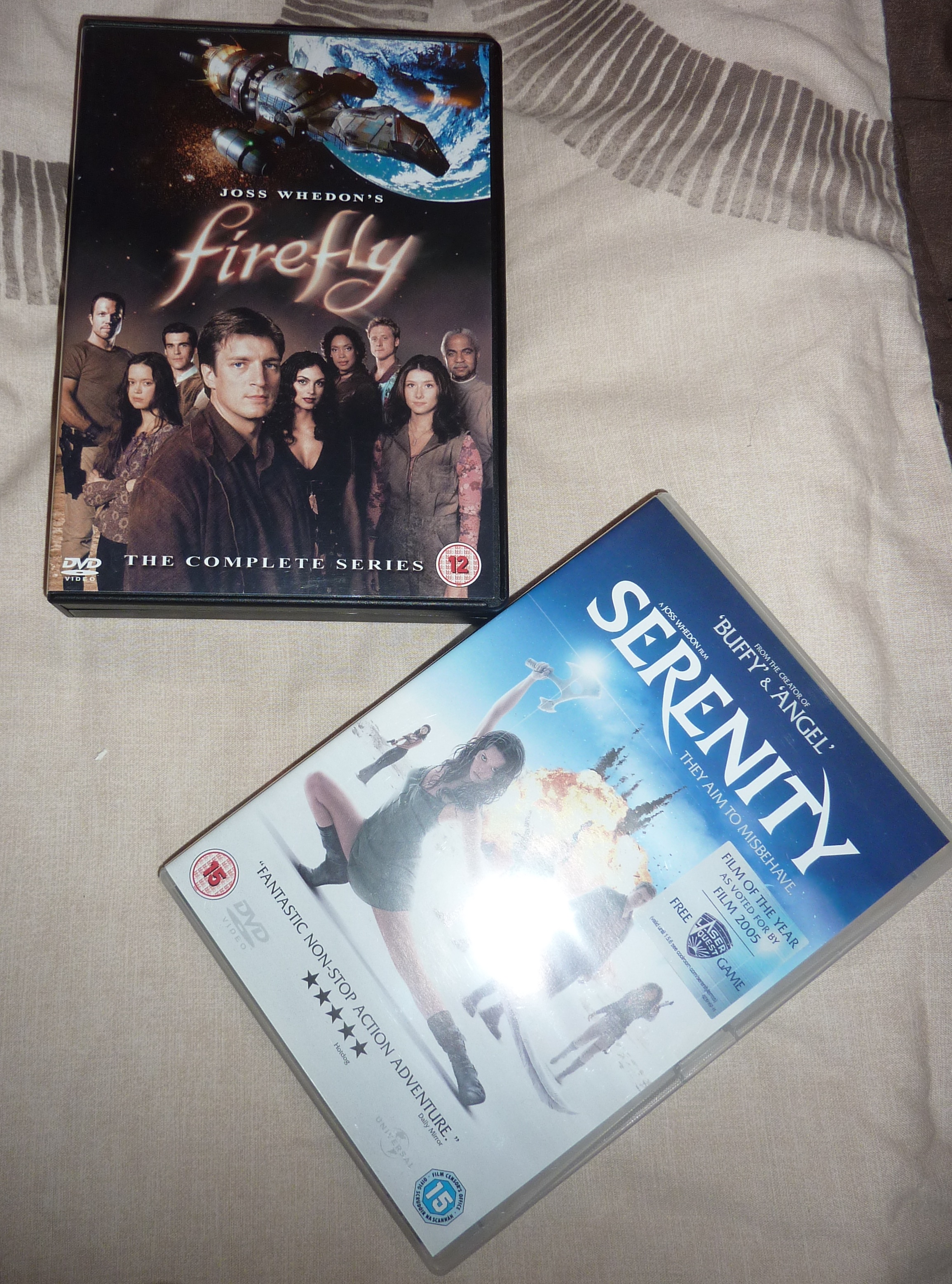
I have to admit to coming to Firefly late in the day – think it might have been less than 3 years ago even though it started in 2002 (actually must have been because I was able to follow some of the actors on Twitter straight after watching and I’ve not been on Twitter more than that amount of time).
That evil priest dude who poked Xander’s eye out in Buffy was suddenly nice!! (And then he turned into Castle and stayed nice – yay).
Nathan Fillion, as evil priest dude is otherwise known plays Mal – the Captain of a Space transport ship Serenity. His crew are Zoe and her husband/pilot Wash – Jayne (not a girl but a gun loving grump) and mechanic Kaylee (a girl). They are joined by ‘on-the-run’ brother and sister, medical officer Simon and River (who is a bit doolally). Also on board are courtesan Inara and preacher Shepherd.
The show had a western feel with train robberies and shindigs.
As this only got one season and a mere 14 episodes (rude – I’ve just read on imdb that Joss had intended it to run for seven seasons!!) (and I need to watch it again because I’ve only seen it once) – I am not going to single out any episodes but instead highlight some standout ‘bits’.
- The bit where Kaylee puts on a dress and gets to be a girl.
- The bit where a song gets sung about Jayne (lyrics in all their glory here)
- The bit where this is said about Jayne’s statue (linked to the song and copied from imdb)
Wash: [about Jayne’s statue] I think they really captured his essence.
Kaylee: He looks angry.
Wash: Yeah, that’s kinda what I mean.
- All the bits with Inara – she is a pretty complex character.
Finally though, someone saw sense and breathed a final hurrah back to the series by making it into a movie (I wish they would do that with every series they cut off mid story). I loved the big budget ‘Serenity’ and we finally get to properly see why River is on the run.
And a quick nod to Falling Skies
I’ve only seen season 1 so far so no season 2 spoilers please. Looks like a season 3 might be forthcoming too. I do like a bit of Noah Wyle.
How are we all doing with this blogging everyday lark?
I was very naughty today and didn’t start writing until 22.17!! Some days I’ve written and scheduled for the next day but have slacked the last few days. Think I’ll have to use my leave next week to make sure some are scheduled in advance because when I go back to work it will be harder.
Are you a Firefly/Serenity fan?
Which series would you like a movie of to wrap things up? Personally very happy that Veronica Mars is happening – not in this genre I know but still a good show cancelled too soon.
Share this on Facebook, Twitter and Google+

E is for…Ethics #AtoZChallenge
E is for… Ethics
Before I can start collecting data for my research I need to submit a research proposal to an ethical review board at my university.
The seven principles of ethical research as outlined by the College of Occupational Therapists (2003) are:
Minimising Potential Harm
Maximising Benefit
Respect/Equality/Partnership
Autonomy
Honesty, Integrity and Openness
Impartiality and Fairness
Confidentiality and Anonymity
So, as you can see, Ethics isn’t just about not hurting people, though of course that is very important. It is also about ensuring quality of work (e.g. that the methodology matches the aim/research question) and reviewing that even at the start of research the researcher has considered methods of disseminating that research (not just abandoning it in the thesis section of their university library).
I’m just going to highlight a couple of ethical challenges my research presents below. There is much more to consider than just these though.
Ethical challenges in Qualitative research
With qualitative research it can be very difficult at the start of the research to say exactly what the methods will look like because qualitative research often tends to be an interactive process which constantly involves depending on responses from participants. I am lucky in the fact that my university is used to dealing with qualitative research and therefore appreciates that the design will be emergent (Bailliard et al 2013). This is not, however, an excuse for me not to think about the detail. Bailliard et al (2013 p 160) suggest using a road map that highlights a general direction and goal but leaves some flexibility in the route. In terms of using a writing analogy I like to think of this as a rough but flexible plot outline.
When exploring people’s lives there is always the potential to bring up issues that they may find emotive or distressing and so it will be relevant to give advice on counselling services, etc. In fact I think it is important as a qualitative researcher to consider the same for yourself.
Ethical challenges in Autoethnography
When writing autoethnography (as I intend to) you will inevitably identify other people in your life in your writing. How to manage this will be something I need to consider (including issues such as asking them for consent). Even if names are changed, because I am naming myself, people who know me may be able to work out who those people are.
Because I am planning to work with others I need to address their anonymity – do they wish to be named and if so are they aware of potential consequences.
One way round some of these issues may be to create storied amalgams but then this may ‘interrupt’ the flow of the stories told by mixing up or leaving out crucial details that may be vital to developing a fuller understanding of issues.
Some General Practical Considerations
If you are asked to participate in research (I have been a few times now) – do check these things.
You should be given what is generally known as a ‘Participant Information Sheet’ which tells you about the research and what you will be expected to do. You should also be given the opportunity to ask any questions you don’t think have been covered.
Types of information that this commonly includes:
where ethical consent to undertake the research was gained,
details about the researcher and their qualifications,
details about the research aim/questions (though in some cases it may be appropriate to not go into too much depth here in case it influences the outcomes of the study),
details about what will happen to the information you share, e.g. how it will be stored, who will see it, how your confidentiality and anonymity will be protected,
the statement that you are free to withdraw from the study at any time without prejudice (this is especially important if you are participating in a clinical study).
Following reading this you should also be asked to sign a consent form.
Here’s a personal example: I participated in an asthma study where I had allergy testing and sat in a cubicle to try and induce my asthma symptoms. During routine medical checks they discovered a heart murmur and gave me relevant advice to get this all checked. They would have to have considered aspects like this when getting the study agreed. My murmur was all benign in case you were wondering.
References
Bailliard, A.L., Aldrich, R.M. and Dickie, V.A. (2013) Ethnography and the Transactional Study of Occupation. In Cutchin, M.P., and Dickie, V.A. (eds) (2013) Transactional Perspectives on Occupation. London: Springer, pp. 157 − 168.
College of Occupational Therapists (2003) Research Ethics Guidelines. London: College of Occupational Therapists.
So there we have it a whistle stop tour of research ethics.
Have you ever participated in research – did you receive a participant information sheet? How did you find participating in the research?
Have you ever gone to an ethical review board to conduct research? Can you share any hints or tips?


 kirstyes